

Fant Wenger’s work sits in a space that feels both timeless and forward-looking, as if it belongs equally to early myth and speculative futures. He does not commit to a single medium or category. Painting, sculpture, and installation blend into works that feel less like fixed objects and more like active zones—places where forces collide, drift, and reorganize. Since 2016, Wenger has been developing an ongoing body of work titled Frequenz, a long-term inquiry into vibration as a shaping force. Rhythm, resonance, structure, and motion are not metaphors in his practice; they are working principles. His art suggests that what we see is only a surface effect of deeper movements taking place beneath matter. Rather than separating the physical from the immaterial, Wenger treats them as collaborators. His work invites viewers to slow down, tune in, and sense the quiet hum that connects bodies, landscapes, and built environments.
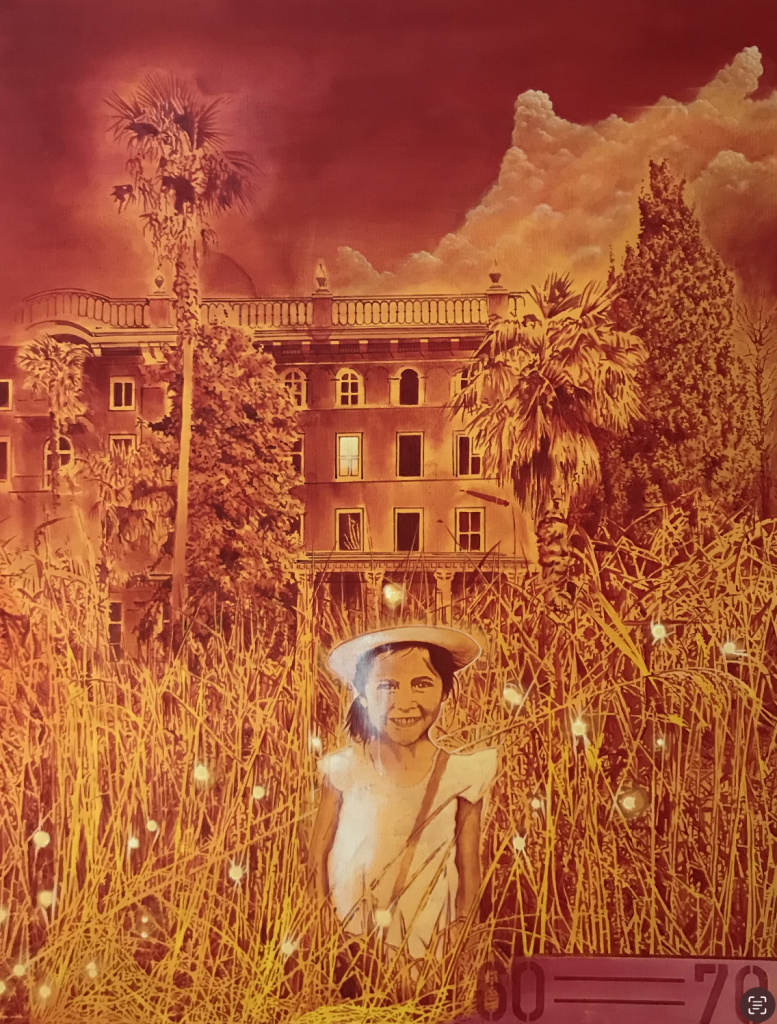
Hotel Paradise (2018)
With Hotel Paradise (2018), Wenger moves away from the overtly electrical tones present in some of his earlier works and steps into a biological register—though the language of signal and transmission never disappears. The image presents a young girl smiling gently amid tall, unkempt grass. Behind her stands the weathered façade of a hotel, its surface washed in an unnatural orange glow. Beneath the image, a small dial marked 60–70 emits a faint light, like a half-forgotten instrument still quietly measuring something long after its original purpose has faded.
At first glance, the scene could be mistaken for a romantic ruin or a wistful memory. But Wenger resists nostalgia. The hotel is not framed as a relic of better times, nor is the child positioned as a symbol of simple innocence. Instead, the work operates through a posthuman lens. The building reads less like architecture and more like infrastructure—comparable to a dormant server that continues to store residual data. It holds traces of warmth, presence, and activity, even as its original function has collapsed.
The glowing dial is key. It suggests calibration, measurement, and range. The numbers 60–70 do not offer a clear explanation, and that ambiguity is deliberate. They imply frequency rather than quantity, hinting at something being tuned rather than counted. The hotel, the grass, the child, and the light are all part of the same system, oscillating within a shared field. In this sense, the landscape becomes an interface rather than a backdrop.
The young girl’s smile is especially unsettling in its calmness. She does not perform emotion for the viewer; she simply exists within the scene, as if she belongs to it as much as the building or the grass. Wenger treats her less as an individual subject and more as a signal—innocence re-broadcast as a frequency that passes through time, memory, and space. She is not looking back at a lost past, nor forward to a defined future. She occupies a present that feels suspended, almost buffered.
Nature plays a crucial role here, but not as a force of renewal or opposition to decay. The tall grass does not reclaim the hotel so much as coexist with it. Biological growth and architectural erosion unfold side by side, without hierarchy. Wenger avoids framing nature as a solution or a corrective. Instead, it becomes another carrier of information, another layer in a complex system where nothing is fully erased.
What makes Hotel Paradise compelling is its refusal to resolve. The warmth of the orange light contrasts with the emptiness of the structure. The child’s smile clashes gently with the building’s abandonment. The dial promises measurement but withholds clarity. These tensions are not problems to be solved; they are conditions to be felt. Wenger allows meaning to flicker rather than settle.
Within the broader Frequenz series, this work marks a shift toward quieter signals. The vibration here is subtle, almost intimate. It asks the viewer to consider how places remember, how environments store emotional residue, and how human presence lingers even after departure. The hotel is not dead. It hums softly, holding onto fragments of life like static caught between stations.
Ultimately, Hotel Paradise is less about loss than about persistence. It suggests that memory does not disappear when structures decay, and that energy continues to circulate long after its original context dissolves. Wenger offers no moral lesson, no warning, and no comfort. Instead, he presents a moment of attunement—an invitation to listen closely to the quiet frequencies that surround us, even in places we think have gone silent.
