
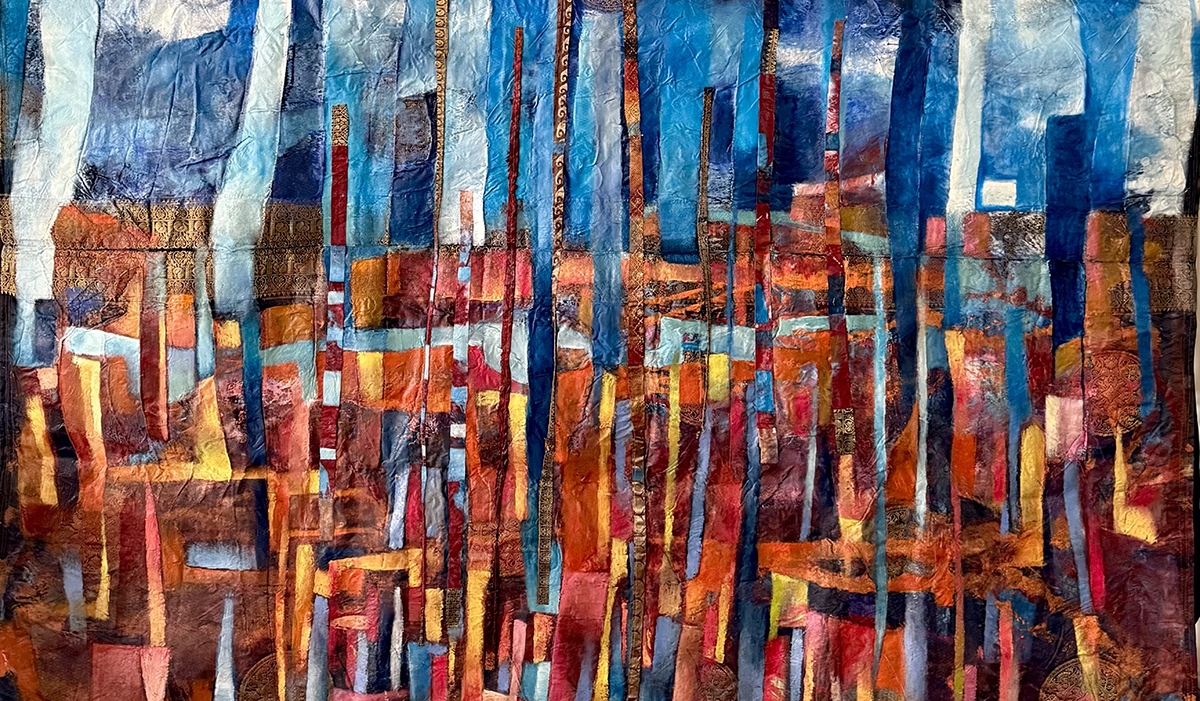
Born in Lisbon in 1962, Miguel Barros has built an artistic life shaped by crossing borders—geographic, emotional, and cultural. His years moving between Portugal, Canada, and Angola gave him a wide lens on place, identity, and the quiet ways people carry memory. Trained in Architecture and Design at IADE Lisbon (1984), Barros brings a designer’s sense of structure into his painting practice: an attention to balance, rhythm, layering, and how a surface can hold both order and surprise. That architectural discipline doesn’t restrict the work; it steadies it, giving his gestures a framework where intuition can move freely. In 2014, he relocated from Angola to Calgary, Alberta, opening a new chapter of exploration while staying anchored to his Lusitanian roots. Across these shifts, his work continues to search for a visual language that can hold multiple worlds at once—like a bridge that allows traditions, textures, and lived experience to meet on the same plane.
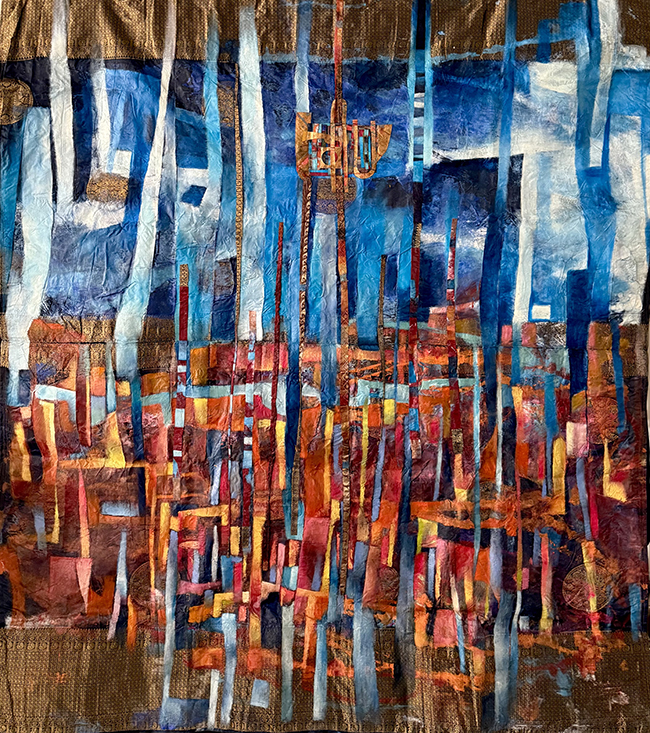
Miguel Barros paints like someone who has learned to live in more than one home at a time. Not simply in the practical sense—living in different countries—but in the deeper way migration reorganizes your inner map. Places begin to overlap. Colors start to carry climate. Materials become souvenirs with weight and meaning. In Barros’ practice, travel is not a theme added afterward; it is the method, the source, and sometimes even the studio itself.
His background in architecture and design is an important key. Architecture teaches you how to think in layers: foundation, structure, skin, light, and the spaces in between. Barros brings that training into painting through composition and construction. Even when the surface appears fluid and atmospheric, it is rarely casual. There is planning in the way forms lock together, in the way tonal fields are arranged, and in the way translucency is used to suggest depth. The paintings feel built as much as painted—assembled through decisions that echo drafting, measurement, and spatial logic.
But what makes the work stand apart is the way Barros merges that structure with lived experience across cultures. Portugal is not presented as a postcard or a fixed identity; it is a pulse that returns through gesture, through warmth, through memory. Africa, India, and Canada enter the work not as “influences” in a generic sense, but as presences carried into the studio through the very substances he paints on. This choice matters. It shifts the work from representation to embodiment. A textile is not an image of a place; it is a place, physically, because it has been worn, used, touched, folded, traded, gifted, and kept.
One of the most compelling aspects of Barros’ recent paintings is his use of everyday fabrics—sarees, capulanas, and Portuguese textiles such as Chita bedspreads from Alcobaça—alongside paper and cotton. These are not neutral supports. Each fabric brings its own history, fiber, pattern logic, and cultural associations. A sari carries the memory of silk, dye, tradition, ceremony, and domestic life. Capulanas suggest rhythm, community, and the visual language of daily living in many African contexts. Portuguese Chita textiles evoke a specific lineage of pattern, craft, and household memory. Barros treats these materials as both physical surfaces and symbolic anchors, turning them into a kind of cartography.
What’s striking is that the materials are not only “sourced” from travel—they traveled with him, packed in luggage, accompanying his movement. That detail transforms the works into records of a journey in the most literal way. The paintings become accumulations of time: folded fabric opened out, carried across airports and roads, then made into a site of labor. In that sense, each piece is an object of passage. It contains the friction of transit and the intimacy of belonging.
Technically, Barros pushes these supports to reveal their character. Fabric behaves differently from canvas; it absorbs, resists, buckles, and stains in unpredictable ways. He leans into that. Layers of oil accumulate through careful building, allowing transparency and translucency to act almost like architecture—thin veils acting as walls of light. As layers gather, a subtle three-dimensional effect begins to occur, not through heavy impasto, but through optical depth. The work feels like you could step into it, as if space is forming behind the surface.
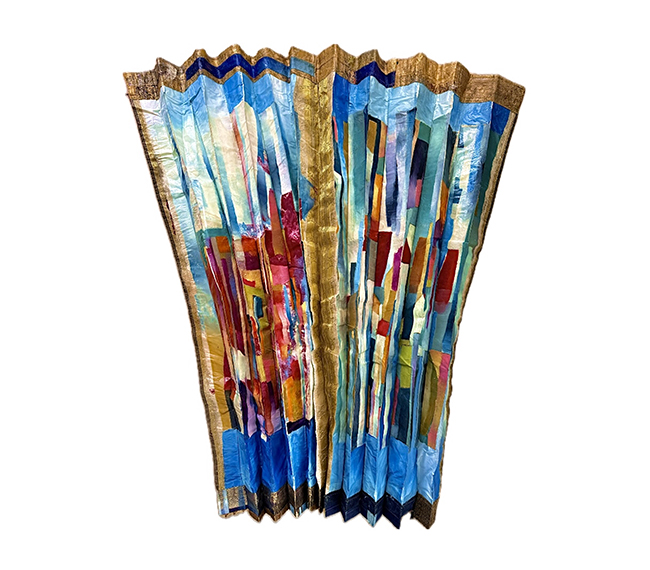
Within this layered construction, figures begin to appear—not as straightforward portraits, but as half-seen presences. Shadows, outlines, and hidden faces drift in and out of view. They read like memories that won’t fully settle: desires, fears, uncertainties, and quiet longings that hover rather than announce themselves. This is where the emotional core of the work lives. Barros isn’t trying to illustrate a narrative; he’s creating conditions where a narrative might surface.
Light plays a central role. Delicate shafts of illumination cut through intricate forms and saturated color, producing a reflective quality—like glimpsing yourself in a mirror that doesn’t give a clean answer back. At times, the paintings suggest urban spaces that feel dreamlike: corridors, facades, intersections, and interiors that appear to be both real and imagined. There’s a magnetism in these environments, a sense that each painting contains a self-contained world with its own gravity.
Yet despite the private nature of memory, Barros is not making work that retreats into isolation. His stated aim is to place people at the center—honoring what is true within each culture and what he has received through generosity in distinct contexts. That ethical position matters. It suggests a refusal to treat culture as decoration. Instead, he approaches difference as something lived and shared: the universal experiences of safety, joy, peace, and the human need for connection. In his hands, art becomes a bridge—not a slogan, but a practice of building proximity between shores.
The viewer’s role is essential. Barros invites us to participate in the meaning of the work by meeting it with our own memory. Because so much is partially concealed, the paintings ask for patience. They reward slow looking. What you see shifts depending on distance, light, and mood. In the space between what is revealed and what remains hidden, the work becomes personal—an intimate exchange between surface and imagination.
In the end, Miguel Barros offers painting as a form of translation: between climates, textiles, histories, and inner states. His works don’t claim a single homeland. They suggest that identity can be layered, carried, unfolded, and rebuilt—again and again—into a language of color, light, and presence.
These two paintings feel inseparable from Miguel Barros’ life path—works formed not only by what he has seen, but by what he has physically carried. They are made with rigor through oil painting on sarees, cotton fabrics, and paper, using materials that traveled in his own luggage. That detail changes how you read the surfaces. The supports are not chosen for convenience; they are companions. They’ve been folded, transported, protected, and then opened again to become sites of focused work. Each painting holds a quiet trace of movement, as if the journey is stitched into the fabric before the first layer of oil is even applied.
The textiles themselves are a meeting point of geographies. Silk sarees from India, cotton capulanas from Africa, and Portuguese fabrics—especially Chita bedspreads from Alcobaça—act as both physical and symbolic evidence of the places that have shaped him. Instead of painting “about” these cultures from a distance, Barros lets their materials enter the work as real presence. Pattern, weave, and color are not background; they are active participants in the composition. A textile carries memory differently than blank canvas. It arrives with its own rhythm, its own design logic, and its own history of touch. That history becomes part of what the paint must negotiate.
In these works, Portugal, Africa, India, and Canada move into dialogue as emotional and aesthetic territories. The paintings do not treat place as a simple theme, but as lived atmosphere. Barros speaks of a Lusitanian essence that surfaces through color and gesture—evoking tradition, memory, and identity—while also opening toward other roots and climates that continue to shape his practice. You can sense this in the way warmth and coolness interact: saturated passages that suggest heat and celebration beside quieter tonal zones that feel more restrained, almost wintered. The paintings hold contrasts without forcing resolution, as if they accept that a life lived across cultures doesn’t blend into one single story—it remains layered.
There is also an ethical center here: Barros’ intention to place people at the heart of the work. He frames cultural encounter through truth and generosity, emphasizing what he has learned across different contexts—sharing, safety, joy, and peace—as a kind of universal human good. That sensibility doesn’t come through as a message pasted onto the surface. It comes through in the way the paintings offer space rather than insist on interpretation. They are not confrontational, but they are not passive either. They feel like invitations into complex worlds where difference is treated as strength, and where art is a bridge capable of bringing distant shores closer.
Technically, the process is intensely layered. Barros explores each material according to its limits—its resistance, absorbency, and expressive potential—building the image through successive veils. Transparency and translucency are central. As layers accumulate, they begin to generate a subtle dimensional effect: depth created not by heavy paint, but by light traveling through thin films. This is where his architectural thinking feels present—painting as construction, image as space.
From this layered method, hidden figures begin to surface. They appear like shadows caught behind glass—memories, desires, fears, uncertainties—quietly inhabiting the pictorial field. They do not arrive fully formed. They emerge gradually, as if the paintings are revealing what has been stored rather than inventing something from scratch. Intricate forms and color fields interlock with delicate shafts of light, producing contrasts and reflections that recall mirrors. At moments, the viewer may feel as if they are wandering through dreamlike urban corridors, where the direction is unclear but the pull is undeniable.
These paintings ultimately depend on the viewer’s gaze to complete them. Meaning is built in the gap between what is shown and what is withheld. Each person brings their own memories to the encounter, and the work makes room for that. The result is an intimate exchange: painting meets imagination, and a private life of travel becomes a shared space of reflection.
