
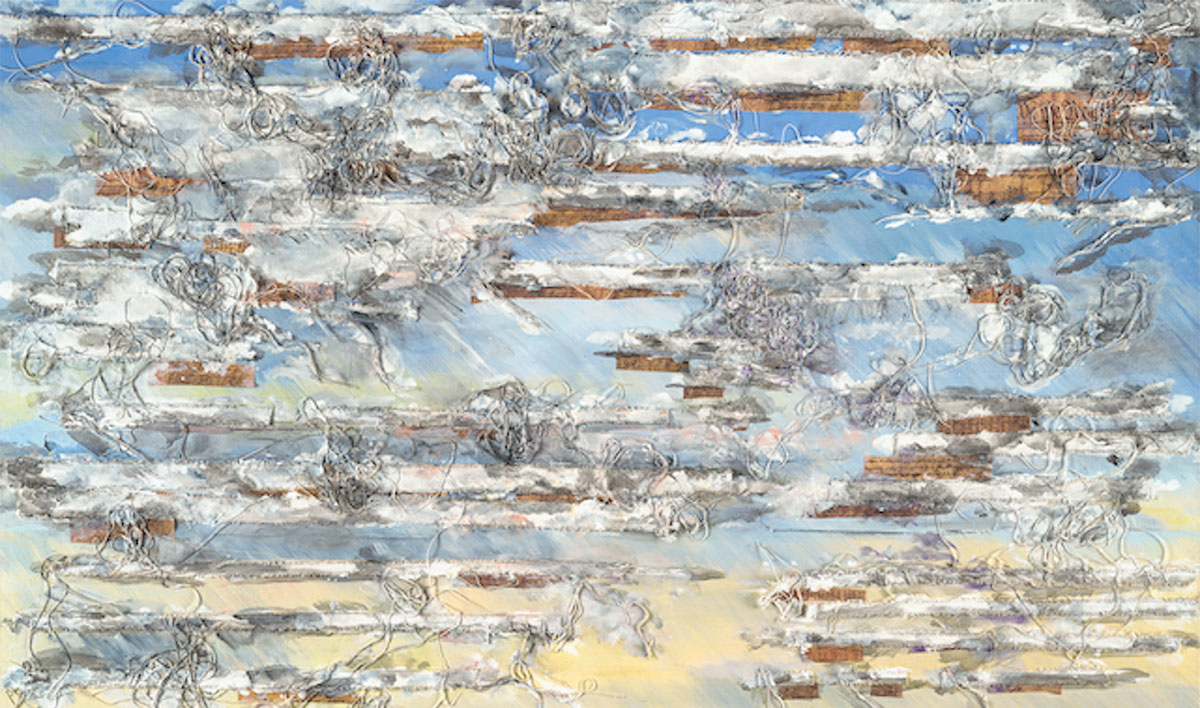
L. Scooter Morris creates artwork that doesn’t simply hang on a wall—it takes up space like a living thing. She describes herself as a sensory illusionist, and you can see why: her pieces operate in that split second between what your eyes report and what your body understands before language catches up. Her “Sculpted Paintings” aren’t content to stay flat. They advance, recede, and shift as you move. Light hits a raised edge and suddenly the whole surface changes. Step closer and you’ll notice the build: acrylic paired with mixed media, thickened areas, ridges, seams, and shadows that feel almost touchable. Step back and the image reorganizes again, like it’s adjusting to your distance. Morris isn’t interested in making something that merely looks nice in a room. She’s after a visceral response—something felt, not just observed.
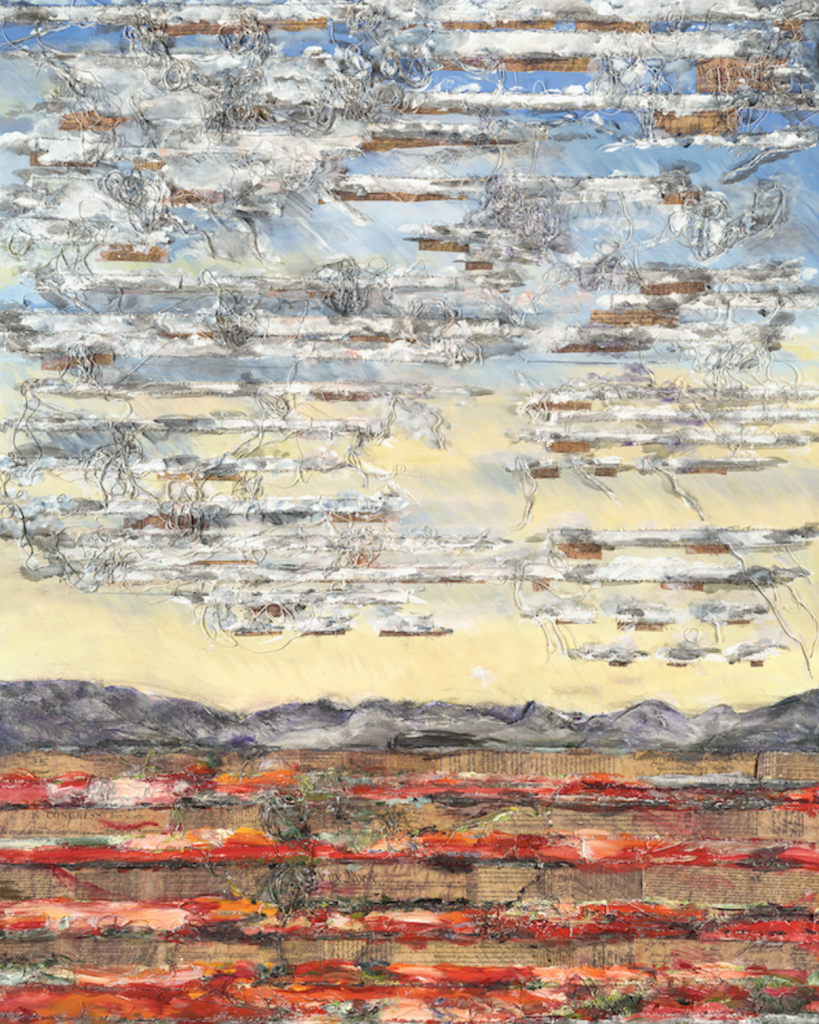
Her work lives between painting and object, where the canvas becomes more like terrain than a picture plane. “Sculpted painting” isn’t a catchy label in her case—it’s how she constructs the work. Sections lift forward while others sink in, breaking the expectation that a painting is one smooth surface. That constant change is intentional. One moment you’re reading color, structure, and overall composition; the next you’re reading the material itself—how a ridge bends the light, how a carved-in channel holds darkness, how a rough patch refuses to dissolve into the background. The piece doesn’t resolve into a single view. It keeps offering new information as you move.
For Morris, texture isn’t a garnish. It’s the main voice. Acrylic gives her immediacy and clarity. Mixed media adds weight, grit, and a sense of consequence. Together they form surfaces that look worked, revised, and insisted upon. You can feel the time inside the process: layering, letting it dry, returning, scraping, building again. That labor matters because it shows up in the final presence of the work. These pieces feel constructed—earned through effort—rather than simply applied.
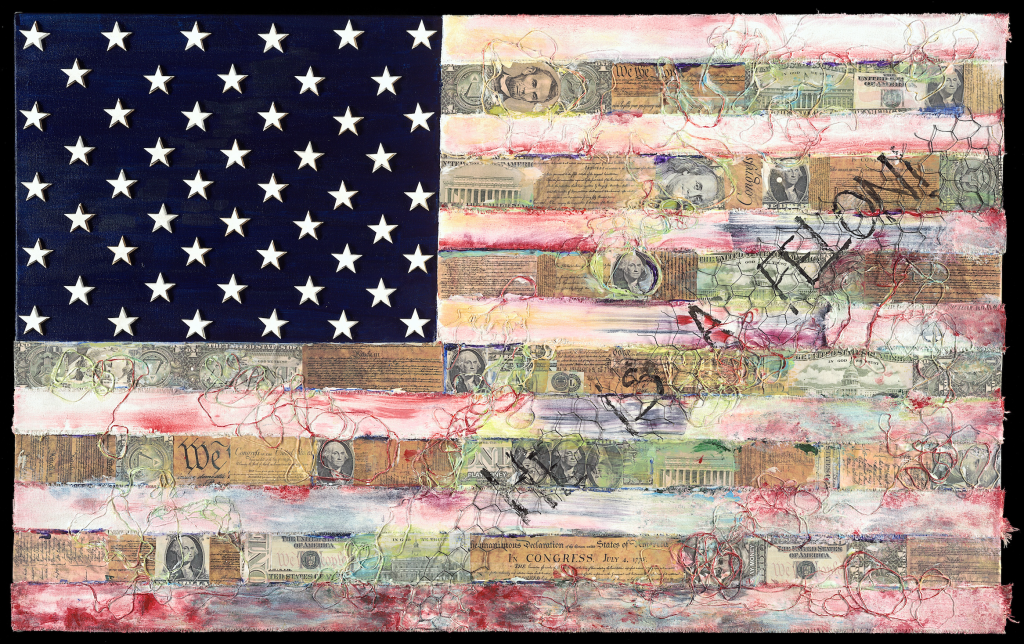
Light, too, isn’t just an effect. It’s a collaborator. Morris’s surfaces don’t passively reflect what’s around them; they respond to it. A raised section can flare brightly, then slide into shadow with the smallest shift in your stance. The drama is subtle but constant. Not theatrical—perceptual. She effectively turns the environment into part of the artwork, because the work only fully activates through changing light and a moving viewer.
Her titles often ground this sensory experience in real-world tension. They steer you toward questions about belonging, power, identity, and the way language can shape a person’s fate. In Morris’s practice, abstraction isn’t a way to dodge meaning—it’s a way to concentrate it. She doesn’t hand the viewer a straightforward message. She compresses big social themes into material and sensation, letting the pressure rise through the surface instead of spelling everything out.
That strategy comes into sharp focus in We Are The People (2025), an acrylic and mixed media work measuring 60” x 48”. The size is important—it meets the viewer at a bodily scale. This isn’t a piece you casually glance at and forget; it holds your attention simply by occupying your field of vision. The phrase “We Are The People” arrives loaded with civic charge, but Morris doesn’t present it as a tidy declaration. She treats it as an uneasy question. Who gets counted in the “we”? Who is excluded? What happens to the idea of “people” when systems divide, sort, and rank?
Visually, the piece reads like a built-up landscape. The surface rises and dips like a terrain of pressure points, as if the painting has its own geology. Light slides across the high areas and disappears into the low ones, echoing the way public life works: some experiences are illuminated while others remain unseen. The layered construction suggests accumulation—history piling onto history, conflict stacking up, ideals pressed against what actually happens. The work carries energy, but it also shows restraint, as if it’s holding itself together while still revealing strain.
If We Are The People carries the hum of collective life, Felon (2025) hits with the blunt force of a label. At 24” x 48”, the format is narrower, upright, and confrontational—like a posted warning or a marker that follows someone around. The title alone reduces a person to a single word, and Morris uses that compression as material logic. She translates the social weight of labeling into a surface that interrupts the eye: stops, breaks, detours. The work suggests restriction and containment without illustrating a literal narrative. And the surface feels permanent in the way labels can feel permanent. It holds marks the way memory holds marks—uneven, layered, not easily erased.
Morris doesn’t preach in either piece. She creates conditions where recognition can happen. You’re asked to move, to look again, to notice how quickly perception shifts—and how quickly judgment can follow. Her art doesn’t demand agreement. It demands attention. It makes you slow down, stay present, and feel your way through complexity rather than rushing to simplify it. That’s the kind of connection she’s aiming for—and why her work stays with you after you’ve stepped away.
