
Paul “Gilby” Gilbertson has spent a lifetime staying close to process—testing materials, watching what they do, and learning how to guide them without forcing them. In the early 1970s, he discovered a watercolor approach that would become closely tied to his work: using salt on wet pigment to create natural, crystalline textures. It wasn’t planned. It happened by chance, the way a lot of good techniques begin. But instead of treating it as a one-time trick, Gilbertson kept working with it, refining when to apply it, how much to use, and how it could support the mood of a painting. Over time, that accidental discovery became a dependable tool in his studio—one that helps him build atmosphere, movement, and depth in a way that still feels true to watercolor’s transparency and unpredictability.
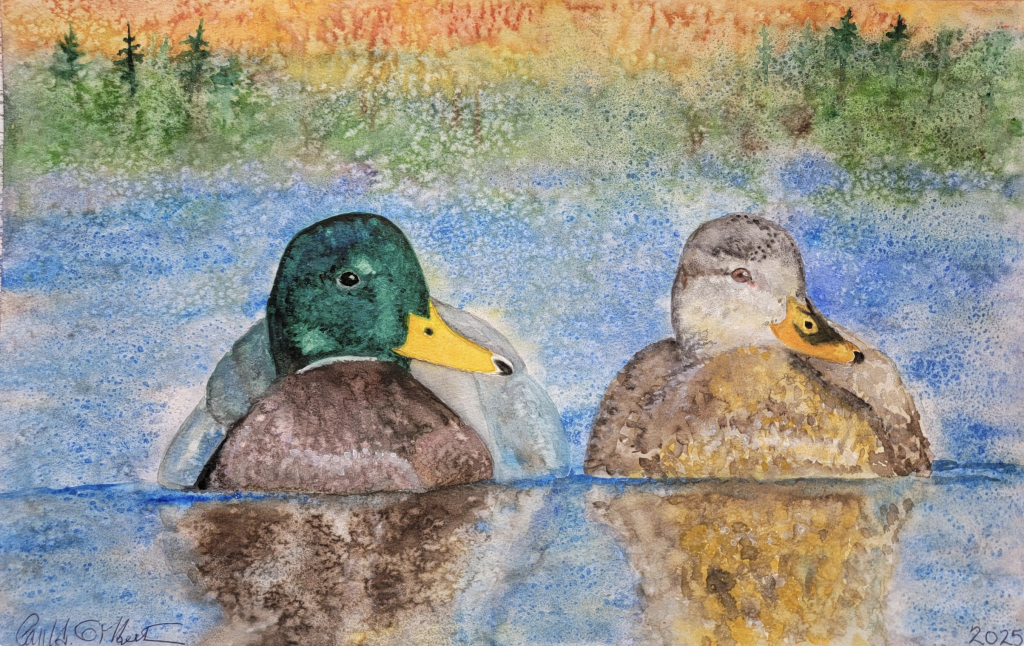
At its core, watercolor is a medium that rewards patience. It asks the artist to make decisions, then accept what water will do once it touches paper. Gilbertson leans into that exchange. His paintings feel guided, not overmanaged. Washes remain open and breathable. Edges soften where they should, then tighten when the subject calls for clarity. And across many passages, you can sense the quiet signature of salt: pigment pulled into tiny blooms and speckled fields that suggest weather, current, mist, or the subtle grit of the natural world.
The salt technique matters because it isn’t decoration—it’s structure. It breaks up large areas so the eye keeps moving. It creates depth without heavy layering. And it mirrors the textures we recognize in nature: the granular look of stone and sand, the haze of water, the shifting patterns of sky. In Gilbertson’s hands, those textures don’t announce themselves as “effect.” They behave like environment. They help the painting feel lived-in.
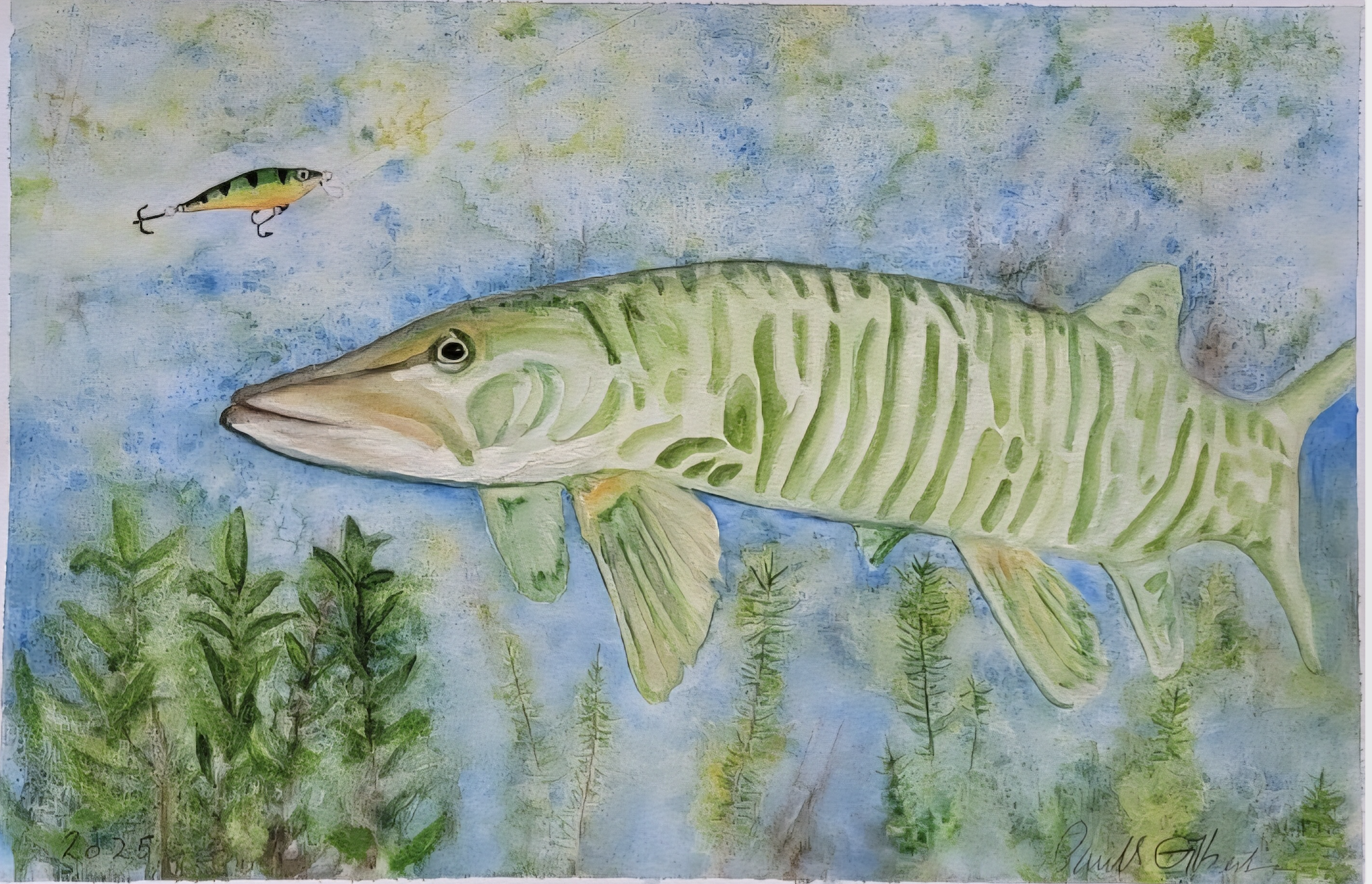
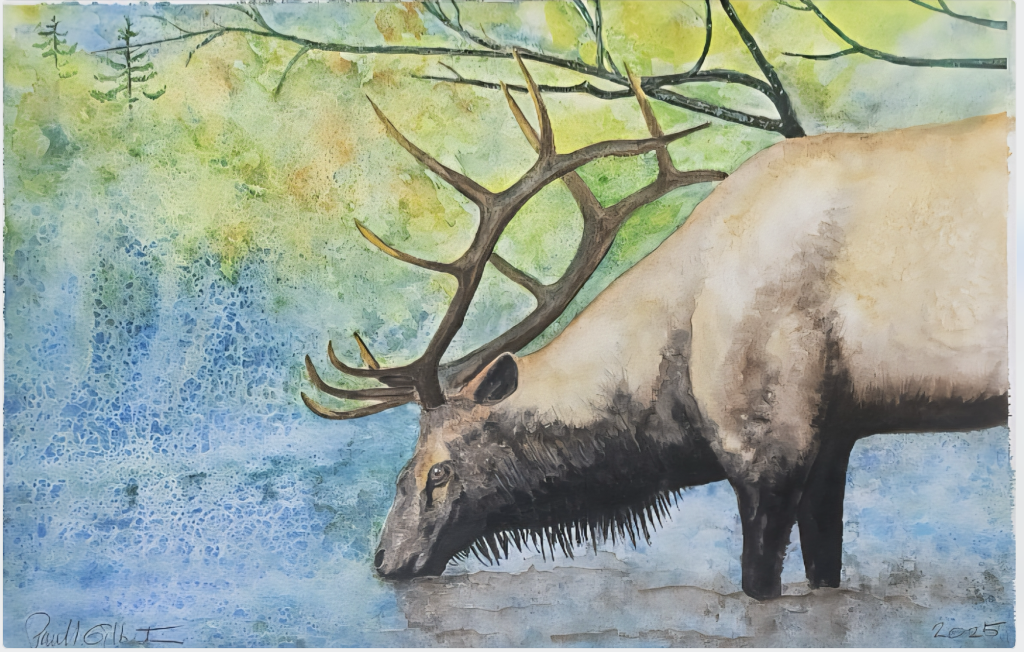
The two 2025 works you shared show how he uses this approach across very different settings. One places us underwater with a large fish gliding through a blue-green field. The other brings us to the edge of a pool, where an elk lowers its head to drink. Seen together, they read as companion pieces—two quiet scenes where stillness holds a kind of tension, and where technique supports mood rather than overpowering it.
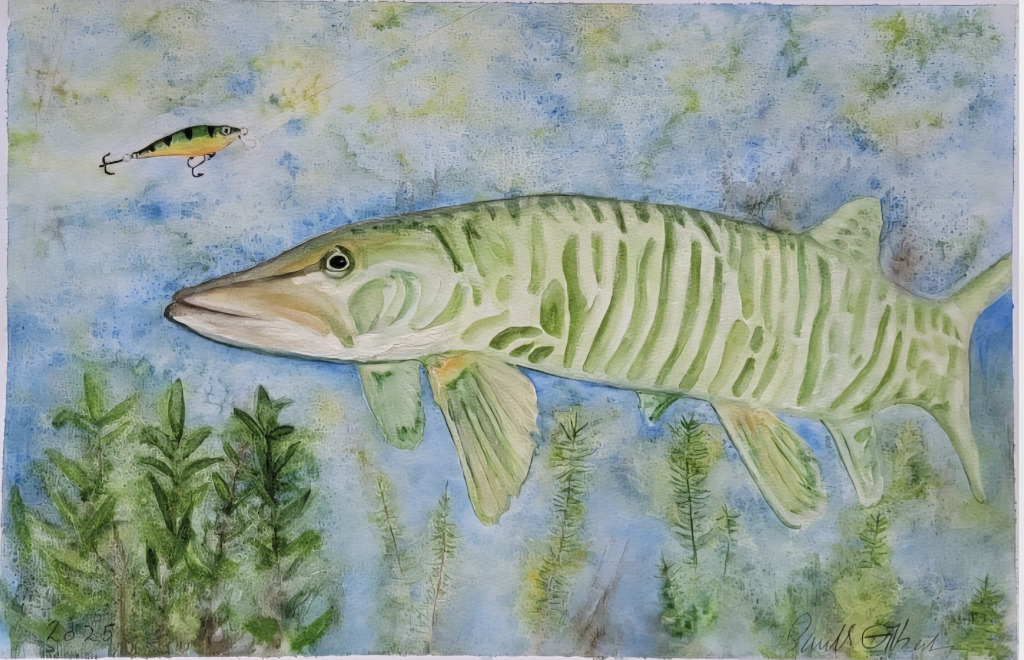
In the Musky painting, the composition is clear and calm. The fish is presented almost like a portrait—large in frame, steady, and fully present. Its pale green body carries rhythmic striping that curves along the form and helps describe volume without needing hard outlines. The eye is rendered with care, giving the subject a watchful intelligence. Nearby, a lure sits in the upper left, small but charged. It introduces a story without spelling it out: attraction, pursuit, and the thin line between beauty and danger. Below, aquatic plants rise like a soft curtain, grounding the scene and giving it depth. The background wash—layered blues and greens broken by mottled texture—reads as water immediately. It’s the kind of space watercolor can describe better than any other medium: not a literal map of what water looks like, but the feeling of being surrounded by it.
The elk painting shifts the mood from floating to weighted. The animal’s body fills the right side of the paper, and the head is lowered in a private moment. The antlers spread upward and outward, echoing the branching lines of the trees behind. This creates a visual rhyme—nature repeating itself in different forms. The background is luminous: greens and yellows suggest filtered light and foliage, while the left side is a lively field of blue texture that feels like water and air at once. The elk’s darker neck fringe and legs add gravity and contrast. There’s a balance here between detail and suggestion: the elk is specific enough to feel real, while the environment stays painterly, atmospheric, and open.
What’s especially strong about both works is Gilbertson’s control of restraint. He doesn’t crowd the paper. He allows space. He lets the medium speak. The result is a kind of confidence that comes from experience: knowing when to stop, when to leave a wash alone, and when to use texture to create complexity without clutter.
These two 2025 paintings are part of a continuing body of work—pieces that reflect Gilbertson’s long relationship with watercolor and his ongoing interest in nature as subject and setting. They also connect to something larger than the studio. Gilbertson has created Gilby’s Foundation for the Arts, an effort centered on donating artwork to help fund nonprofit organizations and charities throughout America. It’s a practical extension of the values that show up in the paintings themselves: attention, care, and a respect for what sustains life.
In a time when art is often discussed only in terms of visibility and branding, it’s refreshing to see an artist build an additional purpose around the work—one rooted in contribution. The foundation adds another layer to how these paintings can be understood. They aren’t only images of wildlife and place. They can also function as support—objects that carry beauty and also help create resources for others.
Ultimately, Paul “Gilby” Gilbertson’s work lands because it feels honest to its medium. Watercolor is difficult to fake. It shows your decisions. It shows your timing. It shows when you’re trying too hard. In these paintings, you see the opposite: a steady hand, a practiced eye, and a willingness to let water do what it does best. The salt textures—born from a chance discovery decades ago—continue to serve the paintings not as a gimmick, but as a natural language. And that language, built through years of exploration, gives his scenes their quiet pull.
For more about the foundation, you can visit: www.GilbysFoundationfortheArts.info
