
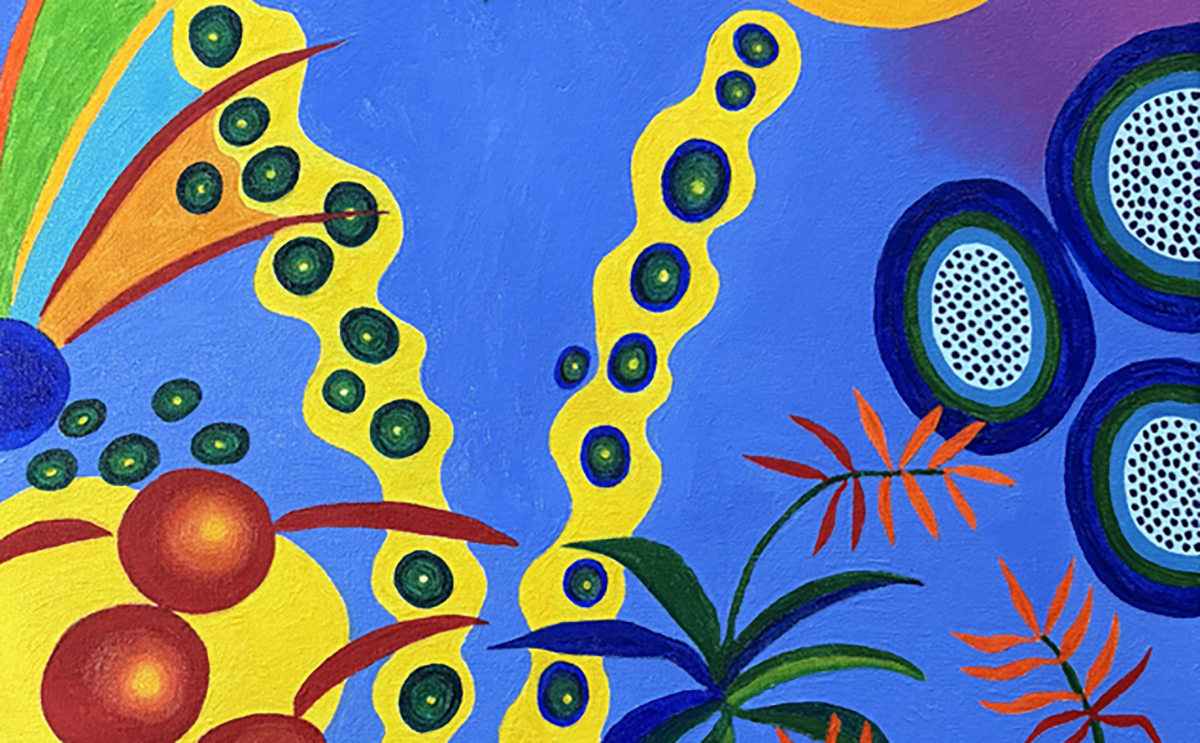
Local artist Oenone Hammersley relocated to Palm Beach Gardens in 2024, bringing with her a visually rich practice shaped by theatre design, travel, and a long-standing commitment to the natural world. Internationally recognized for mixed-media work that leans into bold color, layered texture, and luminous light, Hammersley is especially known for paintings that revolve around water—those shifting surfaces that can read as both invitation and warning. Her works have been shown in Palm Beach, New York, London, Paris, Washington D.C., and Miami, and are held in private and public collections. In Florida, the tropical gardens have become a new spark: dense leaves, repeating patterns, humid air, and quick flashes of brightness.
A practice built from movement, travel, and layered process
Oenone Hammersley’s work has the energy of someone who thinks in scenes. That makes sense: theatre design taught her how to build atmosphere, how to direct attention, and how to make a surface hold drama without becoming chaotic. You feel that background in the way her paintings organize themselves—how bold passages of color act like lighting cues, and how texture behaves like a stagecraft element, not an afterthought.
Her travels through Southeast Asia, India, Africa, and Latin America widened that sense of visual vocabulary. These places didn’t just offer new scenery; they offered new relationships between color, ornament, and environment—where pattern is cultural language, and nature is not decorative, but present, active, and sometimes under pressure. In her studio practice, those influences don’t show up as literal postcards. They appear as rhythm: repeated shapes, layered motifs, and the sense that the painting is carrying more than one climate at once.
Water as beauty and alarm
Hammersley’s vivid depictions of water sit at the center of her larger theme: the planet’s beauty, and the urgency of protecting it. In her hands, water becomes both subject and metaphor. It can read as pure light—rippling, inviting, alive. But it can also suggest fragility: what gets polluted, what disappears, what carries the costs of human convenience. Her artworks raise awareness of deforestation, ocean pollution, and overfishing, and she backs that concern through regular donations to conservation organizations. That pairing matters. The work doesn’t stop at the edge of the canvas; it points outward.
The strength of her approach is that she doesn’t rely on gloom to make the point. Instead, she builds images that are seductive first—color that pulls you in, surfaces that hold you there—then gradually reveals the underlying tension. You may enter through beauty, but you leave with a sharper awareness of what’s at stake.
The tropical garden series: Florida as catalyst
Since moving to Palm Beach Gardens, Hammersley’s recent work has been shaped by Florida’s tropical gardens: lush growth, fast weather, and plant life that feels both abundant and architectural. In this series, her fascination with organic shapes meets geometric patterning, and the result is a kind of visual conversation—wildness meeting structure, nature meeting design.
These oil paintings tend to carry a sense of growth and movement. Leaves fold into one another. Shapes repeat like vines finding a path. Color behaves like a living thing, changing temperature as it moves across the surface. The works invite viewers to stay with the details—because the longer you look, the more the painting seems to “open,” revealing layers of decisions, pours, edges, and buried marks.

In Falling Seeds, Oenone Hammersley draws from botanical forms without turning them into simple illustration. The title suggests beginnings—small origins, quiet potential, the start of growth that can’t be rushed. Visually, the work leans into that idea through playful abstraction: shapes that feel like pods, petals, and drifting fragments, suspended as if caught midair. Rather than describing a single plant, the painting gathers the language of plant life—curves, droplets, clustered marks—and turns it into a field of energy.
Color plays a structural role here. Hammersley’s palette is bold, but not random; it’s balanced with intent, allowing one area to pulse while another calms.

Midnight in the Garden moves into a different emotional register. Where Falling Seeds suggests daylight and outward motion, Midnight in the Garden feels deeper, more inward—like stepping into a dense garden after dark, when color doesn’t disappear so much as transform. The title sets a scene, but Hammersley avoids literal storytelling. Instead, she builds a visual atmosphere: layered shapes that hint at leaves and stems, patterns that suggest hidden structure, and darker tones that give the composition a slow, immersive pull.
The “midnight” quality is not just about darkness—it’s about intensity. Colors appear richer against deeper grounds, and the glossy surface can make highlights feel almost liquid. Hammersley’s balance of organic and geometric elements becomes especially meaningful here. Gardens are wild, but they’re also designed spaces; they carry both freedom and framing. In this work, that duality can feel like a quiet argument: nature is abundant and resilient, yet constantly shaped by human choices.
Both works invite a dialogue between viewer and artwork. Hammersley isn’t trying to deliver a single message in a single glance. The paintings reward slow looking—letting you trace relationships between color and shape, noticing how layers sit under other layers, and sensing how the work shifts between realism and abstraction without needing to choose one. The emotional aim is clear: to build spaces filled with creativity and life, where art becomes a catalyst for inspiration and reflection. And beneath that, a steady reminder: what we’re looking at isn’t just beauty—it’s a living world worth protecting.
You can see her Tropical Garden oil paintings in person at the Palm Beach Modern & Contemporary Art Fair (PB Convention Center), March 19–26, at the Walter Wickiser Gallery Booth.
For more information, visit: www.oenonehammersley.com
