
Kathryn Trotter’s paintings don’t whisper. They arrive with color, texture, and a sense of pleasure in the act of making. At first glance, the work can feel exuberant—animals framed by florals, patterned settings, and paint applied with real physical presence. But the longer you look, the more you notice the structure underneath the brightness. Trotter’s background helps explain why. She began with textiles and fashion design in Texas, training that teaches you to think in layers: pattern over pattern, surface over surface, detail held in balance with the whole. Later, in San Francisco, she explored trompe-l’oeil, an old technique built on illusion and the discipline of making something look convincingly real. Those two foundations—material thinking and perceptual skill—still sit inside her paintings, even when the surface is loose, thick, and lively.
Trotter’s style blends impressionism with heavy impasto. That combination matters. Impressionism gives her permission to let brushwork show and to let light and color do the describing. Impasto gives her a sculptural edge—paint becomes not just a vehicle for an image, but part of the image itself. In person, the surface is a big part of the experience. Raised passages catch the light. Dense strokes create tiny shadows. Smooth areas give the eye a pause before it moves again. The work asks you to step in close, then step back, then come close again, because the painting changes as distance changes.
Animals appear often in her work, and she treats them like sitters in a portrait studio. These are not wildlife scenes in the traditional sense. The goal isn’t to place an animal in a realistic landscape and describe its environment. Instead, Trotter centers the animal’s presence and builds a world around it—flowers like costume, pattern like atmosphere, ornament like storytelling. That approach can feel playful, but it’s also deliberate: it shifts the animal from “subject matter” into “character.” You don’t just register a cheetah or a tiger; you register personality, attitude, and a certain theatrical poise.
Two paintings that show this clearly are “Lilly Ruben” (sold) and “Le Tigre” (available), both oil on canvas and both framed in gold-edged floater frames that reinforce their sense of presentation. Each piece belongs to a visual language where decoration isn’t an afterthought—it’s part of how meaning is built.

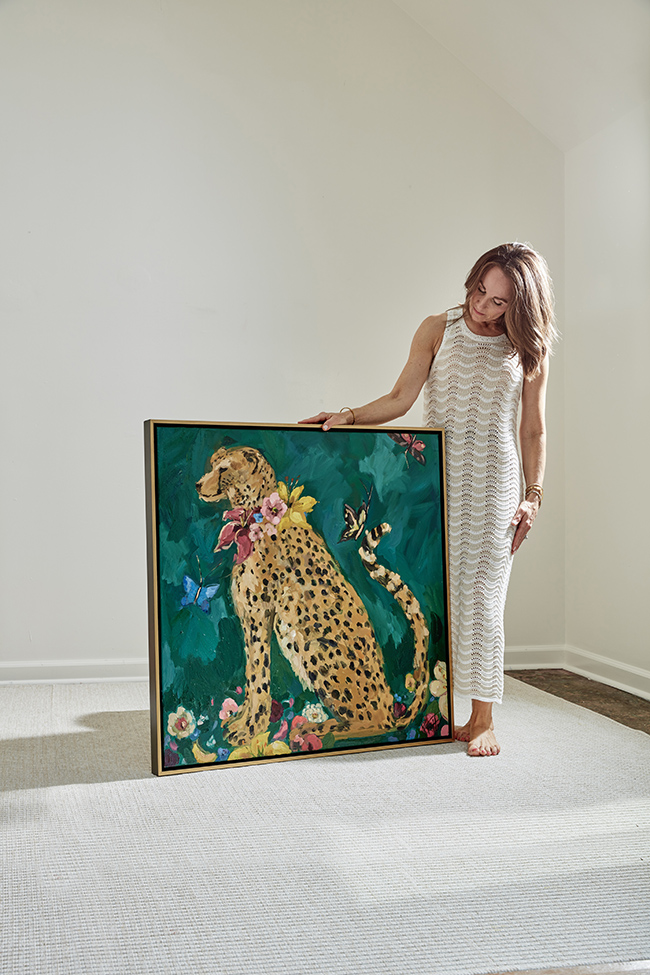
“Lilly Ruben” is a 36×36” cheetah portrait described as bold and colorful, with the animal adorned in a dramatic collar of flowers. The square format suits the directness of a portrait: it keeps the composition focused and frontal. The floral collar does several things at once. It frames the face the way a ruff frames a historical sitter, giving the cheetah a kind of ceremonial presence. It also lets Trotter push her strengths—color relationships, rhythmic shapes, and thick paint that can make petals feel almost built rather than merely painted. The contrast between the cheetah’s sleek identity and the lush mass of flowers creates a satisfying tension: speed meets abundance, precision meets flourish. This isn’t an animal shown at a distance. It’s a personality brought close.
The gold-edged floater frame adds another layer. It doesn’t try to disappear. It heightens the sense that you’re looking at a portrait meant to be displayed with pride, like a statement piece in a room. “Lilly Ruben” was sold through Design Supply Shop in Birmingham, Alabama, a setting that often values art not just as image but as an anchor for a space. There’s also a personal, documentary note attached to the painting’s story: a photo of the artist with “Lilly Ruben” credited to Patrick McGough in Birmingham, AL. That detail matters because it places the work in a lived moment—an artwork moving through people and place, not just an image floating online.

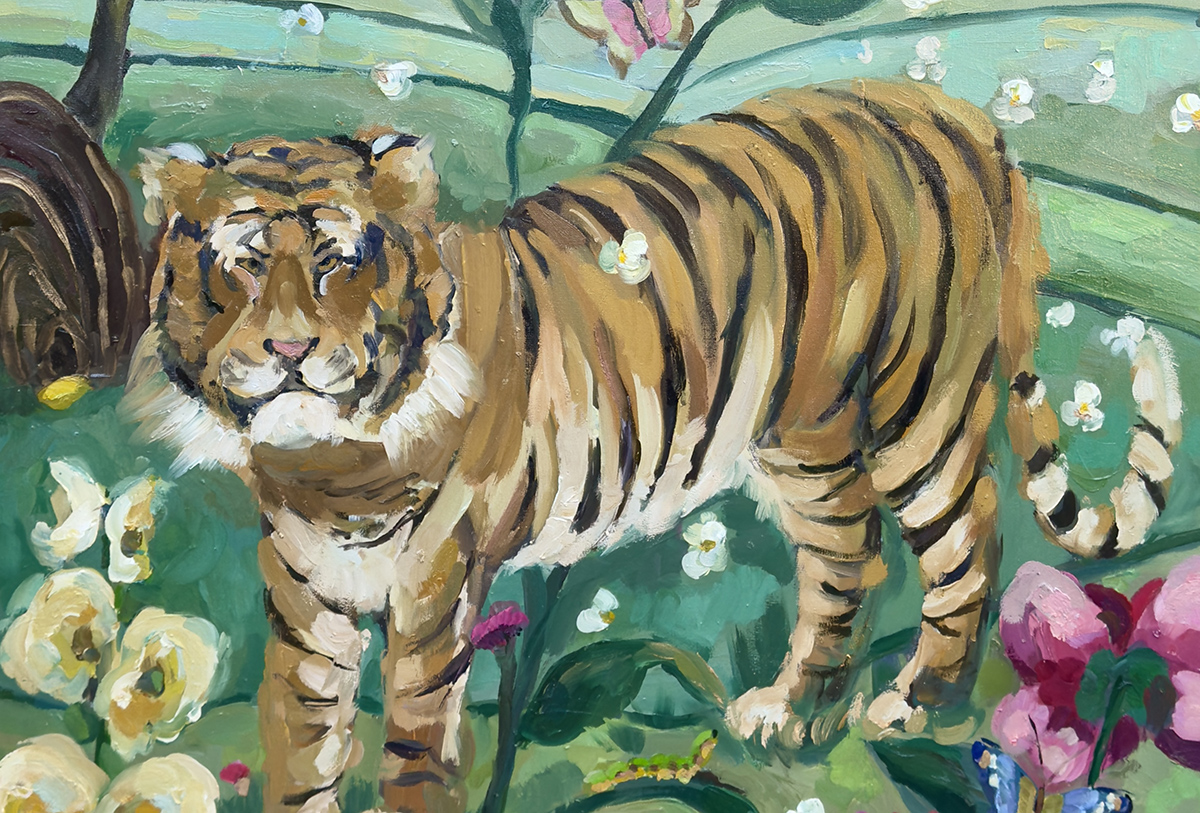
Where “Lilly Ruben” reads as a focused portrait, “Le Tigre” expands into a fuller scene. At 36×48”, it gives Trotter a larger stage. The painting is part of the “Life in Bloom” collection and is described as a vivid work featuring a tiger placed in a chinoiserie-inspired setting with flora and fauna of all kinds. Chinoiserie, with its decorative traditions and imagined landscapes, is a smart match for Trotter’s instincts. It allows pattern to behave like environment and ornament to behave like narrative. The tiger becomes the central force within a world of curated abundance—plants, creatures, and decorative cues that build atmosphere without flattening into mere wallpaper.
A lemon tree appears in “Le Tigre,” described as “a bonus,” and it’s easy to see why: lemons bring sharp notes of color and a playful note of abundance. They punctuate the scene, add brightness, and echo the painting’s broader mood—lush, vivid, and unapologetically alive. Like “Lilly Ruben,” “Le Tigre” is framed in a gold-edged floater frame, creating continuity in presentation and reinforcing that these works are meant to feel finished, intentional, and strong in a space. The painting is available through Michael Mitchell Gallery in Charleston, South Carolina, offering viewers a chance to experience the surface firsthand—something that really matters with impasto, where the paint’s physical presence is part of the point.
Taken together, these works show what Trotter does well: she combines training with instinct, discipline with joy. She uses the visual language of portraiture, the material thinking of textiles, and the perceptual tools of trompe-l’oeil, then pushes it all through thick paint and bright, confident color. The result is art that feels celebratory without being careless—work that holds attention because it’s built, not just pictured.
“Le Tigre”
36×48″ oil on canvas can be purchased at Michael Mitchell Gallery in Charleston, SC
843-577-0400
