
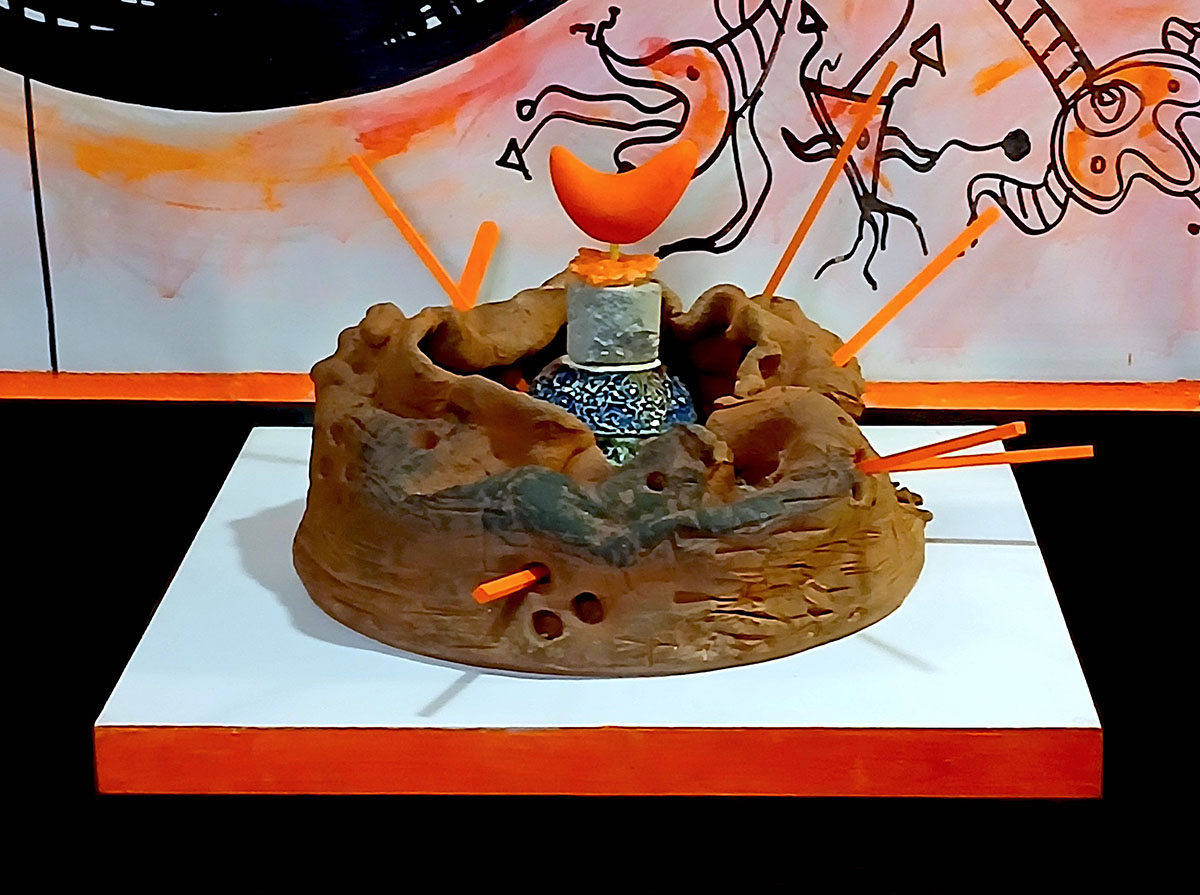
Sylvia Nagy’s work lives where craft meets systems thinking—where an object can feel personal while still speaking in the language of technology, process, and global change. With training that spans industrial design and fine art, she brings a maker’s understanding of materials into a practice driven by curiosity and feeling. Nagy studied at Moholy-Nagy University of Art and Design in Budapest, earning an MFA in Silicet Industrial Technology and Art, an education that sharpened her attention to structure, fabrication, and how ideas become physical form. Over time, that technical base opened into ceramics as a more expansive vehicle for expression—especially during her years connected to Parsons School of Design in New York. There, she taught and also developed a course focused on mold model-making with plaster, treating traditional studio methods as tools for contemporary thought. The result is an approach that stays tactile and hands-on, yet keeps reaching outward—toward movement, innovation, and the way one place, one medium, and one moment can connect to another.
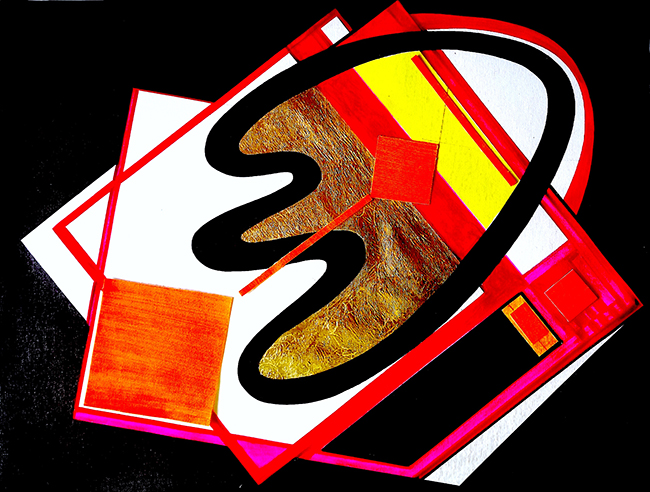
Square in Space
Title: Square in Space suggests a simple geometry, but Nagy uses that simplicity as a doorway into something bigger: how fragments relate, how systems shift, and how an artwork can hold multiple disciplines at once. Her practice is built on an idea she returns to often—everything is connected to everything. It’s not a slogan for her; it’s a working method. Painting, ceramic design, ceramic sculpture, dance, music, science, technology, nutrition—these are not separate lanes. They overlap, collide, and trade energy. Even the chemistry of glazes becomes part of a wider fascination with mixing, transformation, and cause-and-effect.
That cross-current begins early. Before ceramics became central, Nagy trained in mural traditions at the Budapest School of Fine and Applied Arts, learning techniques like sgraffito, fresco, and mosaic. Those forms demand patience and planning, but they also demand commitment: you’re building images that must survive time, weather, and distance. In that environment, she also encountered sculpture assignments and ceramic courses, and she started to realize she didn’t want to stay inside one medium. Painting mattered—but so did the pull of clay, volume, and surface.
Her relationship with sound matters here, too. She describes studying while music played loudly, even as others questioned how that could possibly work. For Nagy, it wasn’t a distraction; it was fuel. She still creates that way—writing while listening, moving between tasks, letting rhythm keep the work alive. She doesn’t wait for other people to approve of the method. She does it because it’s true to how her mind and body operate. In Square in Space, that mindset becomes part of the piece’s internal logic: the artwork doesn’t ask permission to be complex. It’s allowed to contain contradiction—focus and noise, discipline and freedom, solitude and the pressure of the world outside.
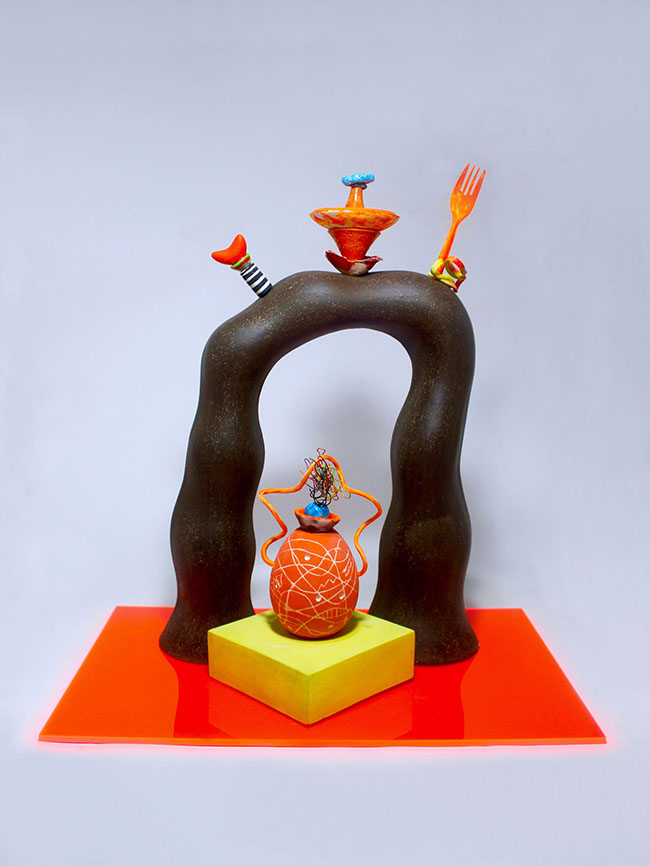
When Nagy moved from mural painting into ceramics at Moholy-Nagy University, she didn’t step away from scale—she took scale with her. There she studied industrial ceramic technology while also gaining experience in large sculptural work. That combination is important: industrial thinking teaches repeatability, engineering, and how material behaves under heat, pressure, time. Sculptural thinking teaches risk, intuition, and how a form carries meaning even when no words are present. Nagy’s work keeps both impulses active at once.
She speaks about a period of intense production—completing a multi-piece mural installation in four weeks by working day and night. She frames it as a “world record” for herself, a moment of almost superhuman output. But what’s more revealing than the speed is what comes after: the delayed outcome. She didn’t receive clear recognition or closure right away. The result arrived years later, after she had stopped expecting anything back. That lag—between effort and outcome—threads directly into the way she thinks about art and time. Sometimes you don’t understand what you made while you’re making it. Sometimes you can’t see where it lands, who it reaches, or what it shifts until long after you’ve moved on.
This is where Square in Space starts to read like a metaphor for transition. Nagy connects her work to the fact that societies cycle through upheaval—waves of ideology, conflict, repair, and reinvention. She references the anti-war call of the 1960s, “Love, not war,” not as nostalgia but as evidence that history turns and returns. In that turning, there are always “missing squares on the chessboard”—gaps in understanding, gaps in empathy, gaps in information. Her art doesn’t claim to solve the board. Instead, it acknowledges the gaps and tries to map them: how one square touches the next, how a pattern emerges, how a single move changes the whole field.
Her life and studio settings echo that sense of movement. She describes settling in Romhild Castle in Germany, a place that carries its own history and scale. A castle is architecture built for permanence, but it’s also a reminder that permanence is an illusion—structures outlast people, and meanings change as they pass from one era to another. In that context, Nagy’s shift from mural to sculpture to installation feels natural. The work becomes a kind of spatial thinking: not just objects, but environments; not just surfaces, but experiences that surround you.
At the center of all this is a quiet truth Nagy returns to: she makes art because it supports peace of mind. She’s honest about what she doesn’t know—she’s not claiming expertise in every political transition or historical force. But she doesn’t need total knowledge to create. What she needs is the permission to respond, to build a form that carries feeling, curiosity, and repair. Square in Space becomes a container for that: a structured shape that still leaves room for uncertainty, speed, sound, chemistry, and the shifting patterns of the world.
If there’s a through-line in Nagy’s practice, it’s this: connection is not decoration. It’s the engine. The square is never only a square. In her hands, it’s a unit of meaning—one part of a larger field, always influencing, always influenced, always in motion.
