
Born in Greensboro, North Carolina, in 1953, Vandorn Hinnant has built a long-running practice that moves easily between studio work and civic space. Early on, he was pulled toward art as both craft and way of thinking—something you can build with your hands, but also use to ask bigger questions. He earned a B.A. in Art Design from North Carolina A&T State University, then continued his training in sculpture at the University of North Carolina at Greensboro, a combination that grounded him in design structure while opening the door to form, weight, and scale. Over time, that foundation expanded into a language shaped by pattern, proportion, and symbolic systems—work that often links math, architecture, and metaphysical inquiry. Now based in Durham, North Carolina, Hinnant is also known for public commissions that invite people to pause, look up, and consider what leadership, dignity, and shared history can look like in physical form.
A Monument to Leadership at FSU — an upward logic
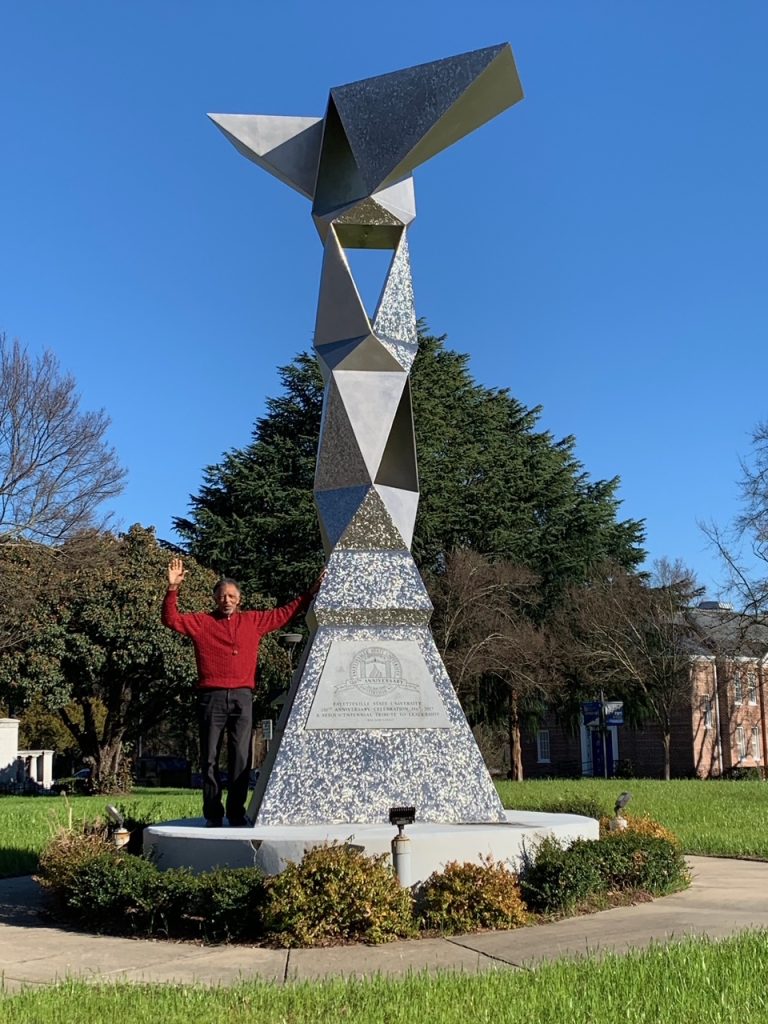
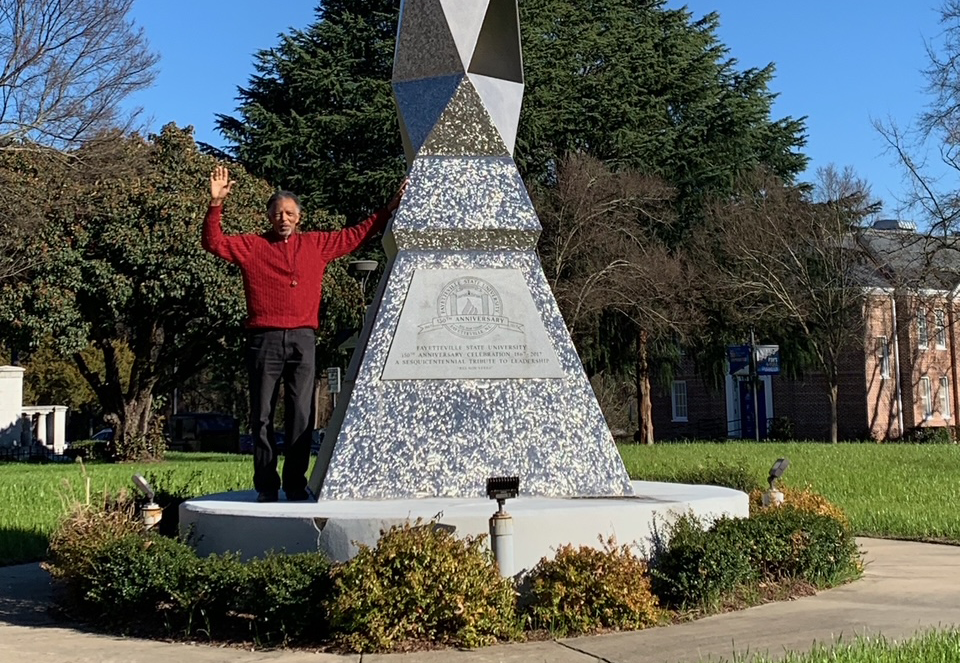
“A Monument to Leadership” at Fayetteville State University is built as a vertical statement—part totem, part architectural marker—designed to feel like uplift made solid. The form suggests motion rather than stillness, with an implied spiral that keeps the eye traveling upward. Its geometry leans on fours: fourfold symmetry tied to the Four Directions, and the idea that leadership depends on balance rather than dominance. Hinnant has described the sculpture as having distinct “levels,” where upper sections evoke leadership (a headdress-like crown that can also read as wings), and lower sections point to the inner forces that support leadership—heart, insight, will, and grounded strength. Even the open spaces matter, functioning like intentional voids: areas that look empty but imply spirit, breath, or the unseen. At the base, inscribed stones anchor the work in history, turning foundation into metaphor—roots that allow the whole structure to rise.
A Monument to Dignity and Respect— a conversation across distance
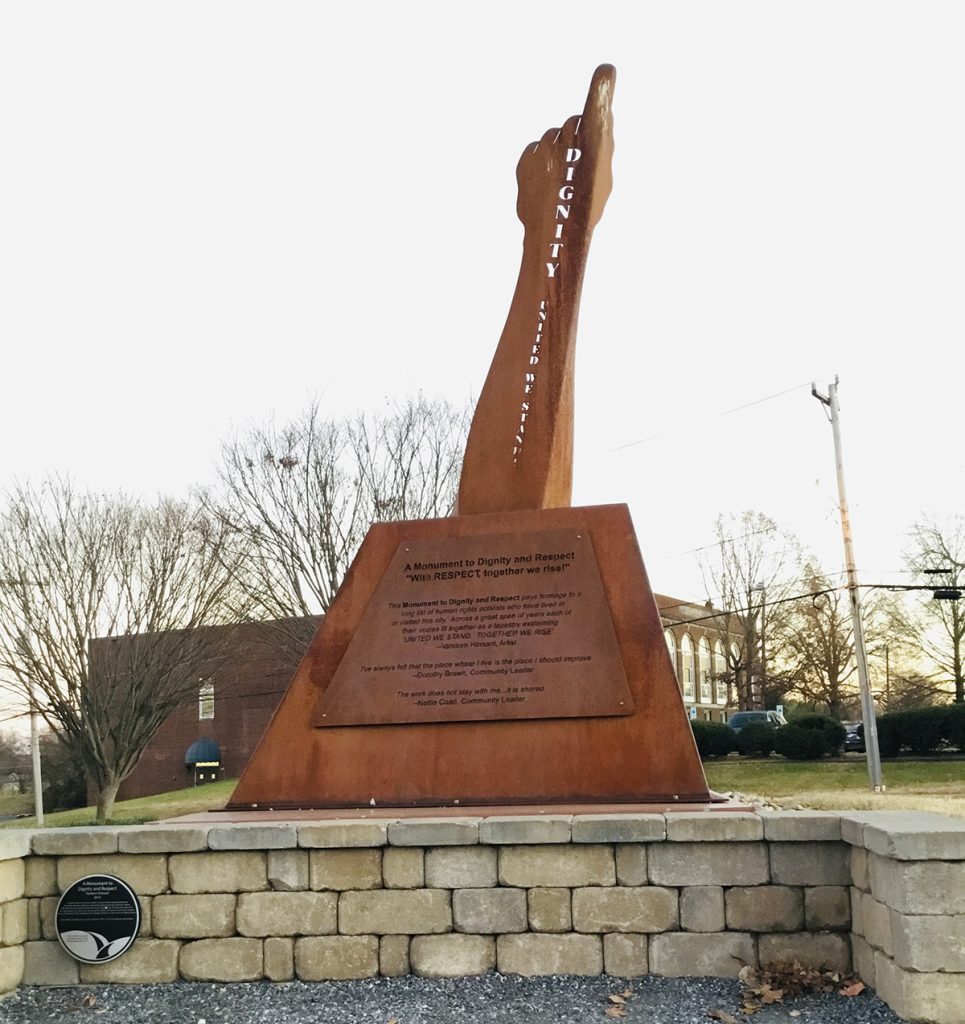
If the FSU work is a single vertical argument, A Monument to Dignity and Respect is a dialogue. Commissioned for Greensboro’s Downtown Greenway and connected to the Ole Asheboro neighborhood—where Hinnant grew up—the installation is split into two parts positioned a block apart so they face each other across space. Each element features a 14-foot Corten steel hand with an index finger pointed upward, set on a base that also carries text. One reads “Dignity — United We Stand,” the other “Respect — Together We Rise.”
The gesture is simple and widely understood: the raised finger can mean “look,” “remember,” “consider,” or “we’re still here.” By making two hands rather than one, Hinnant avoids the lone-hero feel that public monuments can slip into. The work doesn’t command from a pedestal; it meets the neighborhood in two places and asks the greenway itself to function as connective tissue.
Just as important, this piece was shaped through exchange with neighbors. Quotes from Dorothy Brown and Nettie Coad—along with Hinnant’s own words—are cut into panels at the base, turning the sculpture into a place where language and public space meet. That choice matters: it keeps the work rooted in lived experience, not just abstract ideals.
Conclusion
Across these projects, Hinnant uses structure—symmetry, proportion, and clear upward movement—to carry bigger human themes without turning the work into a lecture. His public sculptures hold two realities at once: the precision of design and the emotional weight of place. In the end, what he builds is less about monuments as objects, and more about monuments as reminders—of what we inherit, what we practice, and what we choose to raise together.
