
Today, Sonja Kalb lives and works in Düsseldorf, Germany. She studied Textile and Design Engineering in Germany, graduating with the degree Diplom-Ingenieur Textile and Design. Her early training in textile and design engineering introduced her to the disciplines of construction, material, pattern, and precision. Rather than restricting her imagination, this technical background gave her a strong foundation from which experimentation could develop. In her paintings, careful decisions coexist with spontaneity, allowing structured thinking to meet the unpredictable behavior of pigment.
Kalb approaches abstraction as a process of discovery. Color is not merely applied to describe an object; it becomes an active presence capable of suggesting light, movement, atmosphere, and emotion. Her surfaces evolve through accumulated gestures, changing densities, and contrasts between delicate transparency and physical texture. This balance gives her compositions an internal order without making them feel controlled. Each painting remains open, energetic, and responsive, revealing an artist interested in transformation rather than fixed appearances.
Secret Flora: Nature Reimagined
Kalb’s new Secret Flora series continues her exploration of natural change through light, color, and organic processes. The title suggests something living but partially concealed: a private ecosystem unfolding beyond ordinary sight. These paintings do not reproduce recognizable flowers, gardens, or landscapes. Instead, they translate the sensations of nature into layered abstract environments.
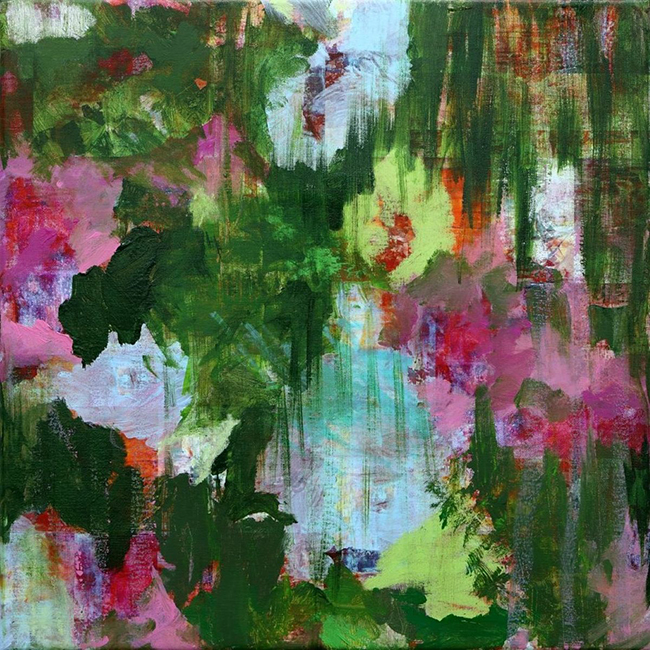
Across the series, deep forest greens are interrupted by passages of pink, violet, turquoise, pale blue, orange, and brilliant yellow-green. Some areas appear dense and shadowed, while others open into luminous spaces. These shifts create the impression of moving between thick vegetation and sudden clearings. The viewer may sense leaves, water, blossoms, or reflected sky, yet these associations remain fluid. Nothing settles into a single interpretation.
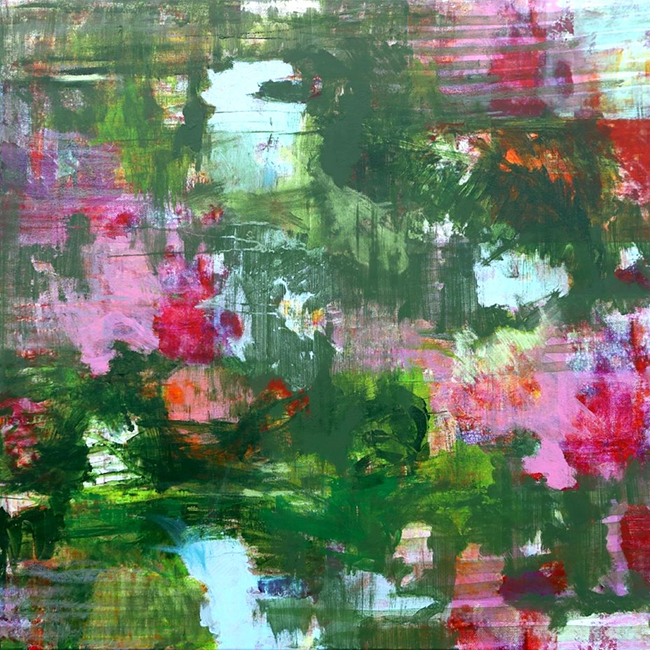
Kalb constructs the works with multiple layers of transparent and opaque paint. This method gives the surfaces a sense of both time and depth. Translucent passages allow earlier colors and gestures to remain partly visible, like memories resurfacing through the present. More solid applications interrupt that continuity, covering what came before and redirecting the composition. The process resembles natural growth, in which new forms emerge over older ones while still carrying traces of their origins.
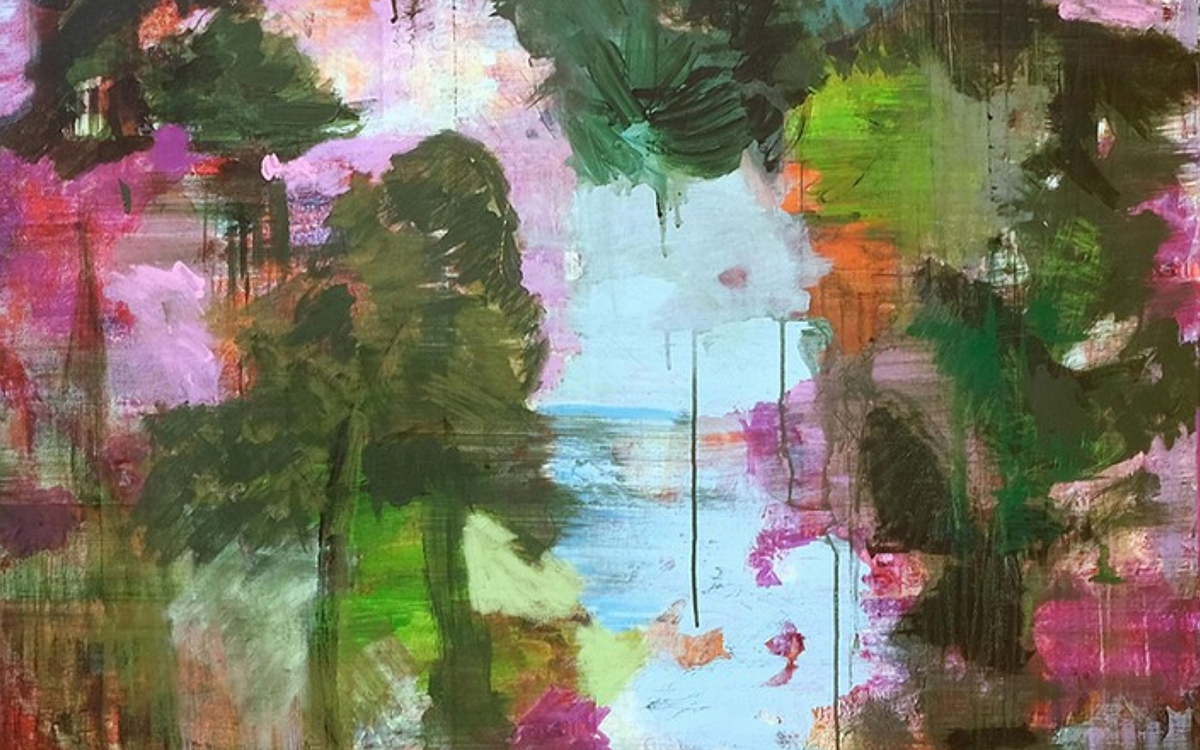
In the attached paintings, broad brushwork establishes weight and movement. Dark green forms gather into irregular masses, recalling dense foliage without illustrating individual plants. Around them, pink and magenta marks appear like flashes of flowering growth. Pale blue areas introduce air and distance, sometimes resembling pools of water or openings in a forest canopy. These contrasting zones allow the compositions to breathe.
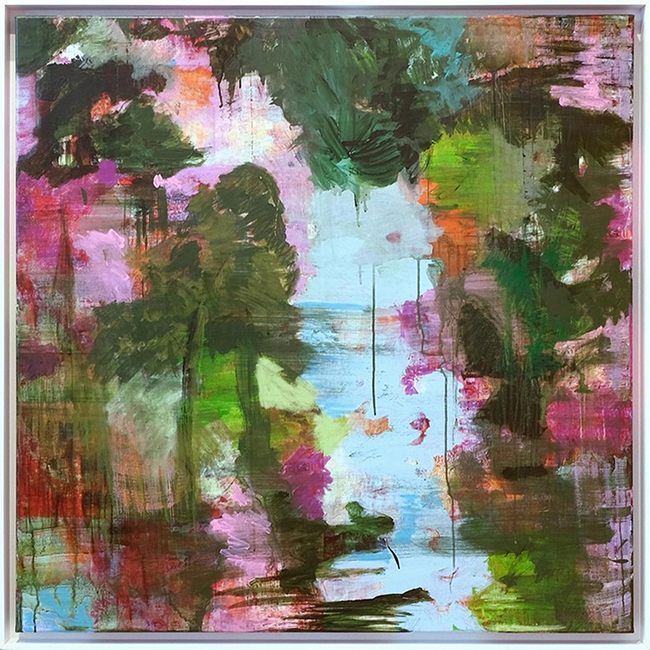
The paintings also contain drips, scraped passages, softened edges, and visible directional strokes. Such marks record the physical development of each work. A vertical drip may suggest rain, sap, or the downward pull of gravity, while a horizontal sweep can evoke water, wind, or a shifting horizon. Kalb does not depend on literal imagery to communicate these ideas. Instead, the behavior of the paint becomes connected to the behavior of the natural world.
Atmosphere is particularly important within Secret Flora. The works seem to exist between specific times of day and changing weather conditions. Their greens can feel cool and shaded in one area, then warm and sunlit in another. Bright pinks emerge through darker passages like color intensified by moisture or fading light. This instability gives the paintings an almost cinematic quality, as if their environments were changing while being observed.
Memory also shapes the series. Nature is rarely remembered with photographic accuracy. A place may return to the mind as a particular light, temperature, color, or emotional impression. Kalb’s abstractions reflect this fragmented experience. Her compositions feel familiar without identifying a particular location. They invite viewers to connect the paintings with their own recollections of gardens, forests, rain, twilight, or seasonal change.
The relationship between concealment and revelation reinforces the meaning of the title. Forms repeatedly appear and disappear beneath neighboring colors. Some marks are immediately visible, while others require sustained attention. A muted patch may gradually reveal several underlying tones; a dark mass may contain subtle variations that become apparent only at close range. The paintings reward slow viewing because their complexity is discovered progressively.
Despite their connection to vegetation, the works are not gentle idealizations of nature. They acknowledge its intensity, disorder, and continuous competition for space. Dark shapes press against luminous openings, and delicate colors coexist with forceful gestures. Growth appears beautiful, but also restless and uncontrollable. This tension prevents the series from becoming decorative, giving it emotional and material strength.
Through Secret Flora, Kalb presents nature as an active state rather than a stable scene. Light passes, colors shift, memories fade, and organic forms continually emerge and dissolve. Her paintings capture that instability without attempting to stop it. By combining the discipline of her design background with an intuitive engagement with paint, she creates environments that feel simultaneously constructed and alive. The series invites viewers not simply to look at nature, but to experience its rhythms, energies, and hidden transformations through color.
