
Born in Innisfail, Queensland, Sebastian Di Mauro is an Australian multidisciplinary artist whose career spans more than three decades. Working between Brisbane and the United States, he explores the connections between materials, cultural identity, history, and place. His diverse practice encompasses painting, sculpture, textiles, installation, and artist books, often transforming familiar imagery into compelling reflections on contemporary society.
With more than 45 solo exhibitions and participation in over 100 group exhibitions internationally, Di Mauro has established a distinguished artistic career. His works are represented in major Australian public collections, including the Queensland Art Gallery | Gallery of Modern Art and the Art Gallery of Western Australia. Notable exhibitions include GREENBACK (2019), Always and Altered, and his participation in Personal Structures – Reflections during the 2022 Venice Biennale. An Adjunct Associate Professor at Griffith University’s Queensland College of Art, Di Mauro continues to investigate the evolving relationship between historical memory, cultural narratives, and artistic expression.
Sacagawea: Reconsidering History Through Art
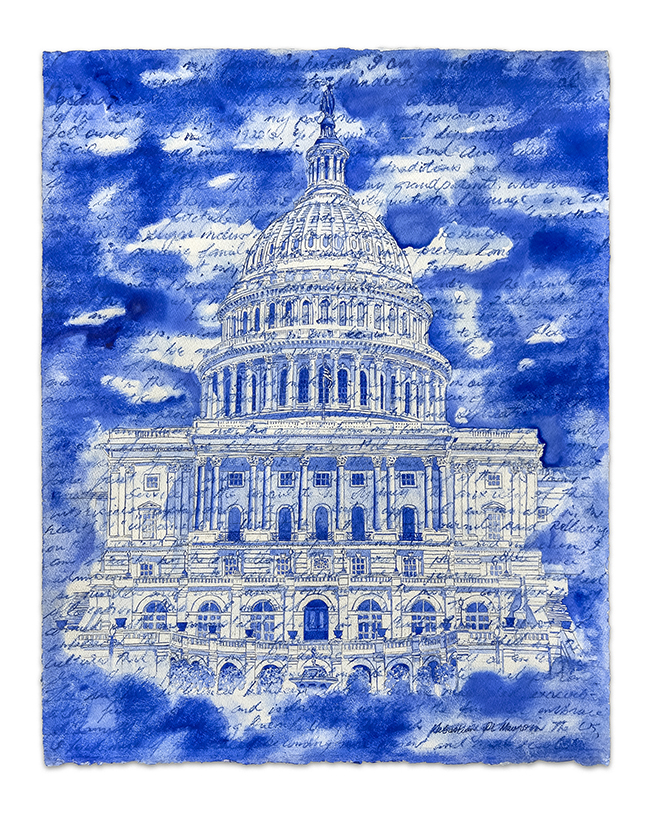
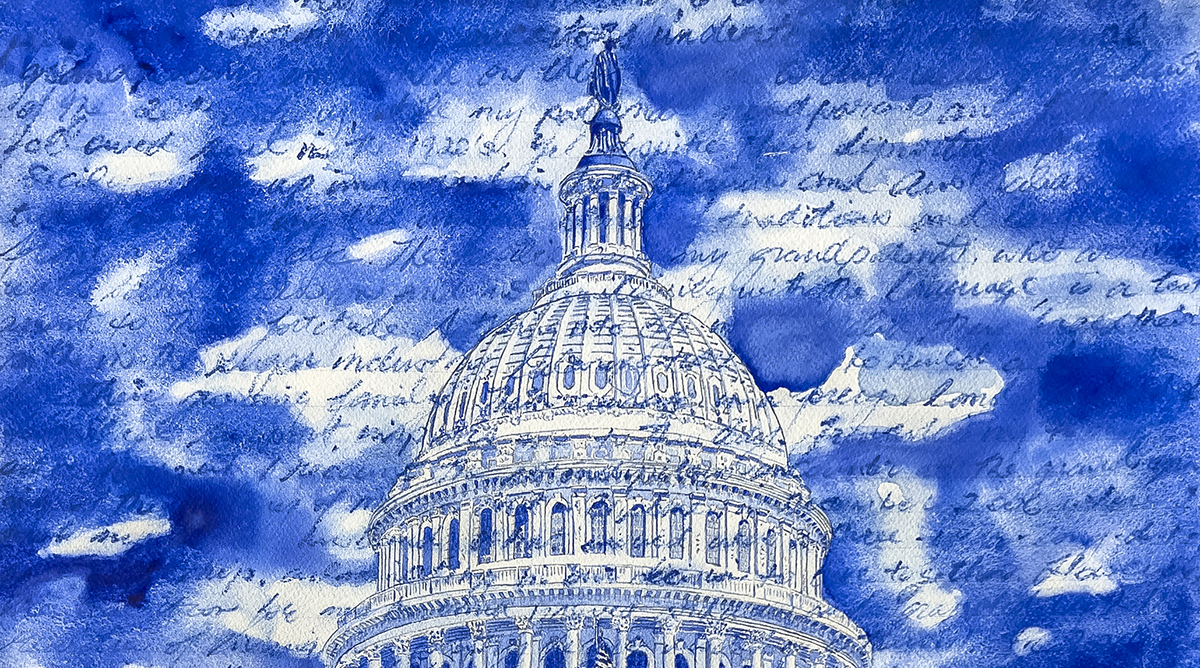
In Sacagawea, Sebastian Di Mauro transforms an iconic American architectural landmark into a thoughtful meditation on national identity, collective memory, and the changing significance of historical imagery. Created in watercolor on Arches paper, the 20 × 16-inch composition depicts the United States Capitol in Washington, DC, rendered in delicate blue lines against an expressive background of rich cobalt tones and handwritten text.
The artwork draws inspiration from the image of the Capitol appearing on the reverse of the United States fifty-dollar bill. By extracting this familiar illustration from its monetary context and presenting it as an independent artwork, Di Mauro encourages viewers to reconsider the cultural meanings embedded within objects encountered in everyday life.
Currency serves a practical economic purpose, yet its imagery also communicates powerful ideas about a nation’s identity. Portraits, monuments, and government buildings become visual representations of historical achievements, political institutions, and collective values. These symbols circulate continuously, often passing through countless hands without receiving meaningful attention. Di Mauro challenges this habitual indifference by giving a familiar image renewed visibility and significance.
The Capitol occupies the center of the composition, its recognizable dome rising prominently against a dramatic blue atmosphere. Intricate architectural details are carefully articulated through fine lines, creating a striking contrast with the fluid watercolor surrounding the structure. The building appears simultaneously monumental and fragile, suggesting the tension between the apparent permanence of national institutions and the changing circumstances that shape their interpretation.
Throughout the background, handwritten passages emerge and disappear beneath layers of pigment. These fragmented inscriptions introduce an additional dimension of memory and communication. Their partially obscured appearance resembles historical documents affected by time, inviting viewers to contemplate the stories that remain visible and those gradually lost or forgotten.
The restrained blue-and-white palette further distinguishes the composition. Rather than reproducing the traditional appearance of printed currency, Di Mauro introduces an atmospheric quality that shifts the image toward reflection and uncertainty. The watercolor’s fluidity contrasts with the architectural precision of the Capitol, suggesting that history, despite its established monuments, remains open to reinterpretation.
An important aspect of Sacagawea concerns the declining presence of physical money in contemporary society. As digital transactions increasingly replace cash, the images printed on banknotes risk becoming less familiar to future generations. Di Mauro raises an intriguing question: when these everyday objects disappear, what happens to the historical references they carry?
The artwork also engages with the contemporary American political landscape. By isolating the Capitol, a powerful symbol of democratic government, Di Mauro invites consideration of how national institutions are perceived amid changing political and cultural circumstances. The composition does not offer a fixed interpretation. Instead, it creates space for questions about belonging, representation, and the relationship between historical narratives and present-day realities.
The title Sacagawea introduces another layer of historical association, recalling the Indigenous woman whose role in the Lewis and Clark expedition occupies an important place in American history. This reference broadens the work’s consideration of national memory, suggesting that a country’s identity encompasses multiple experiences and narratives beyond its most recognizable institutions.
Ultimately, Sacagawea demonstrates Di Mauro’s ability to transform familiar imagery into an engaging exploration of cultural meaning. Through architectural precision, expressive watercolor, and layered writing, he creates a visual dialogue between permanence and change, remembrance and disappearance.
The work will form part of Catching Stars, Di Mauro’s forthcoming solo exhibition at the Australian Embassy in Washington, DC, scheduled to open in late April 2027. Bringing together his ongoing interests in history, identity, and place, the exhibition offers another perspective on the cultural connections that continue to inform his artistic practice.
