
Adamo Macri approaches art as something fluid, never confined to a single direction. Born in Montreal in 1964, he built his early foundation at Dawson College, studying across disciplines that included commercial art, graphic design, photography, art history, and fine arts. That breadth continues to inform his approach. Though widely associated with sculpture, his practice extends into photography, video, painting, and drawing, shifting mediums as ideas require. Rather than isolating each discipline, he treats them as part of the same language. Across his work, recurring concerns surface—identity, change, and the tension between appearance and inner experience. Figures and faces emerge often, not as stable portraits, but as shifting constructions that hover between the real and the imagined.
The Work
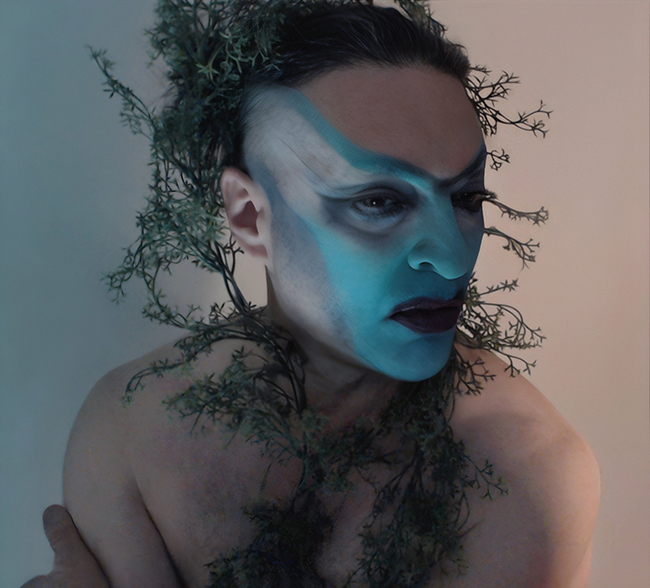
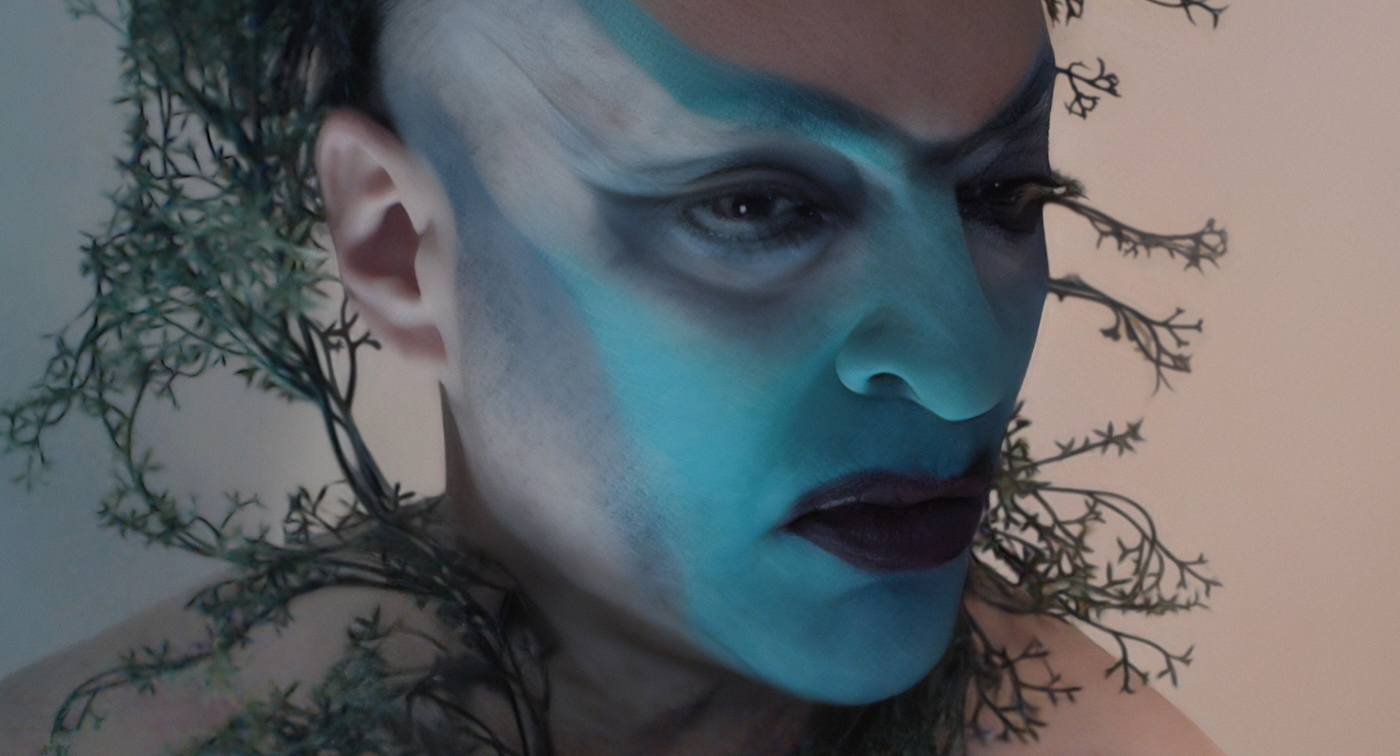
In Hinterland (2016), Macri repositions the idea of landscape, turning it inward. Traditionally, the word refers to a distant region beyond a central hub, but here it becomes something psychological. The face operates as this hidden territory—a place beyond what is visible or socially defined. The figure does not sit comfortably within identity. Instead, it feels displaced, as if removed from any clear structure or origin.
The image is washed in aquamarine, giving it a submerged, almost suspended atmosphere. The head rises through a dense accumulation of organic material that could be read as foliage, marine growth, or unruly hair. This mass does more than surround the figure—it fuses with it. The boundary between body and environment breaks down, leaving the figure embedded within its surroundings. It feels less constructed than uncovered, as though it has surfaced from an unfamiliar terrain where definitions no longer apply.
The face carries a quiet restraint. Dark lips remain still, offering no emotional direction. There is no clear expression to anchor interpretation. Instead, the image holds its meaning in its mood. It avoids direct explanation, drawing attention toward sensation rather than narrative. The figure exists in suspension, caught between states—neither fully recognizable nor entirely unknown.
Macri has described this presence as both grounded and unfamiliar—something that could belong to water or land, hinting at cultural references while also feeling slightly extraterrestrial. These overlapping qualities prevent the figure from settling into a single identity. It carries fragments of multiple origins without committing to any one of them. Displacement remains central. The figure appears to have drifted away from a known place, no longer connected to a stable environment.
There is also a suggestion of the sea running through the work. The head can be seen as a detached figurehead, separated from the ship it once belonged to. Without its original function, it shifts into something else—a character with its own presence. This transformation from object to living form is essential. What once served as decoration now feels active, as if it has entered its own unfolding narrative.
Music also informs the work. Macri has cited David Bowie and the song Red Sails as an early point of influence. The idea of traveling toward a distant, unfamiliar place—both linguistically and culturally—resonates throughout the image. The figure seems to exist within that distance, occupying a space where identity becomes difficult to define. It feels like a translation in progress, where meaning is present but not entirely fixed.
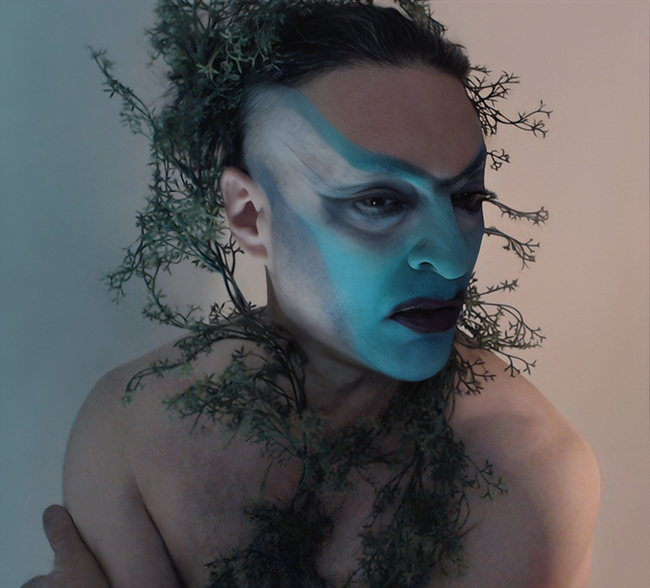
Hinterland also connects to a larger thread in Macri’s practice, where identity remains unstable. Kenneth Radu has linked the work to Memento Mori (2014), noting how both pieces explore the divide between outward appearance and inner reality. In these works, the surface—whether formed through texture, setting, or visual construction—acts as both a mask and a point of entry.
In Memento Mori, this inquiry turns toward mortality. While Hinterland leans into transformation and expansion, Memento Mori draws attention to time and its limits. The title, rooted in the idea of remembering death, situates the work within a long historical tradition. Yet Macri approaches it through his own lens, focusing less on symbolism alone and more on how identity is constructed and altered over time.
The figure in Memento Mori does more than point to death. It reflects on the roles and appearances carried throughout life. As in Hinterland, the outer layer becomes significant. What is visible—expression, posture, surface—only reveals part of the story. Beneath it lies something shifting, something unresolved. Mortality becomes not just a physical endpoint, but a continual process of change, where identity is repeatedly reshaped.
Across both works, there is no attempt to resolve these tensions. Macri does not present identity as fixed or easily understood. Instead, his figures remain in-between—hovering between human and other, presence and absence, clarity and ambiguity. They resist explanation, leaving space for interpretation to unfold.
Taken together, Hinterland and Memento Mori form part of a broader investigation. The figure is not treated as a stable subject, but as something in motion—layered, uncertain, and continually shifting. Macri’s work stays within that unstable ground, where identity is not fully formed, but always in the process of becoming.
