
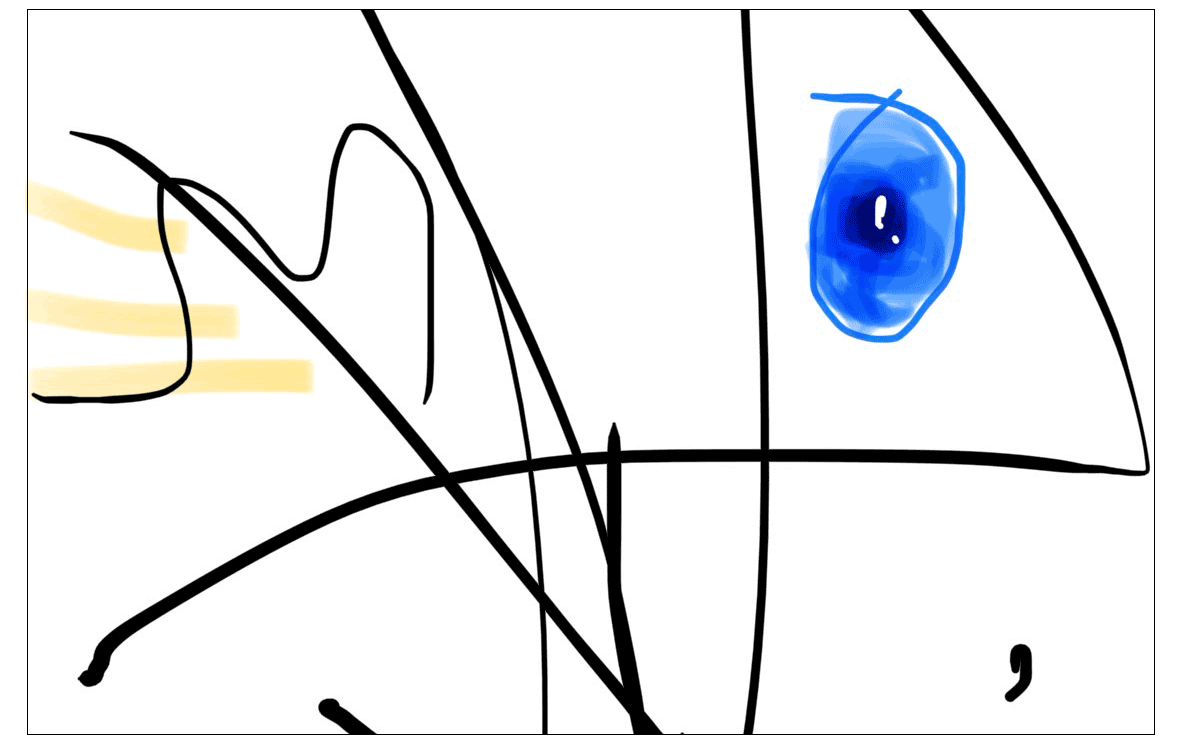
Some artists begin with what is in front of them, while others begin with what is happening inside. Rebecca Navajas belongs to the second approach. Her paintings are not built around precision or careful depiction. They unfold from feeling. Emotion leads, and the visual language follows behind it. Color is not there to decorate the surface. It carries intention and weight. Gesture is not restrained. It moves freely, sometimes shifting direction, sometimes pushing back. Nothing in her work feels fixed. Each piece holds a kind of internal movement, as if it continues to evolve beyond its final form.
Navajas treats identity and experience as something layered rather than settled. Her work suggests that strength and fragility are not opposites, but conditions that can exist at the same time. Vulnerability is not concealed. It is present, acknowledged, and given space. There is a quiet persistence in her paintings. They do not demand attention, but they linger. What she creates is not a record of the visible world, but an interpretation of what it feels like to live within it.
This approach becomes clearer when focusing on individual pieces, where personal narratives are embedded beneath the surface.
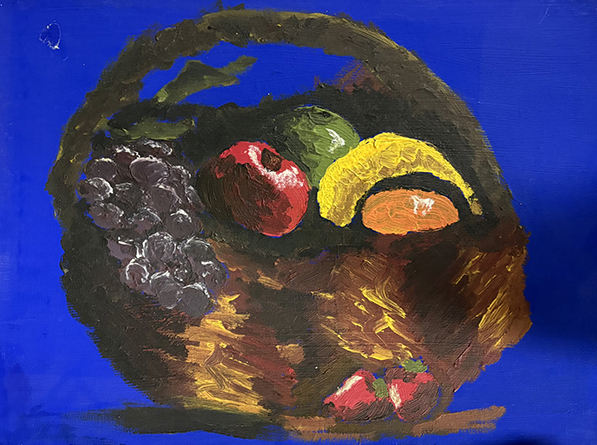
“Still life – still love” initially appears to sit within a familiar tradition. At the front, a basket of fruit is arranged with calm balance. The composition feels measured, almost timeless. Still life, as a genre, often suggests stability and completion, and here that sense is present. The fruit reads as a symbol of fullness, something intact and at rest.
But this is only what is immediately visible.
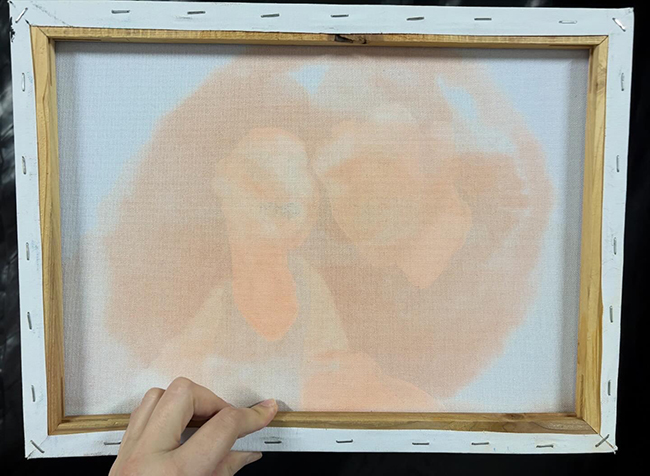
Hidden behind the painting is a second image. A portrait of a couple who are no longer together. This concealed layer alters the entire reading of the work. What appears whole at first glance carries a different reality beneath it. The piece shifts from an image of objects to something closer to memory, to concealment, to the quiet persistence of what remains after something ends.
The separation between front and back reflects the way relationships often exist. Outwardly, things can appear composed, even harmonious, while something unresolved continues underneath. Navajas does not exaggerate this contrast. She allows it to sit quietly, trusting the tension to speak for itself.
Her choice of a still life format adds another layer. Traditionally, still life suggests a paused moment, something held in time. By placing a hidden narrative behind it, she unsettles that idea. The painting is no longer static. It carries a sense of before and after. It suggests that what is seen is only partial, that every image holds something beyond its surface.
In this way, “Still life – still love” becomes less about the objects depicted and more about absence. It considers what lingers after separation, how memory is stored, and how it is sometimes kept out of sight yet never fully gone.
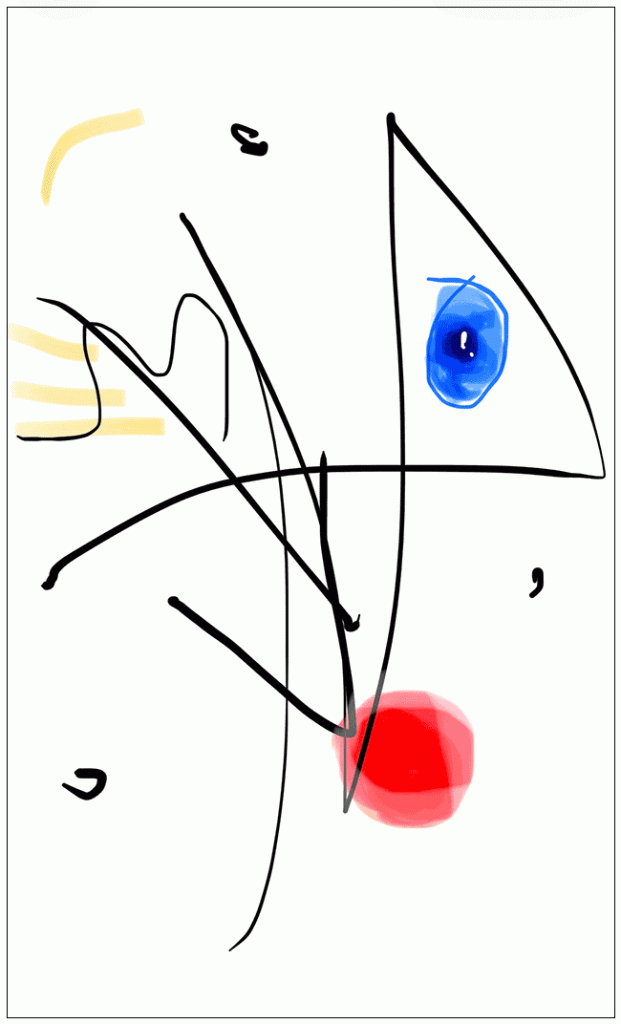
“Dad,” on the other hand, moves in a more immediate and direct way. Created quickly on an iPhone during a flight, it carries a different kind of energy. There is no extended process, no gradual buildup. It captures a moment as it occurs.
The work reflects a personal realization. Her father is understood as a guiding presence, described as both light and direction. The reference to the North Pole suggests orientation, something constant within movement. It speaks to the idea of knowing where you are because of someone else’s influence in your life. It is not only about admiration. It is about grounding.
The use of an iPhone is not incidental. It shortens the distance between thought and image. There is no preparation, no separation between feeling and execution. The drawing exists almost at the same speed as the realization itself. This immediacy gives it clarity. It does not attempt refinement. It remains close to its origin.
Visually, the work likely carries the marks of speed. Lines may be loose, forms unresolved, but this lack of completion becomes meaningful. It reflects how understanding can arrive suddenly, without structure or planning. The piece holds onto that moment rather than reshaping it into something more controlled.
Both works share a focus on what lies beneath appearance. In “Still life – still love,” the hidden portrait reframes the visible image. In “Dad,” the simplicity of the sketch carries emotional depth beyond its surface. Neither work depends on technical complexity. Instead, they rely on intention and clarity.
Navajas does not aim to impress through technique. She focuses on revealing something internal. Her work moves between what is visible and what is felt, allowing both to exist at the same time. There is no effort to resolve that space.
She leaves room for contradiction, for quiet tension, and for the kind of understanding that unfolds gradually rather than all at once.
