
Bobbie Carlyle, an American sculptor with a deeply rooted sense of purpose, shapes her work from a life rich with experience. As a mother of seven and a grandmother many times over, her perspective is grounded in lived moments rather than abstraction. Her practice does not separate art from life. Instead, the two move side by side, each informing the other. She earned her Fine Arts degree from Brigham Young University while raising her family, a path that reflects both determination and clarity. That same focus carries into her sculpture. For Carlyle, bronze is more than a medium. It becomes a way to contain feeling, memory, and movement within a physical form. Drawing influence from artists such as Leonardo Bistolfi, Solon Borglum, Gutzon Borglum, Daniel Chester French, and Michelangelo, she moves freely between classical structure, art nouveau flow, and contemporary expression. The result is a visual language that feels immediate, guided by both control and instinct, and centered on capturing the essence of a moment rather than simply depicting it.
Stretch the Limits
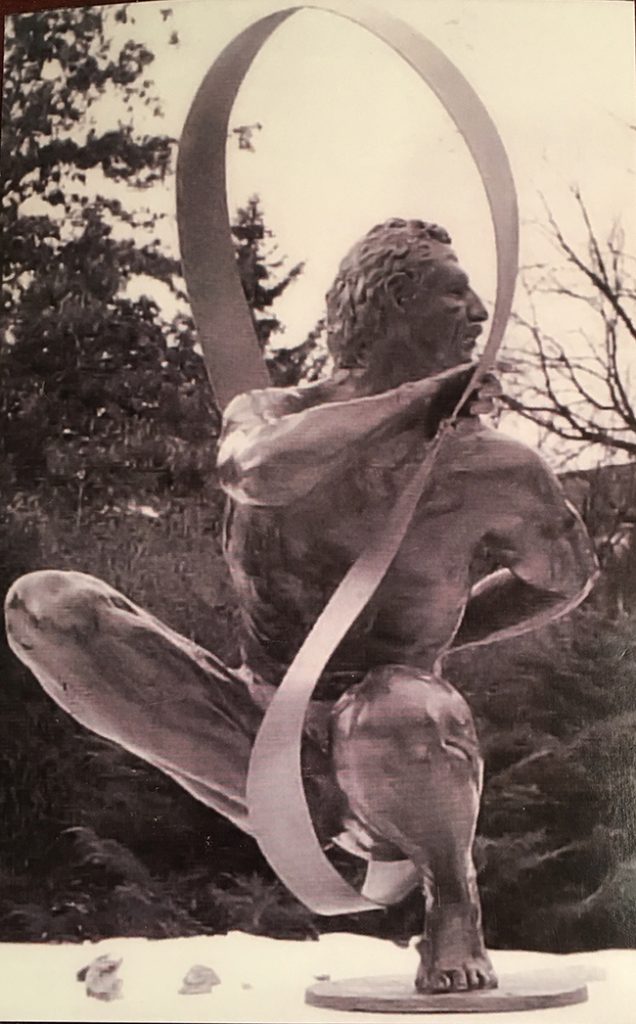
In Stretch the Limits, Carlyle concentrates on the relationship between strain and expansion. The figure twists through a looping form that encircles and engages the body at the same time. This curved structure does not act as a separate element. It becomes part of the figure’s experience, functioning as both a boundary and an extension.
The sculpture is driven by motion. The limbs reach outward, the torso turns, and the circular form pulls the eye through a continuous path. There is no clear beginning or end to the movement. Instead, it unfolds in a steady rhythm. Carlyle uses this flow to suggest something beyond the physical. The work reads as an exploration of internal pressure, where personal limits are not fixed but constantly shifting.
A tension between control and release runs through the piece. The figure feels anchored, yet it leans toward imbalance. This push and pull gives the sculpture its presence. It is not about resolution or victory. It focuses on the act itself, the effort of pushing forward. The bronze surface supports this, catching light along the curves and reinforcing the sense of ongoing movement.
Seaswept
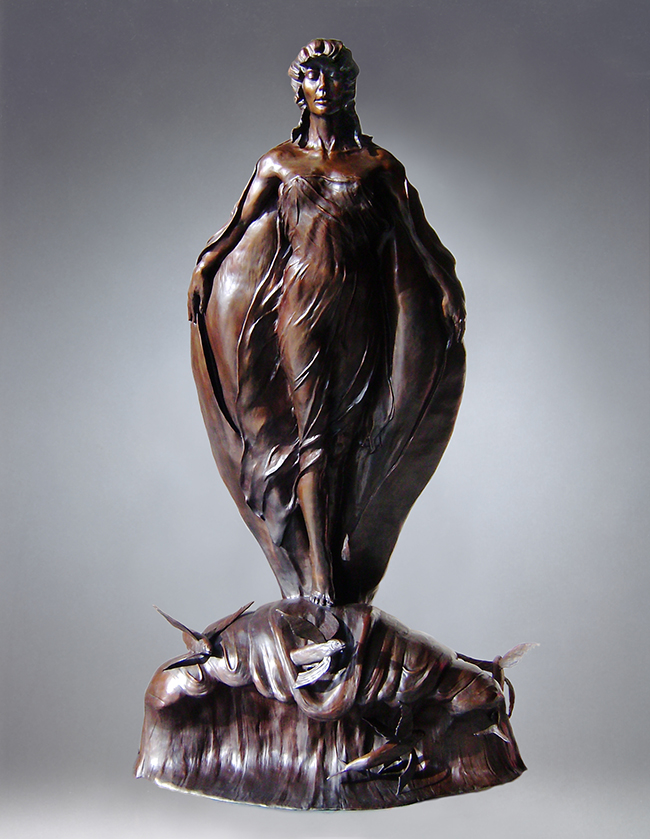
Seaswept shifts the tone while maintaining Carlyle’s focus on movement. The figure stands upright, but the surrounding forms carry a sense of motion. Drapery extends outward, shaped as if by wind or water, creating a surface that feels active rather than still.
The base suggests an organic structure, possibly connected to the sea. This anchors the figure while also placing it within a larger environment. The sculpture does not exist in isolation. It is shaped by forces that move around it.
Compared to Stretch the Limits, this work feels more open. The figure holds a quiet steadiness, allowing the movement to pass through rather than pushing against it. The gesture leans toward acceptance. Carlyle captures a moment where the figure aligns with its surroundings instead of resisting them.
Light plays an important role here. The bronze surface shifts between smooth areas and deeper shadows, creating variation across the form. This gives the sculpture a changing presence, depending on the angle of view. While the figure remains central, the expanding forms extend the experience outward.
Sunriser
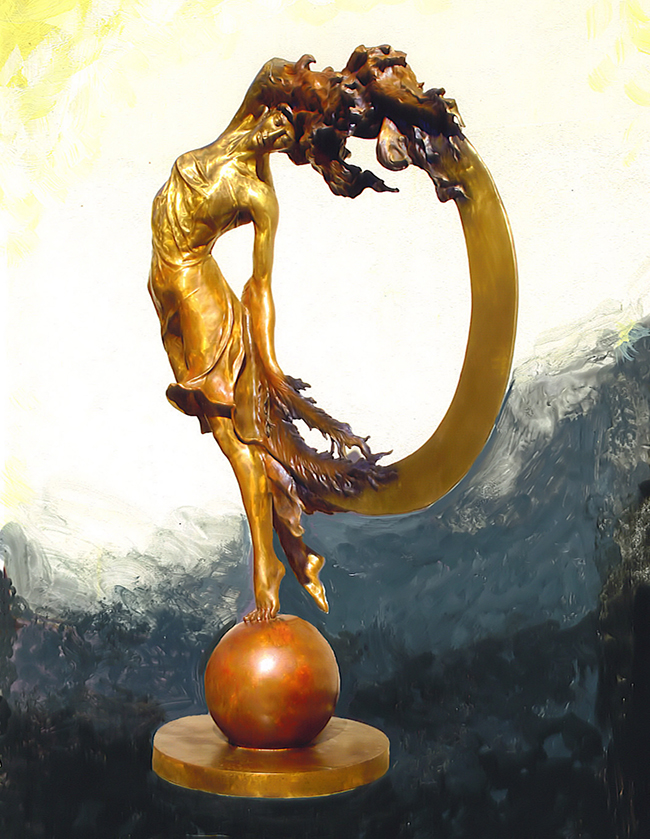
In Sunriser, Carlyle brings together ideas of balance, elevation, and renewal. The figure stands on a sphere, immediately introducing a sense of instability. Behind it, a large circular form echoes the image of a rising sun.
The composition rises upward. The figure extends vertically, while the circular element frames and supports this lift. The sphere beneath the feet suggests transition rather than permanence, as if the figure exists in a moment of change.
There is a contrast between weight and lift. The bronze carries physical density, yet the arrangement of forms gives the impression of suspension. Carlyle uses this contrast to explore the idea of beginning again. The sculpture focuses not on completion, but on emergence.
The posture of the figure is open, though not without effort. A subtle tension remains in the stance, grounding the work. Renewal is not presented as effortless. It is something that requires balance, awareness, and movement forward.
Across these works, Carlyle returns to a consistent idea: giving shape to internal experience. Through movement, tension, and balance, her sculptures hold moments of transition. They do not settle into stillness. Instead, they remain in motion, capturing that brief point where change is unfolding.
