
Alexandra Jicol works from a sense of linkage—between what is felt inside and what exists around us, between recollection and the present. Raised in Bucharest during a time shaped by restriction and social pressure, her upbringing carried contrasts. There was the openness of nature and the calm of rural scenery, set against the discipline and limits of an urban environment under control. These opposites stayed with her. They surface in paintings that hold ease and tension together. Airy passages sit beside tighter, compressed areas. Gentle color meets quiet unease.
For Jicol, making art is a way of noticing and translating lived moments into shape and color. She is less interested in spectacle and more drawn to reflection. Many of her pieces feel like pages from a visual journal where thought, feeling, and release share the same space. The work feels intimate but not closed off, leaving room for viewers to enter and draw their own meanings from the layers she builds.
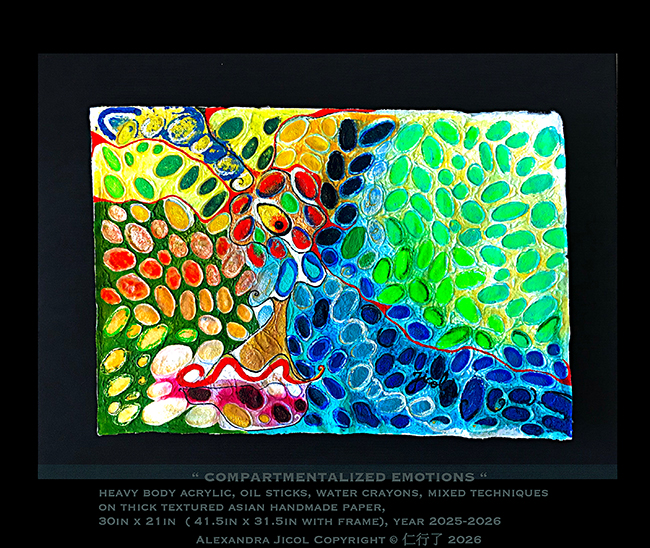
Her painting “Compartmentalized Emotions” (2025–2026) reflects her current focus. Using heavy body acrylic, oil sticks, water crayons, and mixed techniques on thick Asian handmade paper, she builds a surface that records each step. The texture is present. Nothing is overly polished. You can trace where marks overlap and where colors meet or resist one another. The painting shows its history.
The title points to a familiar human habit: placing feelings into separate boxes so daily life can move forward. Jicol turns that mental process into imagery. Sections of color read like containers. Some appear sealed, others fractured. Fragments of words rest beneath layers of pigment, partly hidden. They echo the thoughts people try to push aside but that remain underneath.
Thin red lines move across the composition like threads. They hint at emotional traces that linger. Still, the painting is not fixed in heaviness. Jicol speaks about hope, passion, and generosity as what endures. That mood appears in lighter passages where color opens up. The work does not try to tidy emotion into conclusions. It accepts that feelings overlap, blur, and remain unfinished.
Her decision to sell only originals connects to this idea. Each painting exists as a single record of a moment and cannot be duplicated. Even her note that colors change under different lighting adds to the meaning. Perception shifts. What we see depends on context, just as emotions do.
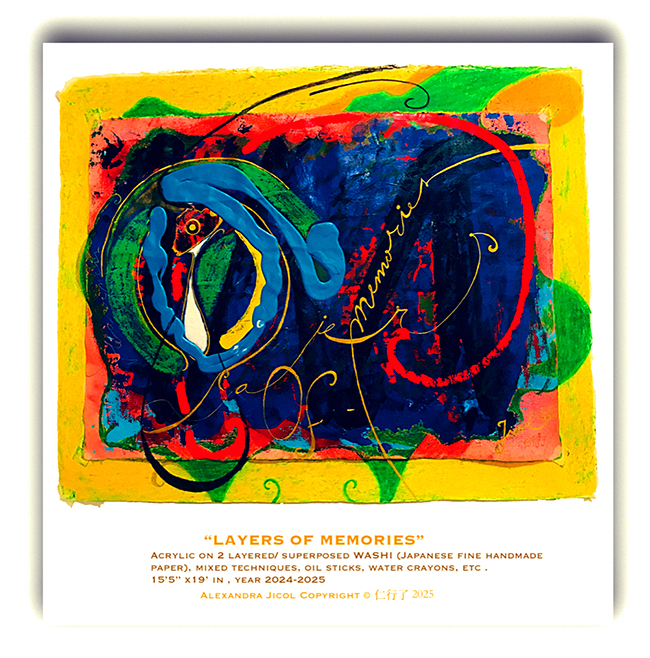
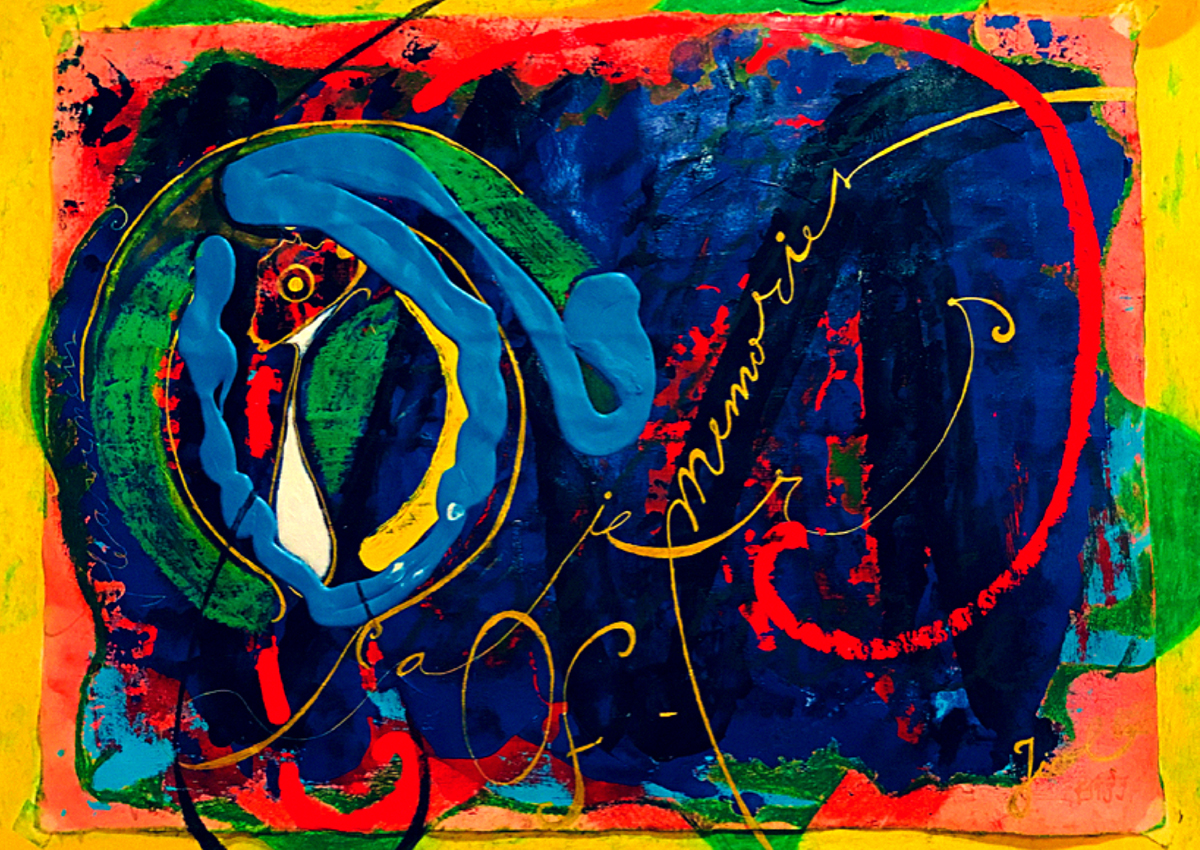
If “Compartmentalized Emotions” is about sorting and containing, “Layers Of Memories” (2024–2025) is about buildup. Created on two sheets of Japanese handmade paper placed together, again with acrylic, oil sticks, and water crayons, the piece reflects how memory gathers over time. Nothing fully disappears; it is covered, softened, or reworked.
Jicol speaks of memories that range from grief to tenderness, from trust to longing. This range shows in the painting’s movement between dense and open areas. Some sections feel weighted with pigment; others breathe. The double layers of paper act as a quiet metaphor. One layer supports the other, much like earlier experiences support who we become.
There is also the sense of sudden return. Memory can arrive without warning. A hue, a surface, or a faint word can pull someone back. Jicol keeps her imagery abstract rather than narrative. She does not assign fixed stories. This openness lets viewers attach their own recollections. The painting becomes a meeting place for shared human experience rather than a single autobiography.
In both pieces, process holds equal importance to the finished image. Mixed media allows revision. A mark can disappear and later reappear at the edge. This mirrors how people revisit and rethink their own histories. Handmade paper adds delicacy and touch. Pigment sinks in differently, creating depth without gloss.
Jicol often speaks of herself as an observer—someone who watches, listens, and absorbs without quick judgment. That stance carries into the work. The paintings do not tell viewers what to feel. They present emotional terrain and allow quiet exploration.
Her palette also shows restraint. Even when color grows richer, it does not overwhelm. It settles. This invites slower looking. Viewers can remain with the painting and notice gradual shifts instead of taking everything in at once.
At its core, Jicol’s art returns to a direct idea: facing the inner world with honesty. Feelings organized or tangled. Memories light or heavy. Moments of connection and distance happening side by side. Her paintings do not offer tidy endings. They offer recognition. And within that recognition, viewers may discover parts of their own stories, layered softly across the surface.
