
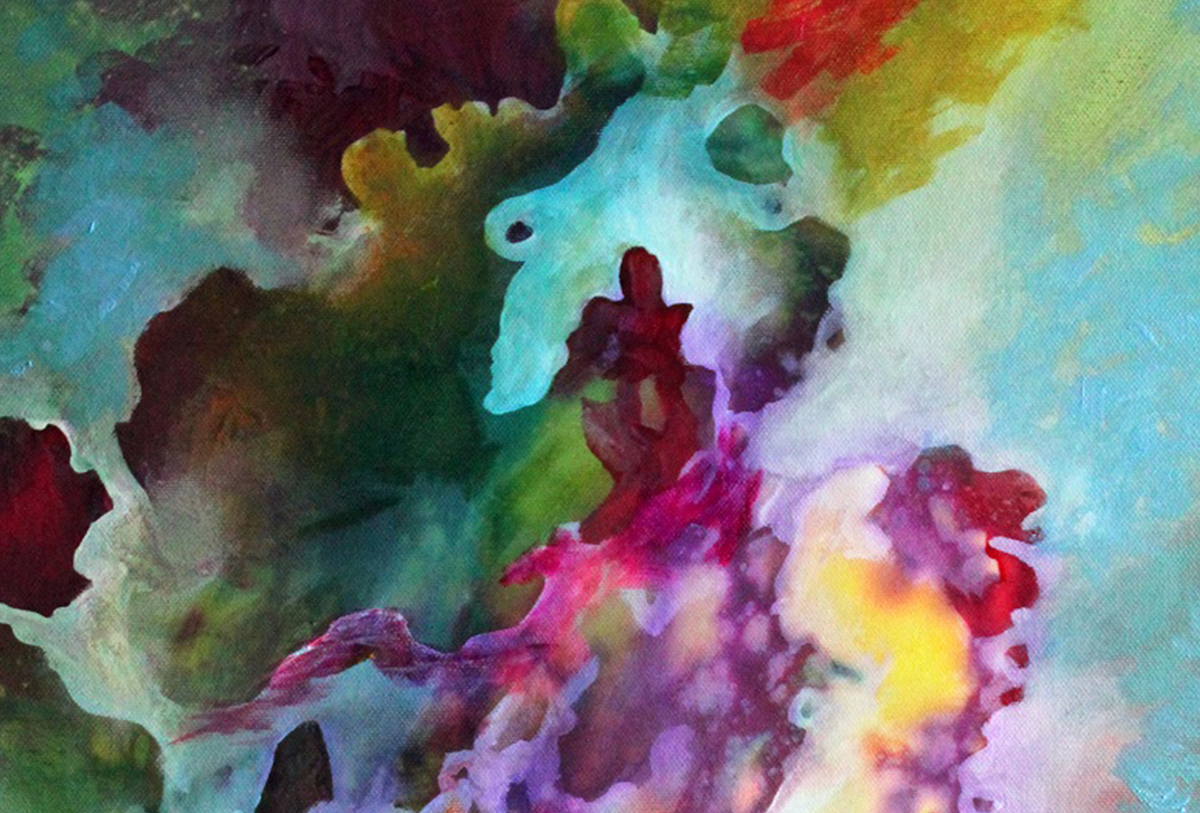
Eliora Bousquet, a French-listed abstract painter and illustrator, paints at the threshold between emotion and infinity. Born in Angoulême, France, in 1970, she began her artistic path in 2009—a late start that reads less like delay and more like arrival. Her practice is guided by intuition, wonder, and a steady fascination with the night sky’s quiet rhythm. Nature and cosmos sit side by side in her work, not as separate subjects, but as two ways of describing the same pulse: growth, drift, brightness, disappearance, return. Each canvas feels like a meeting point between heaven and earth, where color becomes language and silence becomes meaning. Eliora isn’t trying to record what the eye can name. She is trying to surface what the body already knows—those wordless shifts in mood and awe that happen when you look up, look out, or look inward and realize the world is much larger than your daily frame.
Bousquet’s paintings often behave like weather systems. They don’t “compose” in a rigid, architectural way; they gather, spread, thin out, and concentrate again. The sensation is immersive. You’re not standing in front of a picture of something—you’re standing in front of a field of energy that keeps changing depending on where your eyes land. Her surfaces hold soft veils and sudden blooms. Edges dissolve. Colors bleed and then snap into focus. It’s the kind of abstraction that doesn’t ask you to decode a hidden message; it asks you to notice what your own mind does when certainty disappears.
Even when the palette is bright, there’s an undertow of depth. Bousquet uses luminosity the way some painters use line: as a structure. Light isn’t just highlight; it’s a pressure point that steers the whole painting. In these new works, light appears in multiple forms—glowing cores, misty halos, and spark-like flecks that feel suspended rather than placed. That quality gives the paintings an almost cosmic scale, as if you’re seeing both a close-up and a far-away view at once: cell and nebula, tide pool and galaxy.
Taken together, the three new paintings read like a small suite about formation—how things come into being, how they hold, and how they slip back into flux.
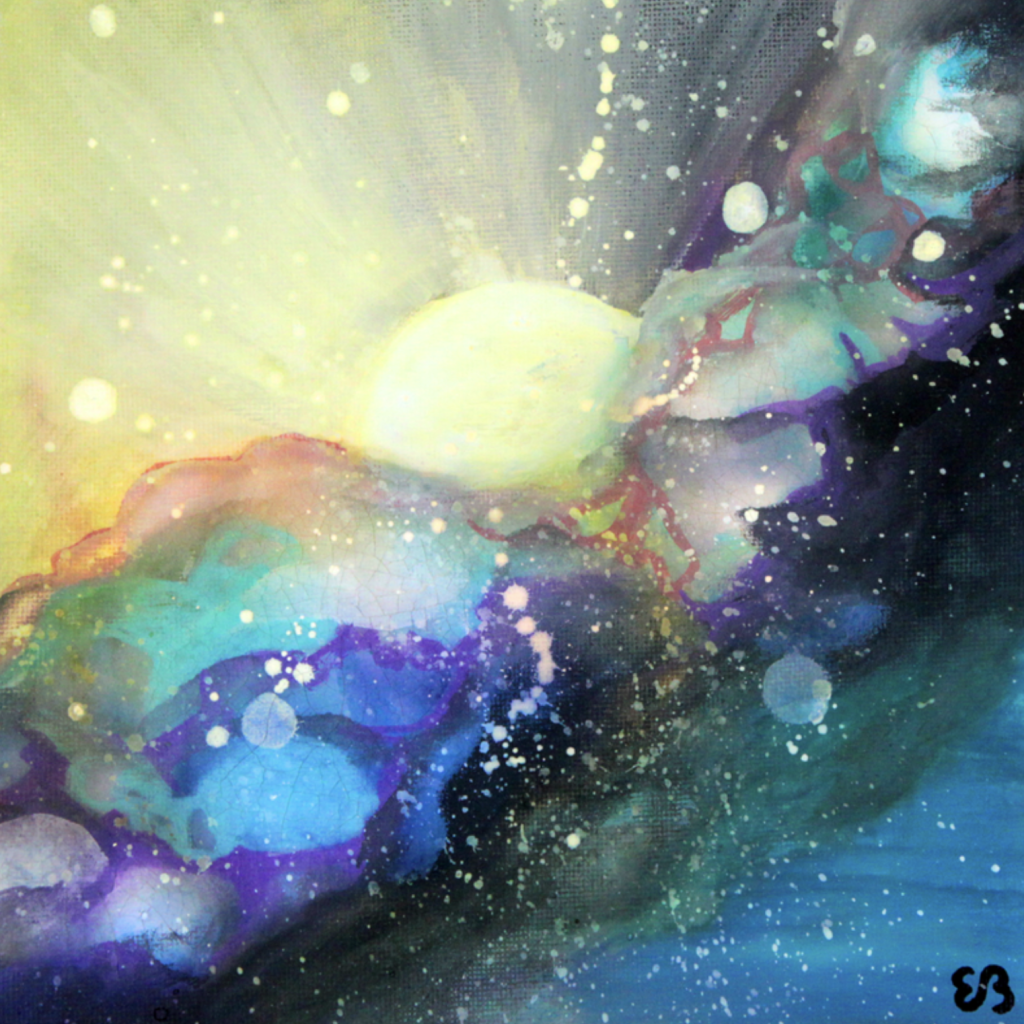
This piece opens with a warm radiance that feels like sunrise filtered through mist. A pale, moon-like glow sits near the center, surrounded by layered blues and purples that pool and shift like deep water. The surface is animated by scattered specks—some like drifting pollen, some like stars, some like spray kicked up by movement. That constellation of marks does something important: it breaks the calm without destroying it. The painting holds both tenderness and motion. The left side glows with a soft yellow-green atmosphere, while the right side deepens into darker blues and charcoal tones, as if the painting is turning from day toward night. There’s also a subtle sense of topography—rounded forms that stack and overlap like underwater rocks or cloud banks. You can read it as a landscape, but it refuses to settle into one place. It’s more like a memory of light hitting a surface than a fixed scene.
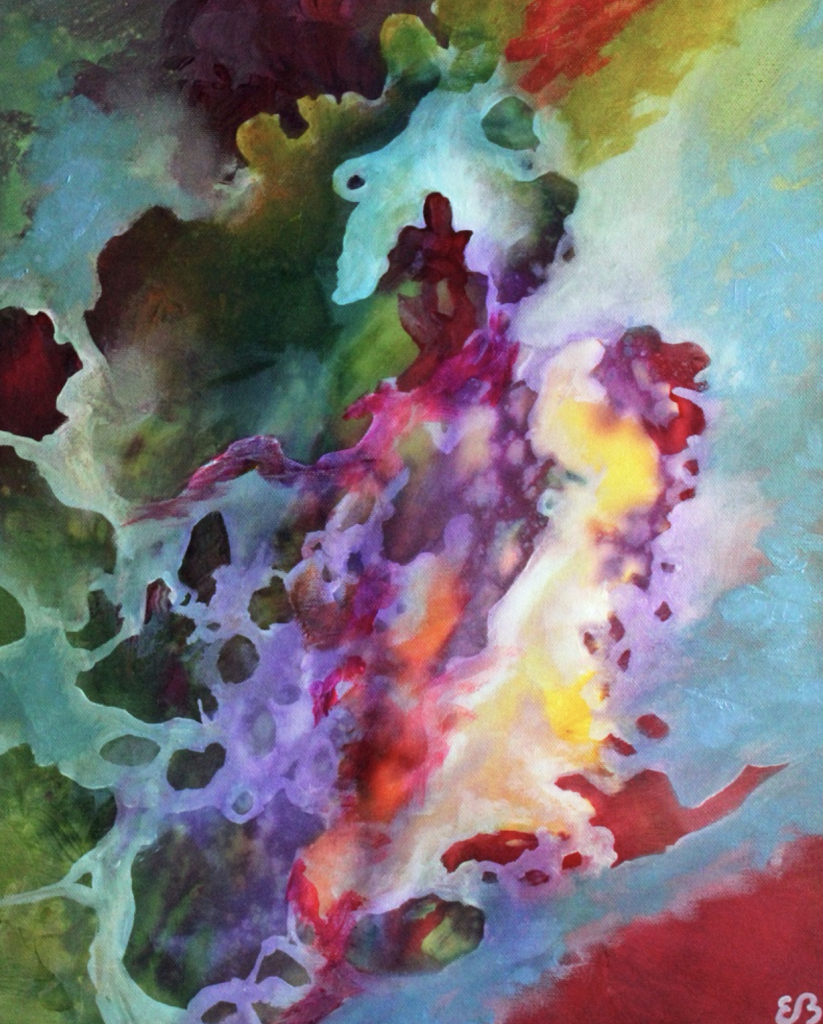
Work 2
Here the mood changes. The painting feels more organic, more turbulent, and more bodily. Saturated reds, magentas, violets, and amber heat appear within a cooler field of aquas and sea-greens. The forms suggest coral, reef, or a blooming mineral deposit—something alive and vulnerable, but also resilient. Negative spaces open like pockets and caverns, and the paint seems to have eaten its way through the surface in lace-like patterns. The result is both beautiful and slightly unsettling, like nature seen up close where you can’t pretend it’s only decorative. This work carries the strongest sense of pressure and push-pull: dense areas compacted against airy washes, bright warmth pressing into cool translucence. It’s easy to imagine this as an underwater world, but it also works as a psychological map—emotion gathering in the body, intensifying, then releasing.
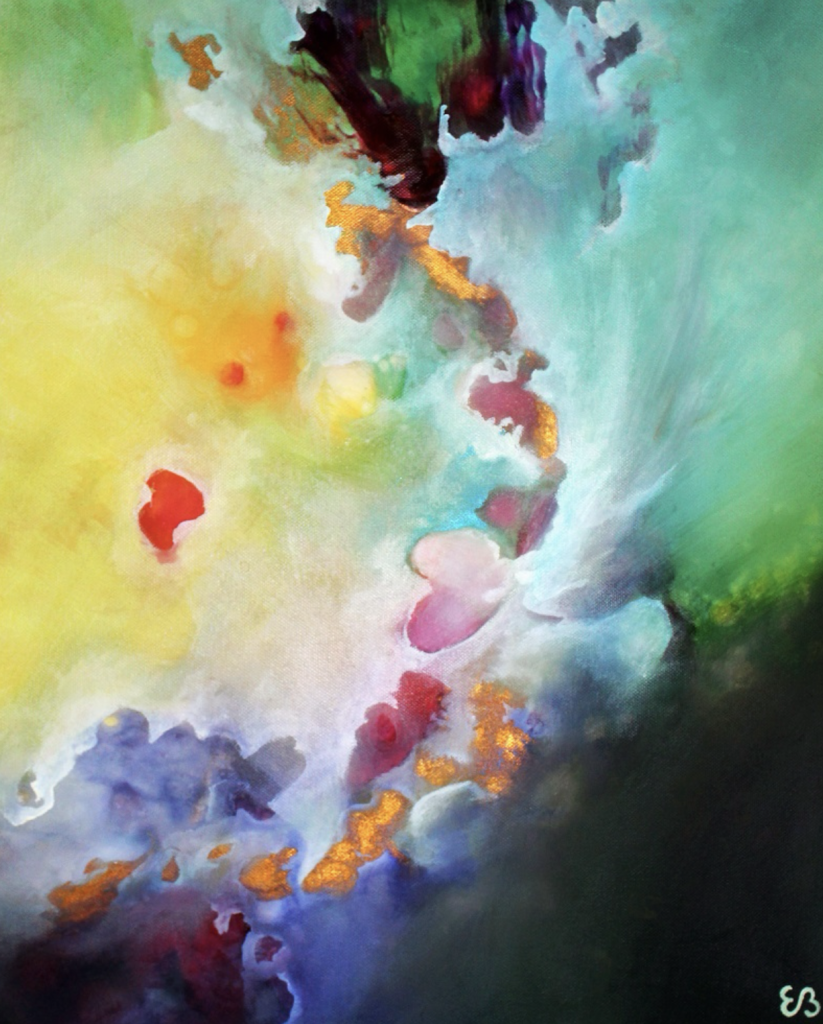
Work 3
This painting feels like a clearing. Where the second piece is dense and reef-like, this one is spacious, airy, and vertical—built around a bright, pale center that reads almost like a portal. A soft yellow glow expands on the left, while the right side drifts into green and teal. Throughout the composition, small, warm metallic accents (golden-orange) appear like sparks or fragments—little reminders of matter inside a mostly atmospheric space. The forms are less “object-like” here and more like passing presences: hints of petals, embers, or drifting organisms. What holds the work together is the way the light seems to breathe. The center isn’t a flat white; it’s layered, clouded, and gently radiant, as if the painting is lit from within. The feeling is quiet but not empty—more like a pause between waves, a moment where the mind stops grasping and simply floats.
Across these three works, Bousquet’s language stays consistent—flowing edges, luminous cores, layered transparencies—yet each painting leans into a different register: cosmic-water calm, organic intensity, and open-air release. That range is part of her strength. She keeps abstraction emotional without turning it into drama. She keeps it spacious without turning it into decoration. And she keeps it mysterious without closing the door on the viewer.
