
Miguel Barros’s work is shaped by distance, movement, and a life lived across cultures. Born in Lisbon in 1962, his path stretches through Portugal, Canada, and Angola, each place leaving its trace on how he constructs images. His move from Angola to Calgary in 2014 introduced a new environment, yet Lisbon remains a constant point of return. With a background in Architecture and Design from IADE in Lisbon, Barros builds his paintings with a sense of structure that feels present but never restrictive. It serves as a foundation rather than a rule. His work unfolds between control and instinct, where geometry meets atmosphere, and where memory becomes something tangible. The result is a body of work that feels grounded yet open, composed yet fluid.
His paintings begin with Lisbon, though not as a literal place. It appears as something internal, shaped by recollection rather than direct observation. The city emerges through fragments—color, rhythm, and layered forms. The word azulejoextends beyond its reference to ceramic tiles and becomes a visual system, a way of organizing space and experience. Alongside it, Azul’Tejo resonates both visually and poetically, connecting the blue of the Tagus River to the broader identity of the city.
Blue plays a central role in his compositions. It is not decorative but structural in its own way. It suggests depth, air, water, and time, stretching across the surface with a sense of continuity. This expansive blue is balanced by warmer tones—reds, oranges, and golds—that anchor the image. These opposing forces create a subtle tension. The viewer senses both stillness and movement, as if the painting is holding two states at once.
While his architectural training is evident, it never dictates the outcome. Instead of presenting clear, fixed perspectives, Barros breaks down structures into vertical and horizontal elements. Lines rise like supports or divisions, organizing the surface into layered segments. These forms suggest buildings, streets, and facades, but they remain unresolved, shifting between recognition and abstraction. The result is a space that feels fluid, where multiple viewpoints coexist.
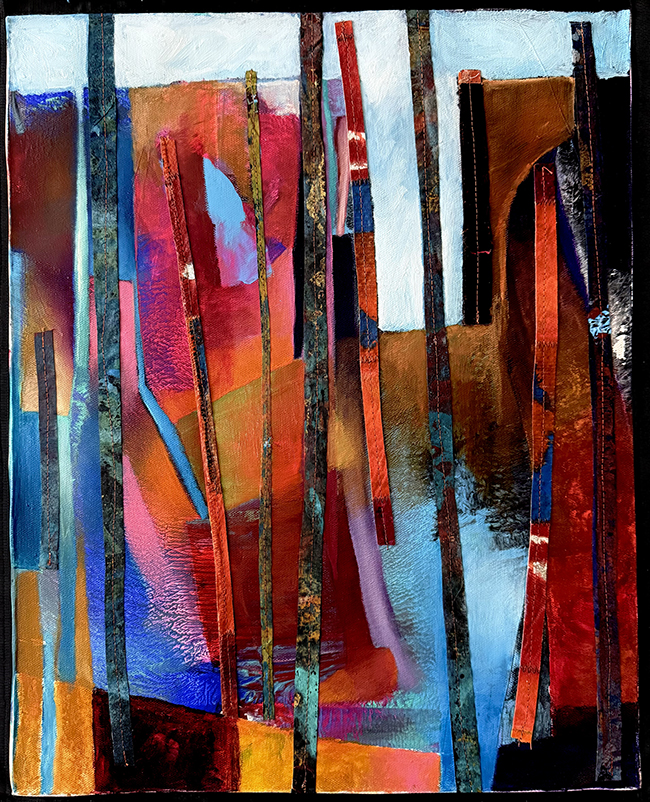
This approach is especially visible in The Old Cathedral of Lisbon. The painting hints at a recognizable structure, with arches and openings that evoke a historical presence. Yet these elements are partially concealed, interrupted by vertical bands that move across the surface. These bands act like moments of interruption, or perhaps like time passing through the image. The cathedral does not stand as a fixed object. It appears instead as something remembered, shaped by distance and feeling.
The surface itself reinforces this idea. Layers of paint overlap and interact, sometimes revealing earlier gestures, sometimes covering them entirely. This layering mirrors the nature of memory—constructed, altered, and reworked over time. The image does not offer a single, stable reading. It asks the viewer to move through it, to piece together fragments rather than rely on clarity.
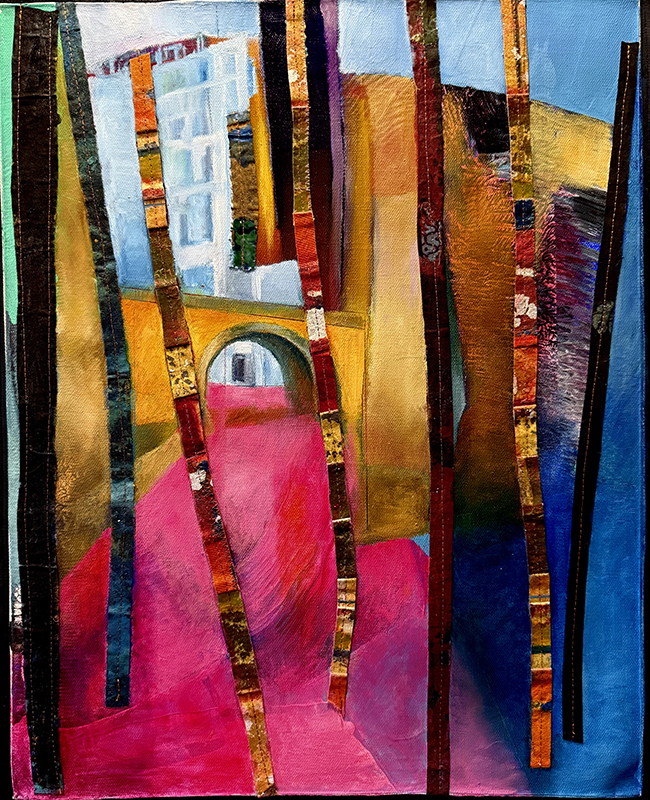
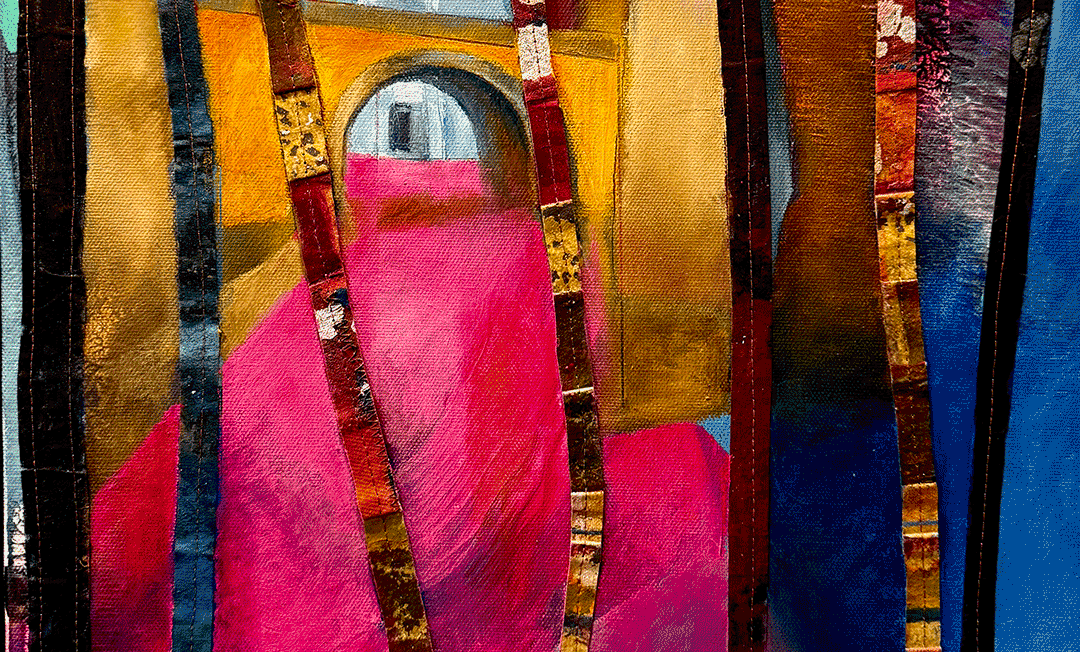
In The Pink Street Lisbon, the atmosphere shifts. The introduction of pink brings a sense of immediacy and warmth. While the structural framework remains, the color changes the emotional tone of the work. The street is not depicted directly but suggested through planes of color and directional movement. The composition draws the viewer inward, creating the sensation of entering the space.
There is a feeling of movement within the painting, as if one is walking through it. Vertical elements continue to divide the surface, acting like markers or passing forms. They create a rhythm that guides the eye, giving the work a steady pulse. The viewer moves between these divisions, navigating a space that feels both constructed and in flux.
Across both paintings, Barros presents the city as something alive. It is not a static arrangement of buildings but a surface that responds to light, memory, and presence. Lisbon becomes an environment that continues to shift, where every wall and passage contributes to a larger whole. The paintings reflect this by avoiding a single focal point. Instead, they invite the eye to travel, discovering connections between color, line, and form.
A sense of longing runs quietly through the work. The city is not physically present, yet it remains close. This distance sharpens the emotional clarity of the paintings. Details are reduced, but what remains carries more weight. The work does not aim to replicate the city. It seeks to hold onto its essence.
Barros operates in the space between abstraction and recognition. The viewer may not immediately identify specific places, but there is a familiarity that persists. This balance allows the work to function on multiple levels. It can be read as an exploration of color and structure, or as a reflection on place and memory.
Ultimately, his Lisbon is not fixed. It continues to shift, shaped by recollection and reinterpretation. Through layered surfaces, shifting lines, and carefully balanced color, Barros turns the city into an internal landscape—one that can be revisited, reshaped, and experienced anew each time.
