
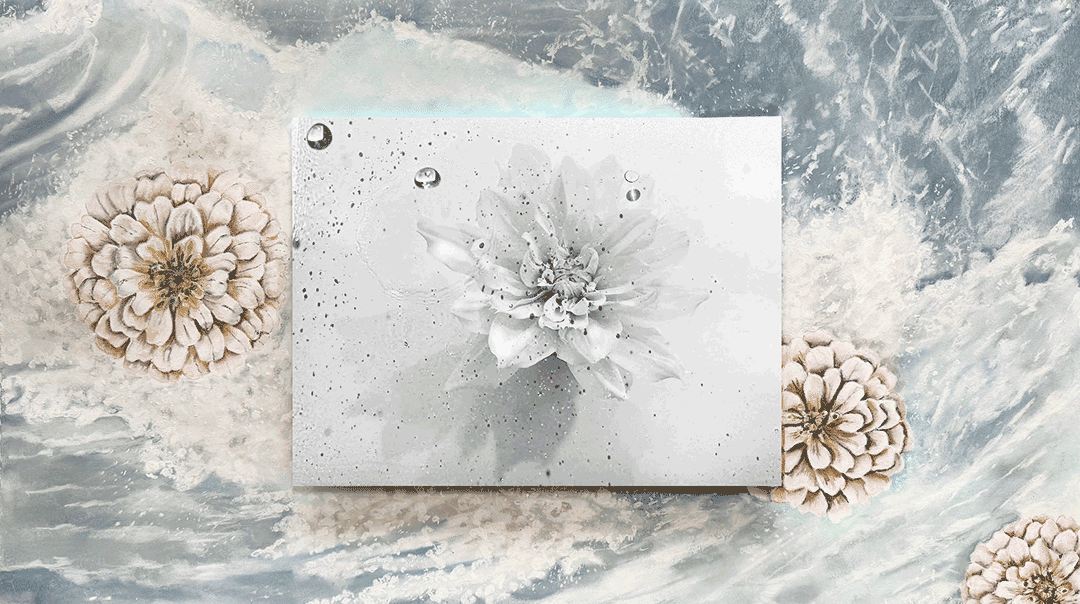
Nancy Staub Laughlin works across pastel and photography, allowing the two to merge into a single visual language. Based in the United States, she earned her BFA from Moore College of Art in Philadelphia, a background that continues to influence how she approaches composition and surface. Her work has been shown in galleries and museums along the East Coast and is held in both private and corporate collections. Critics, including Sam Hunter, have recognized her work for its distinct character. That sense of distinction comes from how her images avoid clear classification. Rather than separating photography from drawing, or observation from invention, Laughlin brings them together, shaping images that feel both constructed and intuitive.
In her recent works, The Floriferous Tides of Froth and The Blooming of Froth, water becomes the foundation of the composition. The ocean is not treated as a passive backdrop. It shifts, moves, and carries the structure of the image. Waves stretch across the surface, breaking apart and reforming, creating a steady rhythm that directs the viewer’s attention. Nothing feels fixed. The surface remains in motion, as if the image itself is still unfolding.
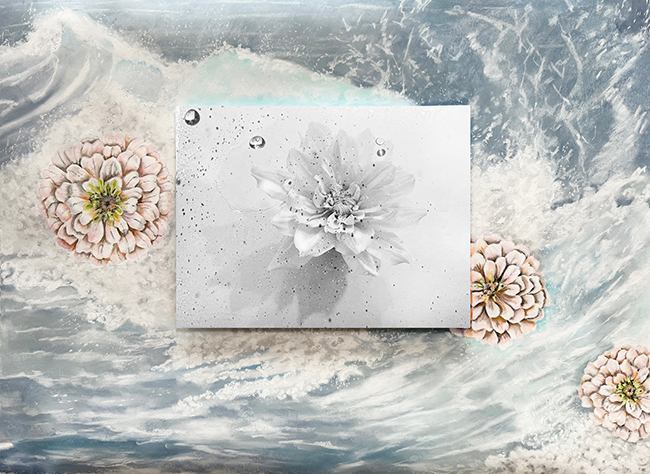
Within that movement, floral forms begin to appear. These flowers are not placed on top of the scene. They seem to rise from within it, shaped by the same force that drives the water. In The Floriferous Tides of Froth, a central bloom appears in grayscale, hovering slightly apart from the surrounding color. It feels suspended, yet still connected through texture. Around it, softer flowers echo its form, creating a sense of repetition without exact duplication. The contrast between the monochrome center and the muted tones around it directs the eye, offering a moment of stillness within the shifting surface.
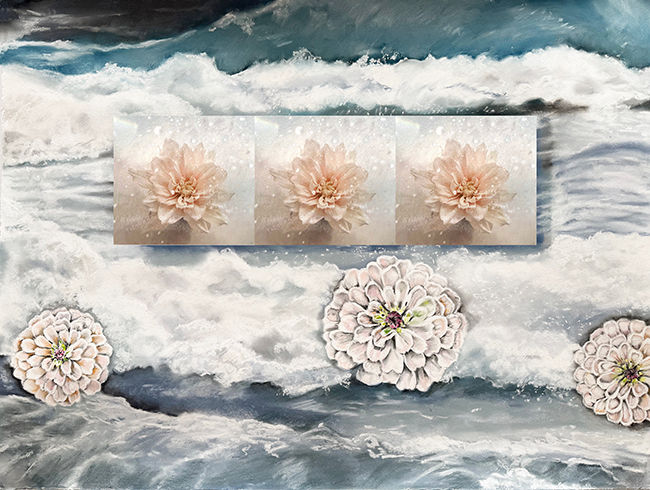
In The Blooming of Froth, the structure opens up. Instead of a single focal point, three flowers stretch across the center, forming a horizontal sequence. This interrupts the vertical movement of the waves and changes how the image is read. The viewer’s eye moves from side to side, following the repetition, before returning to the motion of the water behind it. The palette here feels warmer, but the connection to movement remains. The flowers are not static forms. They carry the same sense of energy as the ocean, as if they are part of its continuous flow.
The combination of pastel with mounted photography is central to how these works function. The photographic layer provides a sense of depth and familiarity, anchoring the image in something recognizable. Over that, pastel softens the surface, adding atmosphere and a physical presence. The result is a layered image where light feels embedded rather than reflected. Some areas remain clear, while others dissolve into texture, creating a balance between definition and ambiguity.
Space within the work is handled in a way that creates subtle tension. The ocean suggests depth and openness, extending beyond the edges of the composition. The flowers, by contrast, often feel closer to the surface, slightly flattened or compressed. This difference creates a push and pull between depth and surface. The viewer is held between these two conditions, never fully settling into one. That tension contributes to the sense of motion that runs through the work, even when the image appears still.
Rather than telling a direct story, Laughlin builds atmosphere. The repetition of forms, the layering of materials, and the contrast between control and fluidity create a mood that unfolds gradually. There is a sense of calm in the color palette, but it is balanced by an underlying movement that never fully stops. The ocean can feel quiet or restless at the same time. The flowers, often linked to stillness, shift into something more active, becoming part of the same continuous motion.
Her work rewards patience. It does not reveal itself immediately. Instead, it invites the viewer to spend time with it, to notice the small shifts in color, texture, and form. As these details begin to connect, the initial contrast between elements softens. Water and flower, stillness and motion, photography and pastel begin to work together as one.
Through these works, Nancy Staub Laughlin does not attempt to replicate the natural world. She reconfigures it, allowing its elements to merge and transform. What emerges feels both recognizable and reimagined, grounded in what we know, yet shaped by a different way of seeing.
