
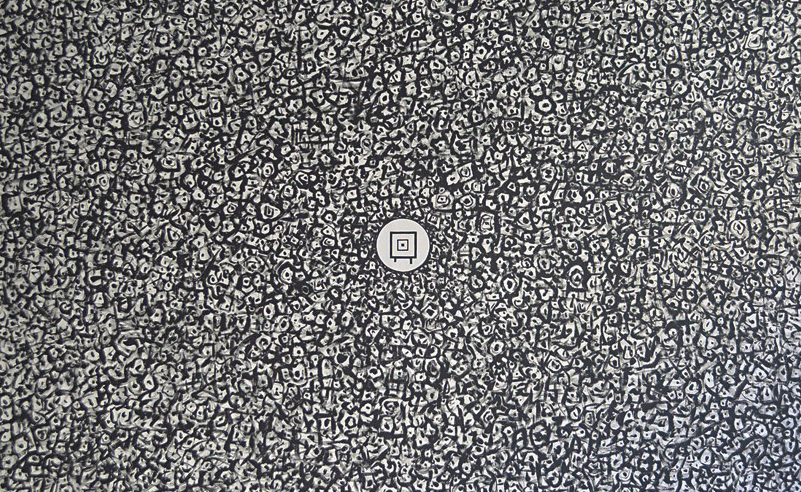
Nicola Mastroserio isn’t chasing what’s fashionable. His studio isn’t a response to the market, and his choices don’t pivot around what might sell. Instead, his practice turns inward—toward questions that don’t move on a seasonal calendar. He treats art as a kind of inquiry: not a mirror for appearances, but a method for approaching what sits underneath them. What matters in his work is essence—how reality is built, how it’s felt, and how it might be understood beyond the surface of daily life.
That inward focus gives his art a particular stance. It’s reflective without being distant, philosophical without becoming academic. Mastroserio’s images suggest that life is shaped by hidden forces—structures of thought, sensation, and intelligence that organize what we call “real.” His paintings become steady meditations on existence: what it means to be here, to think, to sense, and to search for the deeper logic moving through the world.
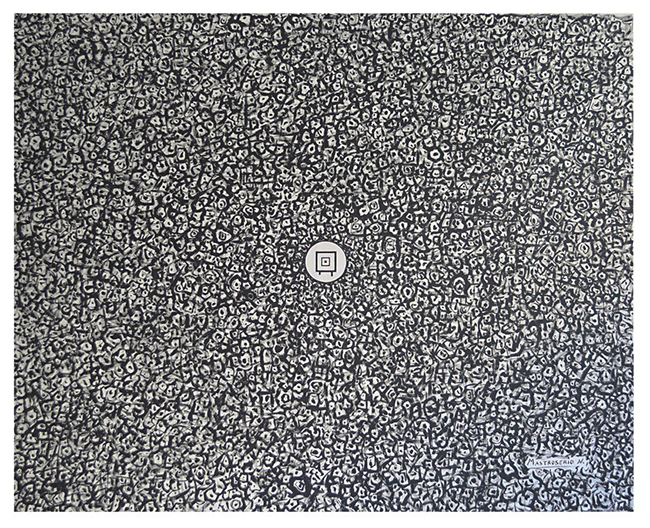
Esse Thesis (146 x 182 cm)
In Esse Thesis, Nicola Mastroserio sets out to picture an idea that is both conceptual and intimate: the origin-pattern of life itself. The work is presented as a representation of “Cellulism” (Cellulismo), an existentialist theory he has developed through study, observation, and intuition—an attempt to understand what generates life and how life generates worlds. Rather than treating life as a biological accident or a mechanical sequence, Cellulism positions life as a formative intelligence: something that shapes matter and non-matter according to a shared internal thought.
This is the key premise Esse Thesis asks the viewer to sit with. If matter and non-matter can be shaped by the same living principle, then reality isn’t split cleanly into the physical and the spiritual. It becomes one continuum—different densities, different modes, but one originating impulse. In that sense, Mastroserio isn’t painting a “scene.” He’s mapping a structure. The canvas becomes a field where physical intelligence, ultra-physical intelligence, and spiritual intelligence can be imagined as variations of the same generative source.
At the center of the work, he places what he identifies as the Universal Symbol of Life, depicted as the origin of all created things. This center functions like a nucleus—visually and philosophically. It suggests that creation begins with a single organizing mark or principle, and that everything else radiates outward from that core. Even without adopting the full framework of Cellulism, the viewer can feel what that central placement implies: an insistence on origin, on beginnings, on the possibility that the universe has a readable grammar.
Because the painting operates as a thesis, it also operates as an invitation. It asks the viewer to consider reality not as a fixed fact, but as a living system that can be understood—and perhaps influenced—through awareness. Mastroserio’s language around the work makes this explicit. His goal is not only to “know” created things, but to use that knowledge “for the benefit of all human beings.” That aspiration shifts the painting from private philosophy to public intention. Esse Thesis isn’t only a personal worldview made visible; it’s proposed as a foundation that could be shared.
A major thread in his research is the tension between what divides us and what unites us. He frames this in terms of the “limits imposed by life” and the strategies human beings can implement to live well—specifically, to achieve longevity, happiness, and a fuller manifestation of individual potential within a complex social organism. In this framing, society becomes almost cellular: many parts, one body; many individuals, one system. The implication is that the health of the whole is inseparable from the health of its parts, and that understanding the principles of life might change how we treat one another.
Esse Thesis also carries a clear ethical horizon. Mastroserio describes his research as a gift offered to humanity for “a prosperous and wonderful future,” and he links this knowledge directly to a possible process of world peace—achieved through love and fraternity among human beings and “evolved cosmic entities.” Whether one reads that cosmology literally or symbolically, the direction is unmistakable: he is aiming at unity, at a widening of empathy, at a future where human conflict is not treated as inevitable.
This is where the painting’s scale matters. At 146 x 182 cm, the work is large enough to feel environmental—something you face rather than simply view. That physical encounter supports the work’s ambition: it wants to be more than an image. It wants to function like a diagram, a portal, a proposition. The viewer stands before it as if before a model—one that suggests the universe is not only vast, but structured; not only mysterious, but also, in some way, comprehensible.
Mastroserio’s framework continues to expand through symbols. From Cellulism, he identifies two distinct emblems: the Universal Symbol of Life (2012) and the Universal Symbol of Love (2025). Placed alongside each other, those dates suggest a long arc—more than a decade of building, refining, and pushing his thinking forward. In that span, love isn’t treated as separate from life, but as a necessary consequence of understanding life correctly. If life is the originating intelligence, love becomes the relational intelligence—the force that makes coexistence possible.
Ultimately, Esse Thesis is best approached as a painted philosophy: a work that proposes a living order beneath the everyday, and a path from insight to ethics. It asks what life is made of, what intelligence might mean beyond the brain, and how a clearer understanding of existence could affect the way we live together. Mastroserio isn’t offering a decorative statement or a market-friendly motif. He’s offering a system—an inquiry—set into visual form. And by doing so, he positions art not as commentary on life, but as one of the tools through which life might be understood, and, in time, improved.
