
Sebastian Di Mauro’s work begins from a place of displacement. Born in Australia and later relocating to the United States, he entered a cultural landscape that felt both recognizable and unfamiliar. The America he had absorbed through film and television—constructed through distance—shifted when encountered directly. Living alongside a partner connected to Wilmington, Delaware, he moved between two understandings of place: one imagined, the other lived. That tension continues to shape how he approaches image and material.
Rather than treating identity as stable, Di Mauro works through its instability. His practice reflects movement, contradiction, and the layering of experience over time. This is evident in his choice of materials. Found textiles, pre-existing imagery, and stitched additions form the basis of his process. These surfaces already carry meaning before he begins. His role is not to erase that meaning, but to interrupt and reshape it. In doing so, memory and place are not simply represented. They are questioned and reassembled.
A quiet tension runs through his work. What appears on the surface is only part of the image. Beneath it sits another structure, one that becomes visible through intervention. Found tapestries play a central role. Often depicting pastoral or historical scenes, they arrive with a sense of completion, as though their narratives have already been settled. Di Mauro does not accept that finality. Through stitching, he reopens these images, allowing them to shift.
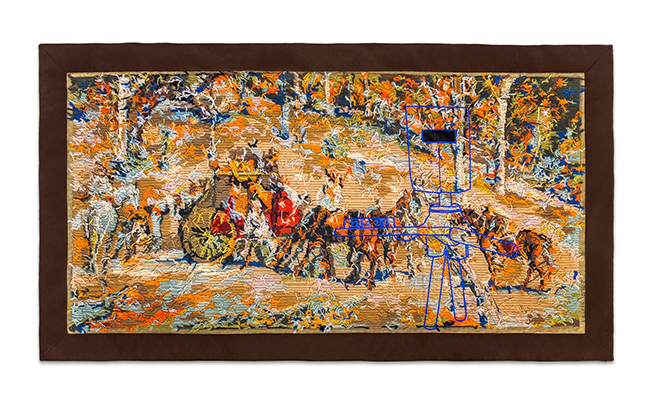
In Bolters (2026), this process engages directly with Australian history. The work is built from a found tapestry printed on Twill Waratah textile, framed by a green felt border and altered through hand-stitched blended yarn. The original scene suggests a familiar moment: bushrangers intercepting a stagecoach. The reference to Tom Roberts’ Bailed Up (1895) is clear, yet it is not treated as something fixed. Instead, it becomes material to work through.
At the center of this altered scene, a new element appears. Ned Kelly is introduced, but not in a conventional form. He takes shape as a letterbox made from scrap metal, marked with the house numbers of two rural homes in the Northern Highlands of New South Wales. The gesture feels grounded in lived experience, as if discovered rather than invented. At the same time, it carries the weight of a national symbol.
This shift changes how Kelly is understood. Rather than existing as a distant historical outlaw, he becomes part of an everyday setting. The letterbox is functional, ordinary, and easily overlooked. By inserting it into the composition, Di Mauro brings myth into proximity with daily life. The separation between past and present begins to collapse. What once belonged to history is now embedded within the familiar.
The stitching reinforces this transformation. It moves visibly across the surface, never attempting to disappear. Each thread marks a point of intervention, introducing another layer of authorship. The original tapestry remains intact, but its stability is disrupted. It is no longer a closed image. Instead, it becomes something open, subject to revision. Bolters shifts away from simply recalling a historical scene and moves toward examining how such images continue to circulate and evolve.
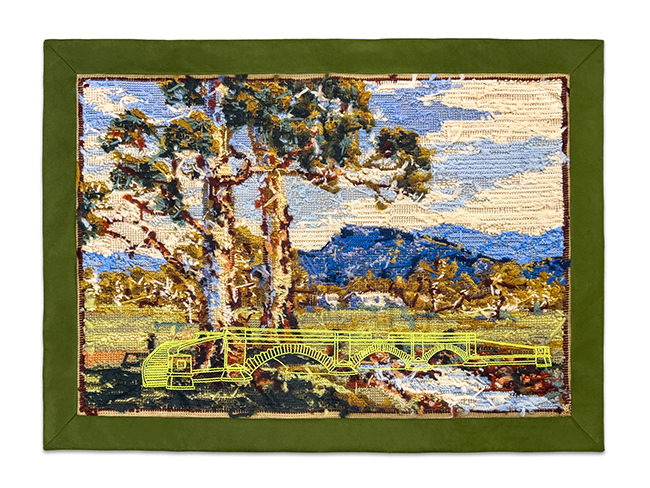
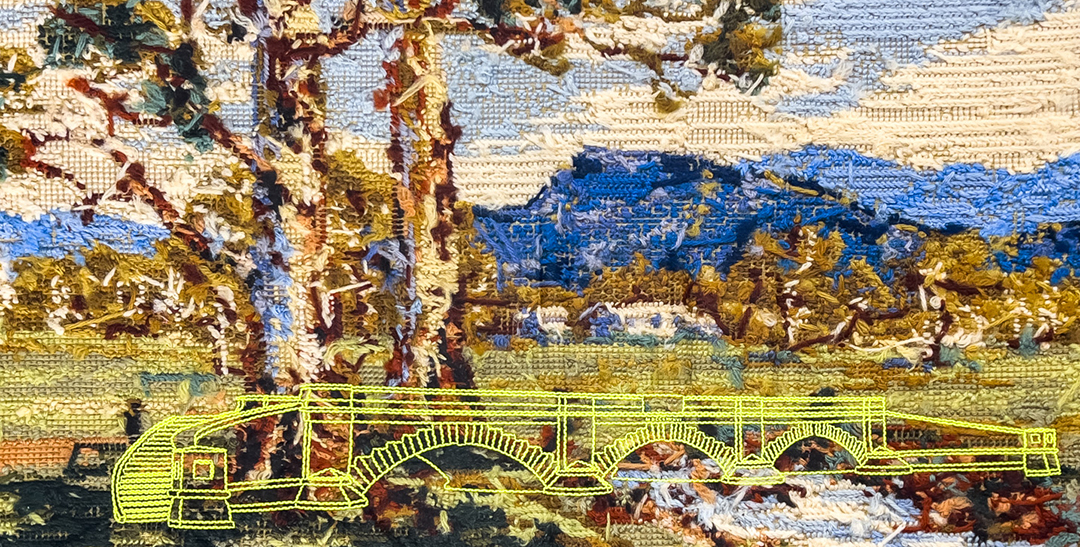
In Abridged Landscape (2026), Di Mauro turns toward what is left out rather than what is remembered. The work begins with the reverse side of a traditional landscape tapestry, printed onto fabric. This choice is significant. The back of the tapestry exposes its structure—the threads, the labor, the underlying system that supports the image. What is usually hidden is brought forward.
Onto this surface, he stitches the form of the Ross Bridge in Tasmania. The bridge carries a specific history, built through the labor of convicts. This reality stands in contrast to the calm, idealized landscapes often depicted in such tapestries. Where the original image suggests harmony, the stitched addition introduces a more complicated narrative.
Here, stitching functions as a form of return. It does not erase the existing image, but it insists on another layer. The bridge takes shape gradually, constructed through thread rather than painted illusion. This slows the act of looking. Attention shifts from what is depicted to how it is constructed, and to what has been omitted.
Abridged Landscape draws attention to the gaps within representations of place. Landscapes that appear serene often rest on histories that remain unspoken. By bringing the Ross Bridge into view, Di Mauro points toward systems of labor and control that underpin colonial settlement. The work does not dramatize these histories. Instead, it allows them to surface through material and process.
Across both works, a consistent method emerges. Di Mauro does not begin with a blank surface. He starts with images that already exist—textiles, scenes, fragments of visual culture—and works into them. This approach reflects his broader engagement with memory and identity. Just as his own experience moves between locations and perspectives, his works exist between states. They are neither entirely new nor entirely inherited.
What results is a practice that resists closure. The surfaces remain layered and unsettled, open to multiple readings. History is not presented as fixed. It is something that can be revisited, adjusted, and rethought. Through stitching, layering, and recontextualizing, Di Mauro creates works where different timelines coexist, allowing past and present to remain in continuous exchange.
