
Carolin Rechberg is a multidisciplinary artist whose work emerges from the meeting point of substance, perception, and thought. Raised in Starnberg, Germany, she navigates effortlessly between numerous forms of expression, from ceramics and drawing to installation, painting, performance, printmaking, photography, poetry, sculpture, sound, textiles, and voice. Rather than aligning herself with a single discipline, she treats art as an open field of exploration—one guided by physical engagement, rhythm, and sensory awareness. For Rechberg, creation is not merely a route toward a finished object; the act of making itself holds profound significance. Her approach is deeply embodied and immersive, activating touch, movement, and intuition. Through this holistic process, she investigates states of transition, fragility, and regeneration. Each piece becomes more than a visual artifact; it evolves into an encounter—an invitation for viewers to experience internal shifts, heightened awareness, and personal reflection.
A Fountain of Life (2026)
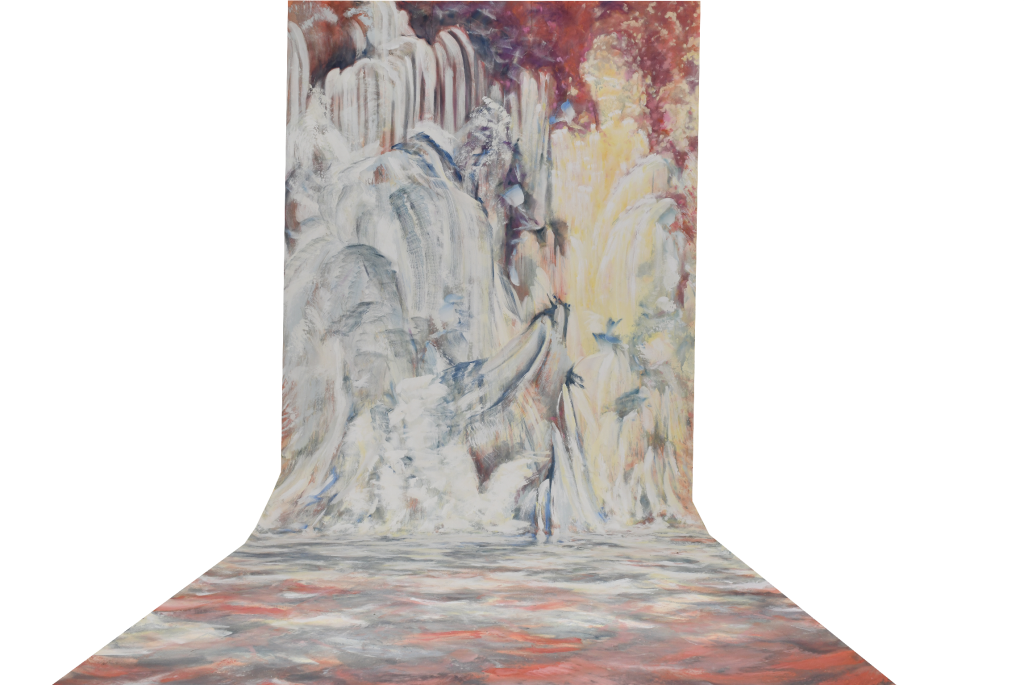
Mixed Media on Canvas
H 265 cm × W 211 cm × D 208 cm
With A Fountain of Life, Rechberg constructs a work that transcends the limits of traditional painting. Towering at over two and a half meters, the piece commands space with near-sculptural authority. The canvas does not remain confined to the wall; instead, it spills forward onto the floor, softening the boundary between upright surface and ground plane. This spatial expansion transforms the painting into an enveloping installation, encouraging viewers to step into its presence rather than simply stand before it.
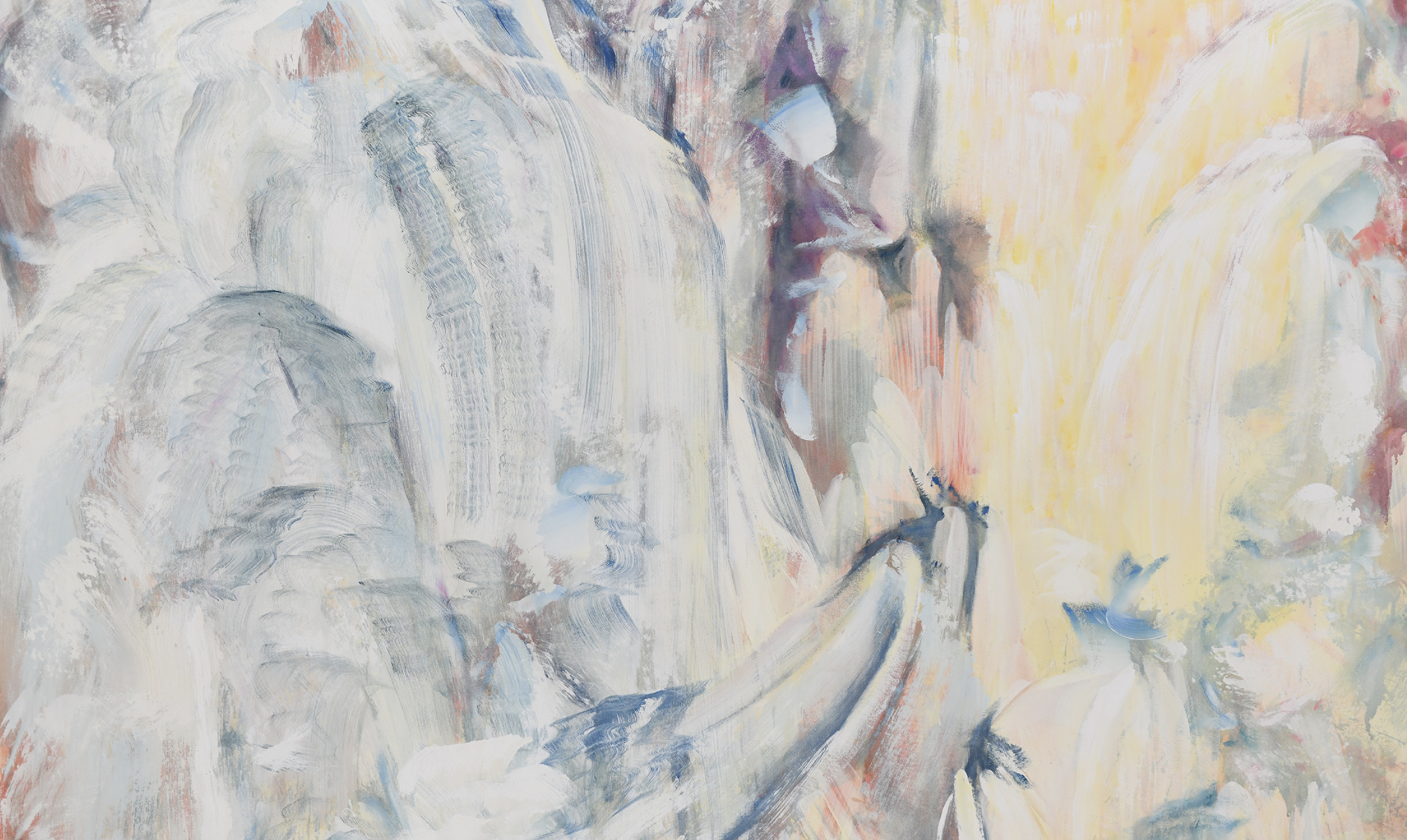
Visually, the composition evokes the force of a waterfall or a cascade of luminous energy pouring downward from a blazing canopy of color. The upper region radiates in saturated reds, oranges, and yellows, conjuring sensations of warmth, combustion, and vitality. As the eye travels downward, the palette cools into whites, greys, and subdued blues, creating a dialogue between fervor and calm. Broad, expressive gestures and layered textures animate the surface, suggesting movement, gravity, and the continuous pull of flow. Paint appears to surge and dissolve at once, echoing the vitality implied in the title.
The imagery of falling water carries dual associations—destruction and sustenance intertwined. While the torrent appears forceful, even overwhelming, it also nourishes and replenishes. Near the base, color disperses into a reflective, pool-like expanse, reinforcing a sense of cyclical continuity. The viewer’s gaze follows the downward rush, only to be drawn back upward toward the glowing source, enacting a visual rhythm of descent and return.
Rechberg’s interdisciplinary background informs her handling of both material and space. The canvas behaves less like a flat support and more like a performative element. Its extension onto the floor enhances the sensation of immersion; one can almost feel the weight of cascading water and the shimmer of refracted light. The experience becomes bodily as much as visual. Rather than presenting a static scene, the work generates an atmosphere—an environment shaped by motion and energy.
On a metaphorical level, A Fountain of Life reflects themes of renewal and awakening. The transition from blazing intensity to reflective stillness may be understood as a journey from turmoil to clarity, from raw force to integration. It suggests a generative source that continuously feeds lived experience. In this sense, the painting embodies Rechberg’s commitment to art as an ongoing process—fluid, dynamic, and perpetually unfolding. The viewer is not separate from this current but implicated within it, participating in the exchange between color, motion, and space.
The Dying and Ascending Self / Shedding Skins to Rise to Life (2024)
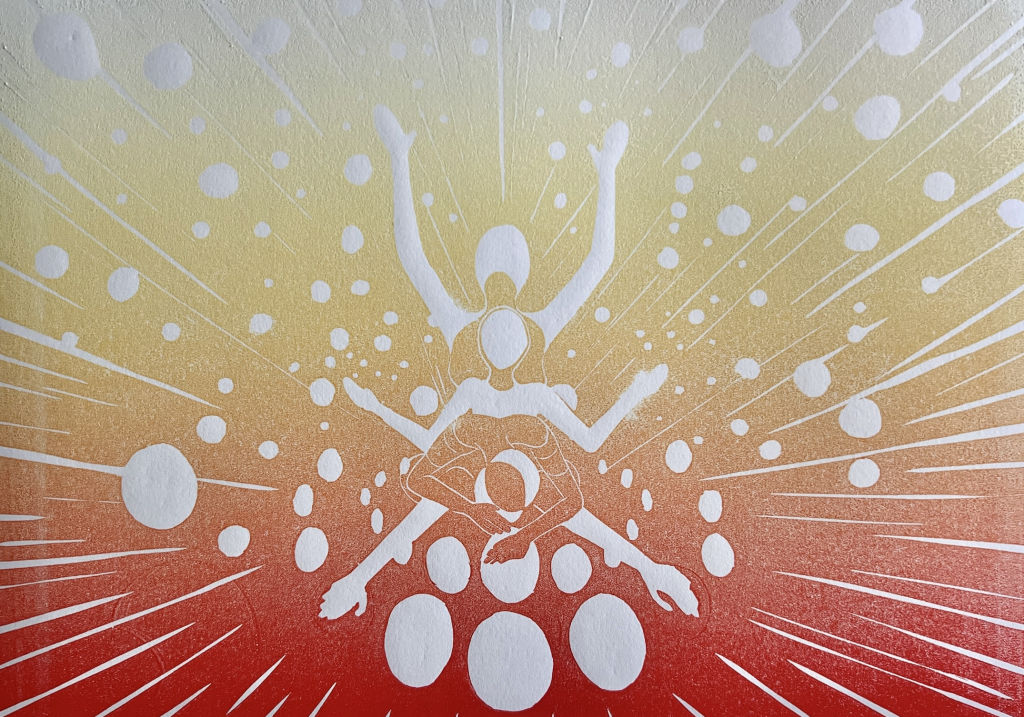
AP Linocut Color Print on Paper
42 × 30 cm
While A Fountain of Life occupies space on a monumental scale, The Dying and Ascending Self / Shedding Skins to Rise to Life distills similar concerns into the concentrated language of print. Modest in size yet conceptually expansive, the linocut offers an intimate meditation on personal transformation.
The composition centers on a stylized human figure, rendered in white against a radiant gradient that shifts from deep crimson at the bottom to luminous gold at the top. The body appears multiplied, with arms extending outward and upward in layered gestures that evoke surrender, emergence, and ascension simultaneously. Surrounding the figure are scattered circular forms—white spheres that may read as cells, planets, or seeds—while sharp, radiating lines amplify the sensation of outward expansion.
The high contrast between the stark silhouette and the warm, glowing background intensifies the visual impact. Stripped of individual features, the figure becomes archetypal—a symbol of the universal human experience. The repetition of limbs implies movement through time, as though successive versions of the self overlap within a single frame. The title’s reference to shedding and rising resonates clearly: identity appears to fragment even as it evolves. The work captures the paradox of transformation—loss and growth occurring in tandem.
The medium itself reinforces the theme. Linocut printing involves carving into a surface, removing material to create an image. This subtractive act mirrors the metaphor of shedding layers to reveal something essential beneath. Each impression carries traces of both precision and variation, embodying repetition infused with subtle difference. The designation as an artist’s proof underscores experimentation and process, aligning with Rechberg’s emphasis on making as an evolving practice.
Where A Fountain of Life externalizes transformation through elemental imagery, The Dying and Ascending Self turns inward. The former immerses the viewer in an expansive, environmental flow; the latter concentrates on the metamorphosis of identity itself. Together, these works illuminate Rechberg’s sustained inquiry into cycles of dissolution and renewal.
Across mediums and scales, Carolin Rechberg examines existence as a continual act of becoming. Whether through sweeping cascades of paint or carved impressions on paper, she articulates the delicate balance between breaking apart and rising anew. Her art encourages viewers to embrace vulnerability, release former skins, and recognize transformation as an inherent rhythm of life.
