
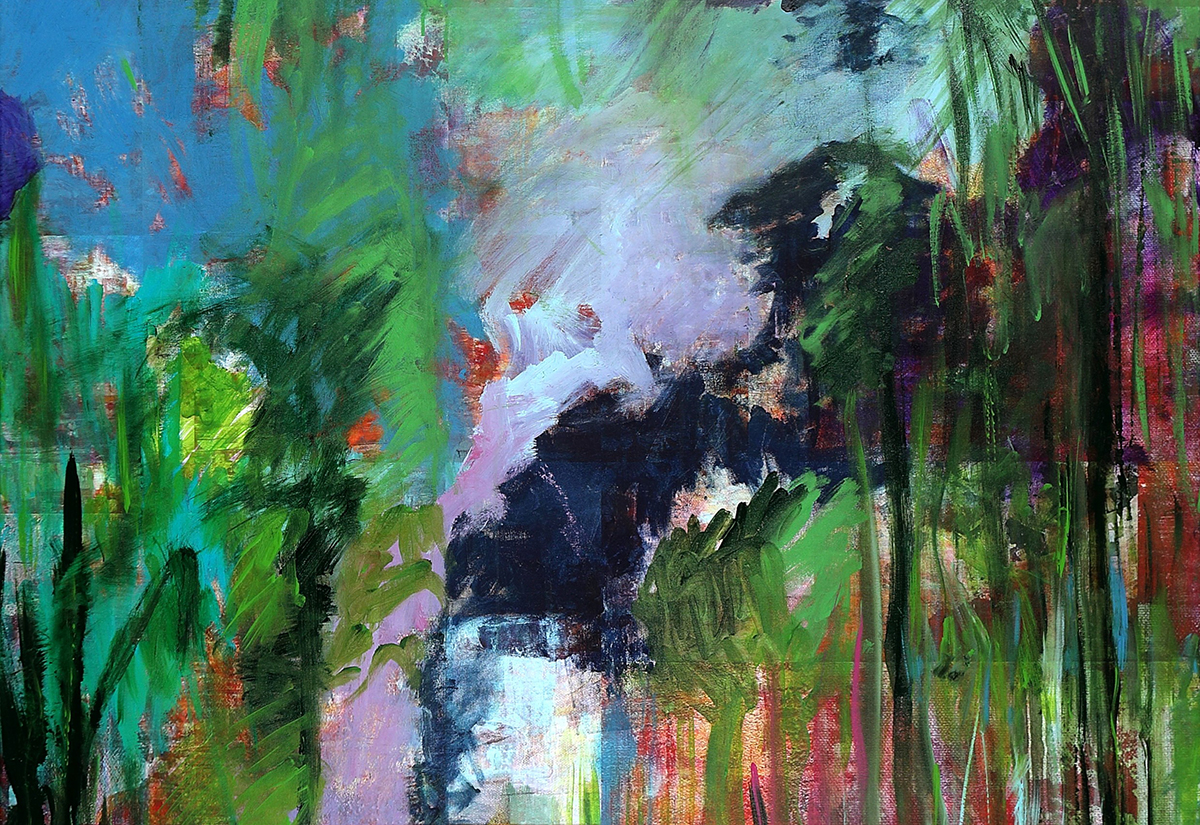
Sonja Kalb’s path into the art world weaves together structure, creativity, and a fearless embrace of change. Born in Stuttgart, Germany, she began in a place that might sound far from painting: textile and design engineering. That early training matters. It gave her a mind for systems—how parts relate, how materials behave, how precision can hold a form together. But what makes her practice feel alive is what she did next: she didn’t stay inside the safety of the technical world. She carried its discipline into a looser, more intuitive language, letting control and spontaneity share the same surface.
In her abstract work, you can feel both sides at once. There’s an underlying order—an intelligence in how color is placed and how space is built—yet the paintings don’t feel rigid. They move. They open. They change depending on how long you stand with them. Kalb’s art doesn’t ask you to decode it. It asks you to enter it.
Nature Pure I–III: A Trilogy You Don’t Just Look At
The trilogy Nature Pure I–III can be taken in quickly if you want: color, texture, motion. But that kind of viewing only catches the outer layer. These paintings reward something slower—an approach that isn’t about “getting it right,” but about letting the work meet you where you are. When you spend time with them, the paintings begin to behave less like images and more like terrain. Paths start to suggest themselves. Boundaries soften. Presences hint at themselves and then pull back.
What’s compelling about this series is that it doesn’t sell nature as tidy or decorative. Nature here isn’t “nice.” It’s contradictory and lush, sometimes generous and sometimes unreadable. Kalb creates a space that can be recognized as organic without turning it into illustration. These paintings don’t point and say, this is a forest, this is a river, this is a creature. Instead, they hold the conditions where those feelings can appear. In that way, the trilogy becomes both outer landscape and inner landscape—what you might call a natural space that also behaves like a psychological one.
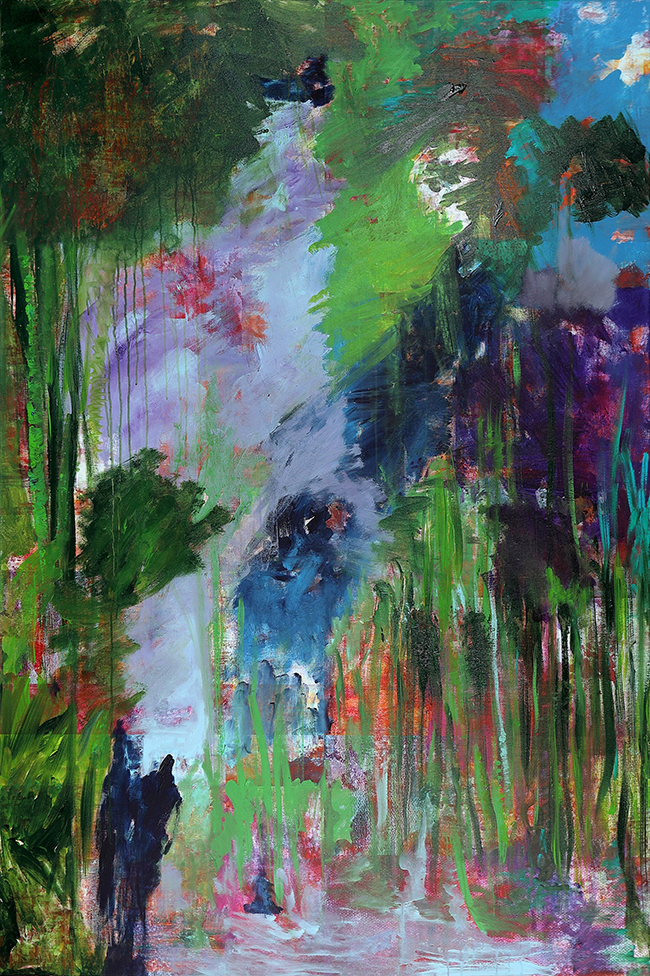
Nature Pure I: The Path That Appears When You Slow Down
In the first painting, there’s a sense of a clearing forming—something bright opening in the center like a corridor of air. It could be read as light cutting through dense growth, or as a stream of breath moving forward. On both sides, deeper zones press in: saturated greens, purple pockets, and flashes of red that feel like brief signals—maybe blooms, maybe warnings, maybe just life insisting on being seen.
Then there are the drips. They matter. They keep the painting from becoming too polished, too “designed.” The drips feel like a choice to let the work stay real—like the surface is allowed to behave the way weather behaves. You get the feeling that something has happened here, not just been arranged.
And under the brightness, there’s a suggestion of shadow. You might register forms—figures, silhouettes, animal shapes—or you might only feel density and depth. That uncertainty is part of the experience. The painting offers interpretation without forcing it. It lets the mind hover between recognition and imagination, which is often where the most honest response lives.
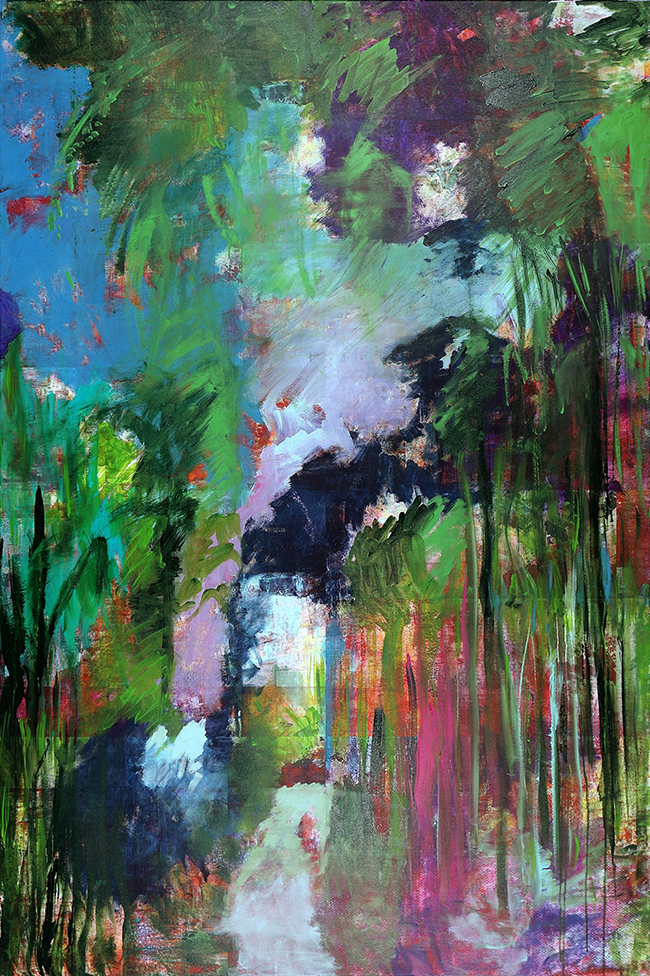
Nature Pure II: The Threshold and the Unnameable
The second work comes across more immediate—denser, more saturated, more confrontational in the best way. On the left, a clear turquoise-blue reads like air after rain. On the right, a magenta zone feels almost like fabric or curtain—something that could part, or block, or stage what comes next. Between them is a milky brightness that could be fog, opening, veil, or doorway.
This is where “presence” becomes strongest. In the darker areas, face-like hints can flash up—not as portraits, not as proof, but as sensation. It’s the feeling of being noticed while you look. The painting holds that tension beautifully: you are invited in, but you are not promised control.
That balance—welcome and warning—gives the work its charge. It’s not trying to calm you down. It’s trying to make you attentive. It asks you to stay alert to what you’re projecting, what you’re sensing, and what might be arriving from the painting itself.
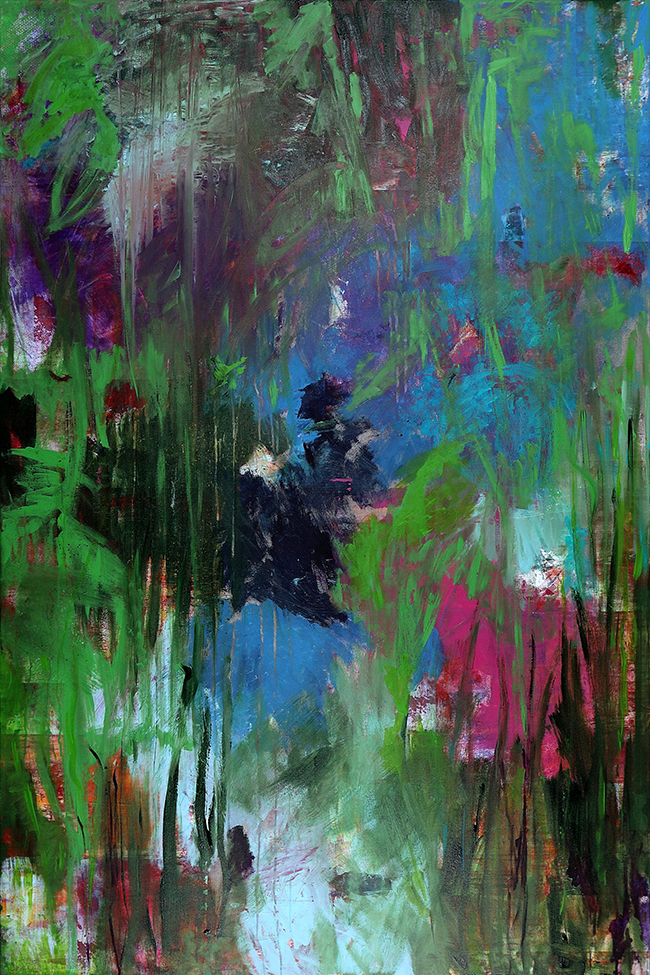
Nature Pure III: Absorption, Depth, and Belonging
The third piece draws the space inward. It feels darker, deeper, more layered. A cool blue dominates one side, while green pushes over it like a living curtain, as if growth is covering something older beneath it. In the center, there’s a dense, dark core—like a silent lake, a thought held in the body, a place you can’t see to the bottom of. Below that, a lighter passage appears—an opening that might be a way out or a way in. The uncertainty stays intact, and that’s exactly the point.
This painting carries a specific emotional shift: the moment nature stops being a backdrop and becomes a system you’re inside of. Not as a visitor. As a part of it. The work doesn’t flatter the viewer; it absorbs them. And in that absorption, it becomes quietly profound—without ever needing to announce itself.
A Simple Way to Meet the Trilogy
If you want a direct way into these paintings, don’t start by trying to recognize anything. Give each one twenty seconds before you label it. First, look for “paths”—clearings, rivers, openings, breaks in density. Then look for “beings”—presences, silhouettes, faces, animal hints, or whatever your mind and body register together.
What unfolds is less about certainty and more about discovery. These works don’t behave like statements. They behave like places. And the longer you let them stay open, the more they give back.
