
Jane Gottlieb’s creative direction has long been shaped by a deep interest in color, movement, and visual energy. Raised in Los Angeles and now working from Santa Barbara, she began as a painter before turning to photography, where she found new ways to investigate composition, rhythm, and light. Over three decades ago, she made a pivotal shift that continues to define her practice: hand-painting individual Cibachrome prints. Through this approach, photographic images are transformed into singular, physical objects that resist easy classification. Rather than presenting photography as something fixed, Gottlieb treats it as a surface to be reworked. Color becomes embedded within the image, not simply layered on top. The result is a body of work that sits between painting and photography, carrying both the immediacy of a captured moment and the presence of the artist’s hand.
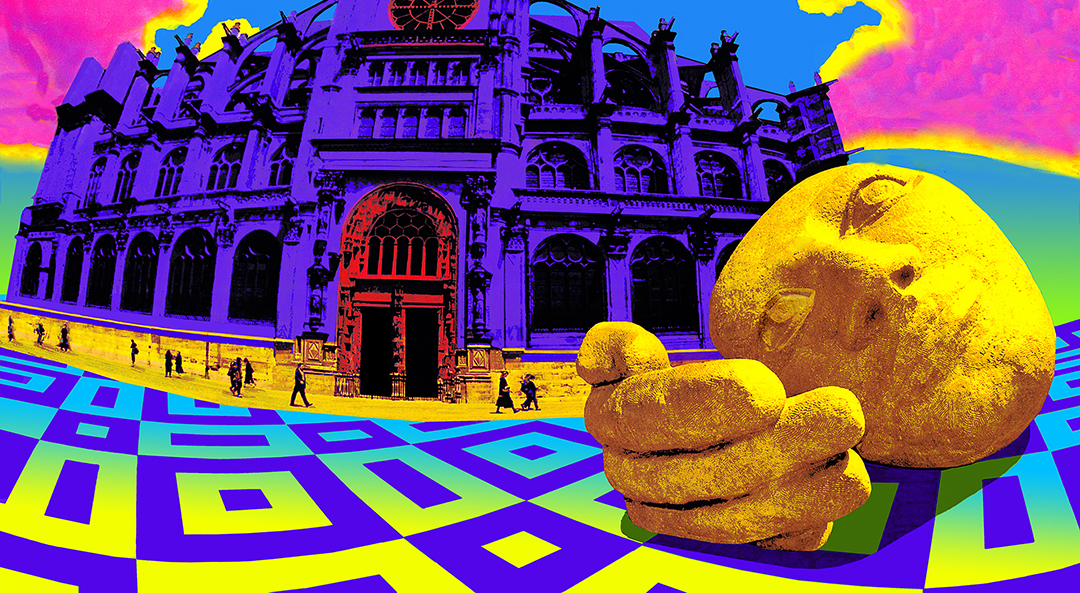
Gottlieb’s work resists being confined to a single category. Photography, for her, is a starting point rather than an endpoint. In Brancusi Head, Paris, this approach becomes immediately clear. The architectural setting, recognizable in structure, is altered through intense, charged color. What might once have been a straightforward image of a Parisian site shifts into something more interpretive, almost theatrical in its transformation.
Color operates here as both a force of disruption and construction. Deep purples, saturated blues, and sharp yellows compress and expand the space simultaneously. Perspective becomes uncertain. While the structure remains identifiable, it no longer behaves as a stable environment. Instead, it begins to feel psychological, as if the space has been filtered through perception rather than recorded objectively. The sculptural head placed in the foreground adds another layer, introducing a presence that feels at once playful and slightly off-balance.
A tension emerges between what is familiar and what has been altered. The architecture provides a sense of grounding, yet the color destabilizes that certainty. Gottlieb builds a quiet sense of motion within a still image. The eye moves continuously, pulled by contrast and intensity instead of traditional compositional logic.
Her process is essential to this effect. By working directly onto Cibachrome prints, she intervenes physically with the photographic surface. This is not digital editing. It is a hands-on exchange. Each mark remains visible, reinforcing the individuality of every piece. The photograph acts as a foundation, but the finished work carries the weight of time, touch, and repetition. It holds both the original moment and the artist’s ongoing interaction with it.
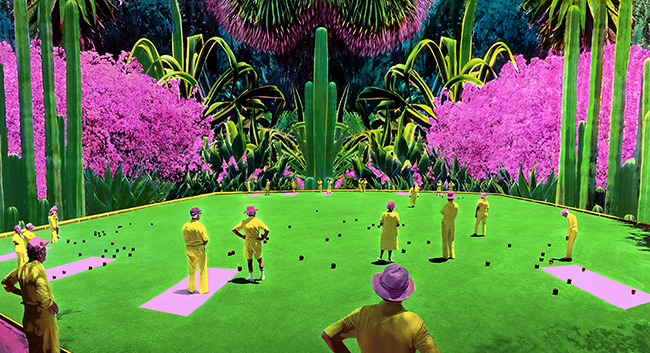
In contrast, Lawnbowler’s Series: Life shifts attention from built structures to human presence, while maintaining the same sense of transformation. The scene depicts figures engaged in lawn bowling, yet the environment refuses to behave naturally. The landscape becomes heightened, almost unreal. Bright greens spread across the ground, while surrounding foliage shifts into exaggerated pinks and dense textures.
One of the key elements here is the treatment of the background. Gottlieb has described altering it to create different emotional tones, and that intention is visible. The figures remain relatively constant, but the surrounding environment shifts. The setting becomes active, shaping the mood rather than simply containing the action.
The figures themselves are simplified and closely aligned in tone, allowing them to blend into the scene while still maintaining their presence. Their placement across the space introduces a subtle rhythm. They appear connected through the shared activity, yet each figure also occupies a separate zone, suggesting both interaction and distance.
Once again, color leads the experience. It does not describe reality but constructs an alternative version of it. The heightened palette creates a sense of altered perception, as though the scene is being experienced rather than observed. Gottlieb moves away from representation and toward sensation, inviting a different kind of engagement.
There is also an understated narrative within the work. The title Life suggests something beyond the literal activity. The scene becomes a reflection on participation and separation. While the figures are engaged in a structured game, the surrounding environment feels expansive and unpredictable. This contrast introduces a quiet tension, echoing the balance between order and uncertainty.
Across both pieces, Gottlieb maintains a consistent approach. She begins with recognizable imagery but moves beyond it through intervention and reinterpretation. The photographic base anchors the work, while the hand-painted surface introduces variability and presence.
Her work exists in a space between mediums. It is neither purely painting nor strictly photography. Instead, it is a hybrid form where color takes precedence and structure adapts. Each piece encourages a way of looking that goes beyond identification, shifting toward experience and perception.
