
For more than fifty years, Pasquale J. Cuomo has remained deeply connected to photography, approaching the medium with the same sense of curiosity that first drew him to a camera as a teenager. What started as a youthful interest steadily developed into a lifelong dedication to observation, craft, and visual awareness. From the era of film negatives and darkrooms to digital cameras, smartphones, and AI-driven technology, Cuomo continued evolving alongside photography itself while staying committed to the simple but demanding act of truly seeing.
Throughout his career, Cuomo refused to confine himself to a single category of photography. His work expanded across weddings, fashion, commercial campaigns, architectural photography, legal documentation, and public relations projects. By the mid-1980s, he had built a professional studio complete with his own photographic lab and high-end equipment, giving him full control over the process from capture to final print. Those who worked with Cuomo valued not only his technical skill, but also his careful eye for detail and his ability to recognize visual moments that others might overlook. He carried himself with quiet focus, allowing the subject to remain central rather than placing attention on the photographer.
That same mindset continues to shape Cuomo’s work today. While photography constantly shifts with new trends and technology, he remains focused on the core elements of the medium: light, composition, structure, timing, and atmosphere. In recent years, Cuomo has returned to shooting film, revisiting the slower and more deliberate process that originally formed his photographic instincts. His work is not driven by novelty or spectacle, but by patience, discipline, and sustained attention to the visual qualities of the world around him.
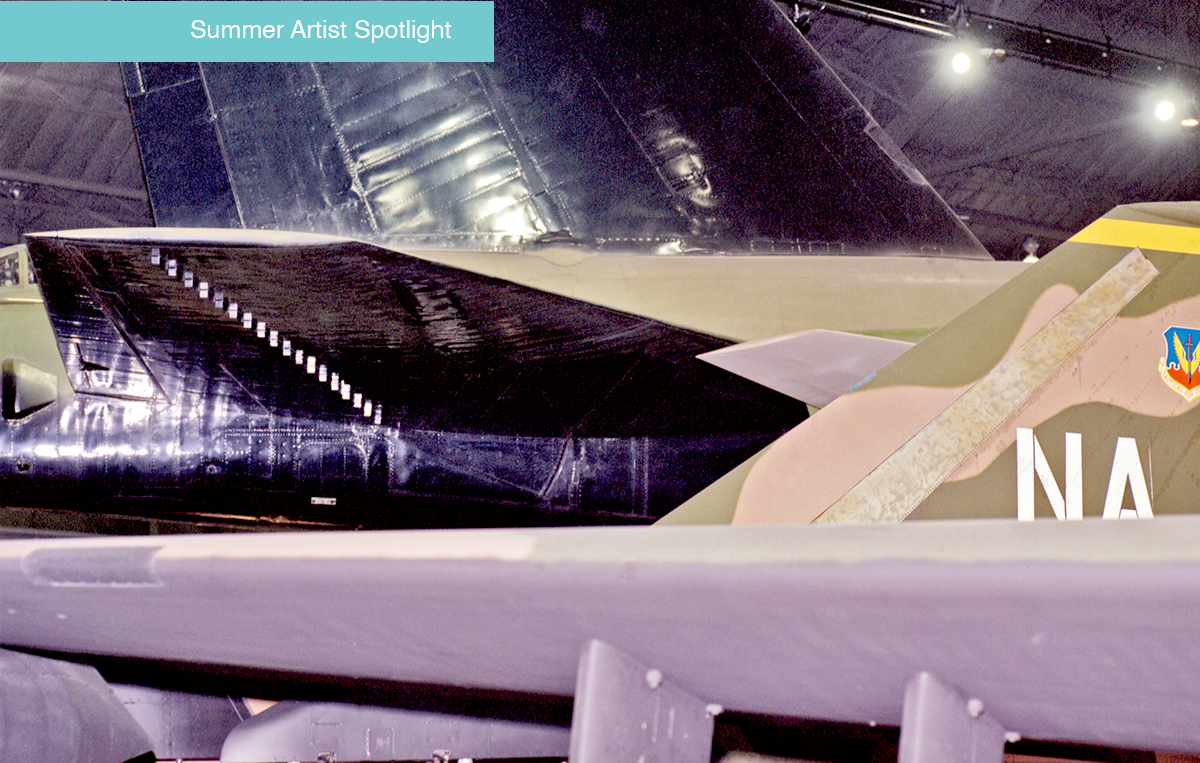
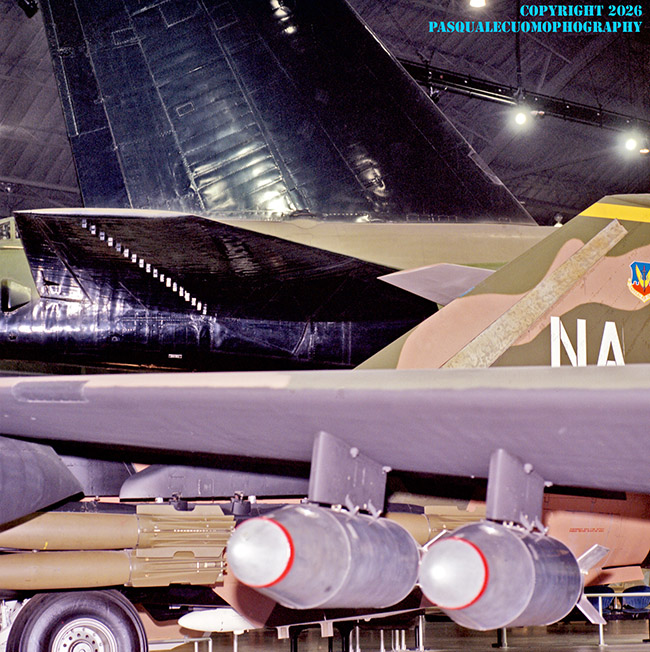
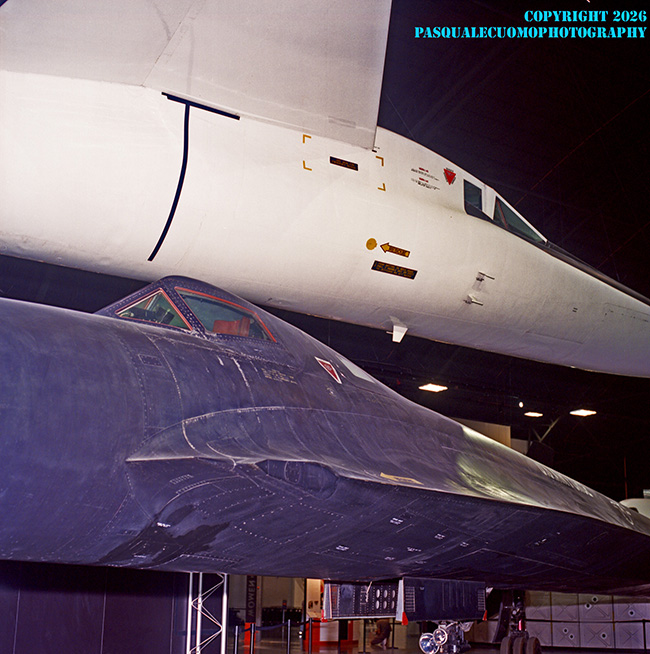
Two photographs created at the National Museum of the United States Air Force in Dayton, Ohio, demonstrate these interests clearly. Although the subject matter centers on military aircraft, the images function as more than documentation of historical machines. Cuomo approaches the aircraft as studies in form, examining geometry, scale, texture, and contrast through carefully controlled compositions.
In the first image, the sharp, angular body of a stealth aircraft cuts across the frame with strong diagonal movement. Cuomo focuses on intersecting surfaces, overlapping structures, and missile forms, transforming the aircraft into an arrangement of abstract shapes and reflective planes. Rather than presenting the machine in its entirety, he fragments it into visual sections, emphasizing line, shadow, and tonal variation. Reflected light glides across the glossy black surface, introducing subtle shifts that soften the severity of the aircraft’s rigid geometry.
The composition reveals Cuomo’s strong sense of balance and rhythm. Even though dark forms dominate much of the image, the photograph never feels static or overly heavy. Repeated shapes in the foreground create movement through the frame, while softer camouflage tones provide visual contrast against the darker surfaces above. The museum itself remains secondary, functioning mainly as a setting that reinforces the aircraft’s scale and physical presence.
The second photograph explores a different relationship between aircraft forms. Cuomo positions two planes within the frame so that one stretches above the other, creating tension between light and shadow, smoothness and density. The lighter aircraft appears almost suspended overhead, while the darker aircraft below anchors the image with weight and depth. Together, the sweeping curves and elongated lines create a composition that feels sculptural and architectural.
Perspective becomes essential to the image’s effect. By working from a lower viewpoint and carefully compressing the framing, Cuomo gives the aircraft a monumental presence. Rather than reading as museum exhibits, the planes become studies in engineering and form. Small visual details such as cockpit windows, markings, and reflected highlights act as compositional accents that guide the viewer through the image.
Both photographs reveal Cuomo’s appreciation for aircraft design without turning the subject into spectacle. He avoids exaggerated effects or unnecessary dramatization, relying instead on the strength of the forms themselves. The images are grounded in observation and structure, allowing the engineering of the aircraft to communicate visually through composition and light.
The photographs also reflect Cuomo’s long relationship with film photography. The restrained tonal range, measured exposure, and deliberate framing suggest a photographer who values patience and careful construction over immediacy. Even within the crowded visual environment of a museum, Cuomo isolates moments of clarity, order, and visual harmony.
After decades spent photographing an enormous range of subjects, Pasquale Cuomo continues to approach photography with discipline, attentiveness, and curiosity. His work at the National Museum of the United States Air Force demonstrates how technical subjects can become thoughtful visual studies when seen through the eye of an experienced photographer. These images are not simply records of aircraft, but reflections on structure, design, atmosphere, and the enduring importance of observation itself.
