
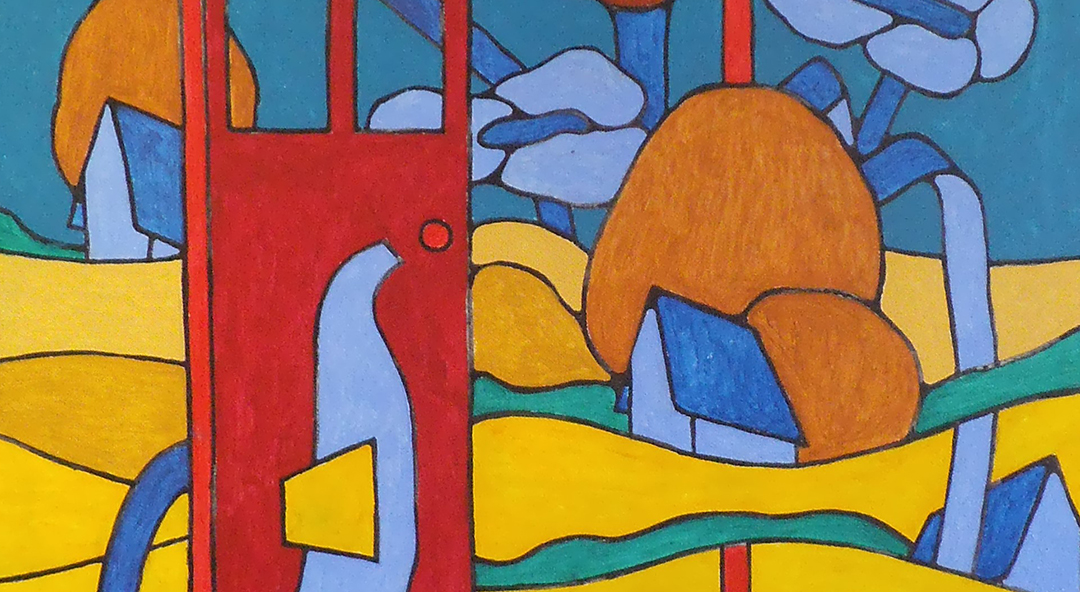
Michel Marant, born on August 4, 1945, in Saint-Junien, France, has shaped a practice grounded in the rhythms of everyday life and a close awareness of the natural environment. Educated at the National School of Decorative Arts in Limoges and affiliated with the Maison des Artistes, he has gradually developed a visual language that feels both personal and consistent. His work moves fluidly across pencil, acrylic, oil, and collage, applied to canvas, paper, and cardboard without preference. While his sensibility echoes aspects of art nouveau, it is not tied to tradition. Instead, he constructs his own system, where line, color, and form operate with clarity and ease. Rather than reproducing what is seen, his paintings rearrange it, presenting a world that feels recognizable yet subtly altered.
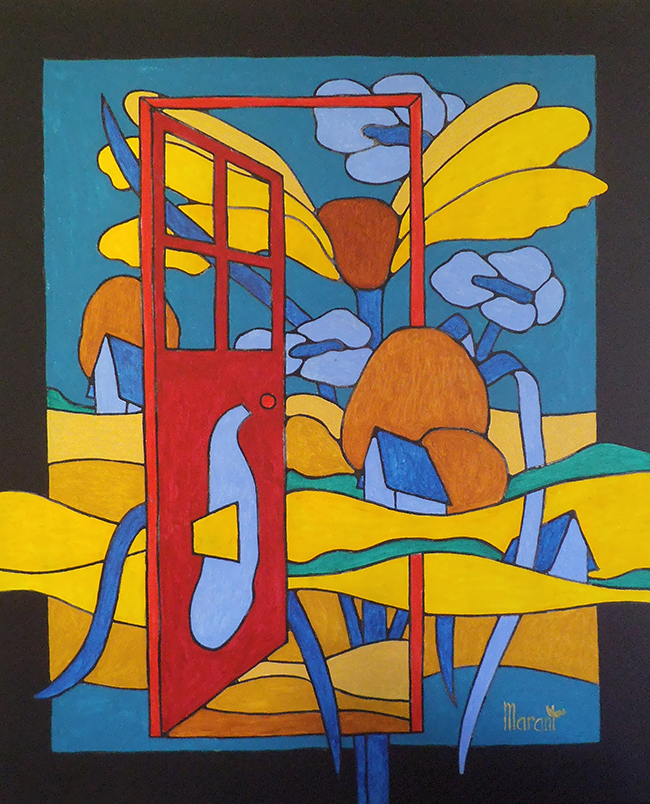
In Opening onto the Dragonfly Flower (2025), Marant creates a scene that holds a quiet tension between openness and containment. A red door stands in the foreground, slightly open, suggesting both access and separation. It does not lead to an interior space. Instead, it reveals a landscape built from flattened shapes and saturated color. Bands of yellow stretch across the composition, interrupted by blue and green elements that read as plants, stones, or fragments of terrain. Above, simplified floral forms rise, their rounded shapes repeating throughout the image.
Here, the door operates less as an object and more as a visual threshold. It frames the landscape while also redefining what it means to enter a space. The viewer is not stepping into a physical room, but into a constructed perception. The strong red of the door pushes forward against the cooler tones around it, creating a clear point of tension. At the same time, the composition remains controlled. Details are stripped back. Forms are simplified, allowing color and structure to carry the weight of the image.
The dragonfly flower is not rendered with precision. It is implied, folded into the overall environment. It becomes part of a symbolic space rather than a literal subject. The landscape itself feels assembled rather than observed, as if each element has been placed deliberately but remains open-ended. This creates a setting that feels stable yet slightly off balance, where depth and scale shift without fully settling.
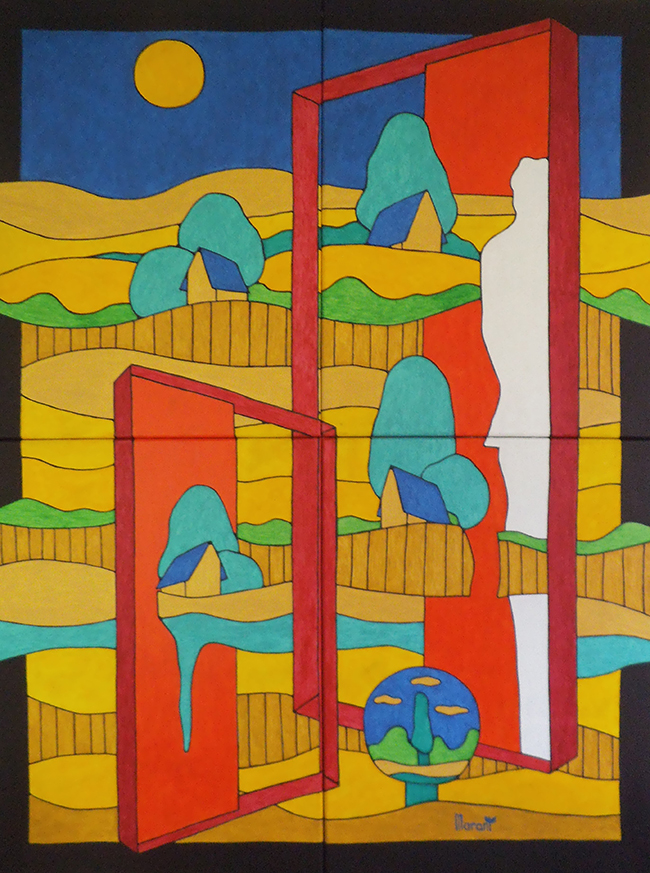
In White Silhouette with Red Frames (2026), Marant extends this idea of framing, introducing a stronger sense of human presence. A white figure stands inside a tall red structure, positioned within a landscape of rolling yellow fields and simplified trees. The figure is reduced to a flat silhouette, with no defining features. This lack of detail removes individuality, allowing it to function more as a presence than a person.
The red structures echo the earlier door but become more complex. One frame encloses the figure, while another leans in the foreground, creating overlapping layers. These elements interrupt conventional perspective, building space through placement rather than depth. The composition suggests dimension, but it does not follow a single, fixed viewpoint.
Color continues to organize the image. The yellow fields stretch across the surface, creating continuity. The blue sky, marked by a simple circular sun, adds clarity and balance. Against this, the red frames stand out with strong, uninterrupted lines. The white figure, held within this structure, feels both anchored and detached. It exists within the space, yet remains separate from it.
Near the lower edge, a small globe-like form introduces another point of focus. Its rounded shape and varied colors suggest a contained world, reflecting the larger landscape around it. This repetition reinforces the idea that the painting operates across multiple layers. Scale becomes relative. Interior and exterior, figure and environment, all exist side by side without a clear hierarchy.
Across both paintings, Marant’s approach remains steady. Forms are reduced, and visual elements are distilled to their essentials. Color and line define space rather than illusion or detail. Frames, doors, and boundaries appear repeatedly, not as limits but as tools that guide the viewer through the composition.
There is a measured rhythm in his work. Repeating curves, horizontal bands, and simplified shapes create a continuous flow across the surface. Even when contrasts are strong, they are balanced within the overall structure. This gives the paintings a sense of calm, despite the shifts in space and perception.
Marant does not offer direct explanations. His paintings present an entry point without dictating direction. The viewer moves through the image, noticing relationships, tensions, and alignments. Meaning is not fixed. It shifts depending on how the work is approached, allowing each viewing to unfold in a slightly different way.
