
Jo Gabe treats painting as a way to preserve experience while letting it evolve. Working in acrylic, oil, and pastel, the practice moves between what is seen and what is felt, where memory shifts and place never fully settles. There are traces of artists like Kandinsky in the relaxed forms and attention to color, but Gabe’s work stays rooted in personal reflection rather than pure abstraction. Landscapes, interiors, and figures are not separated. They function as extensions of lived experience, connected through mood and recollection.
Travel continues to shape this direction. From the layered energy of Sydney to the openness of Queensland, Gabe collects impressions that return later in altered ways. These are not straightforward depictions. They pass through memory, becoming softened, reduced, or reshaped until they carry a more internal weight. What emerges feels less like documentation and more like a reworking of experience, where meaning develops through atmosphere, gesture, and tone.
The Work
Gabe’s paintings exist in a space where representation begins to loosen, allowing emotion and image to blend. This becomes clear in the two works presented, Noosa North Shore and The Voyeur. While one moves through landscape and the other through portraiture, both follow the same intention: to move beyond description and toward something more reflective and psychological.
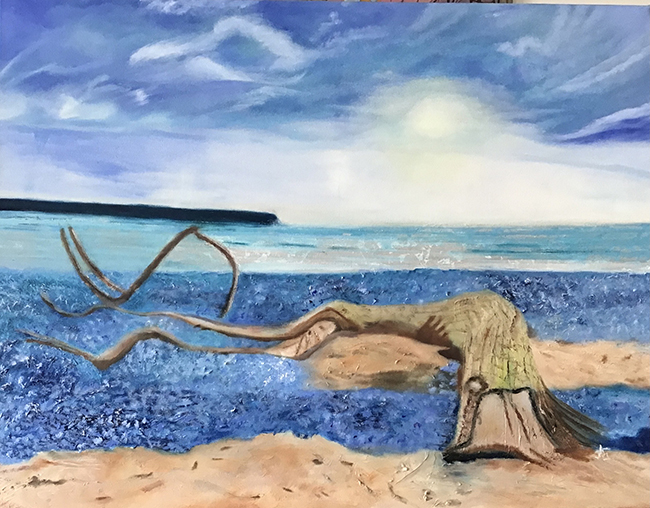
In Noosa North Shore, the coastal setting is immediately recognizable, but that clarity does not hold for long. The horizon anchors the composition, yet everything around it feels unsettled. The ocean is constructed through layers of blue, creating a surface that feels both dense and active. The paint itself carries a sense of movement, echoing the steady rhythm of water.
The use of silverleaf shifts the behavior of light across the surface. Rather than remaining stable, it catches and changes depending on the angle of view. This creates a sense of fluctuation, where the image does not remain fixed. That instability reflects how memory works, where clarity fades and reappears in unexpected ways.
A fallen tree stretches across the center of the composition, extending from the sand into the water. Its shape is slightly exaggerated, guiding the eye across the canvas. It exists both as a physical element and as a suggestion of something more—an interruption, a shift, or the trace of something that has already passed. The absence of people does not create emptiness. Instead, the space feels occupied in a quieter way, as if holding the remains of an unseen presence.
Above, the sky is softened and diffused, contrasting with the heavier foreground. The light feels distant, not immediate, creating a pause within the scene. Time seems to slow rather than move forward, giving the painting a sense of suspension.
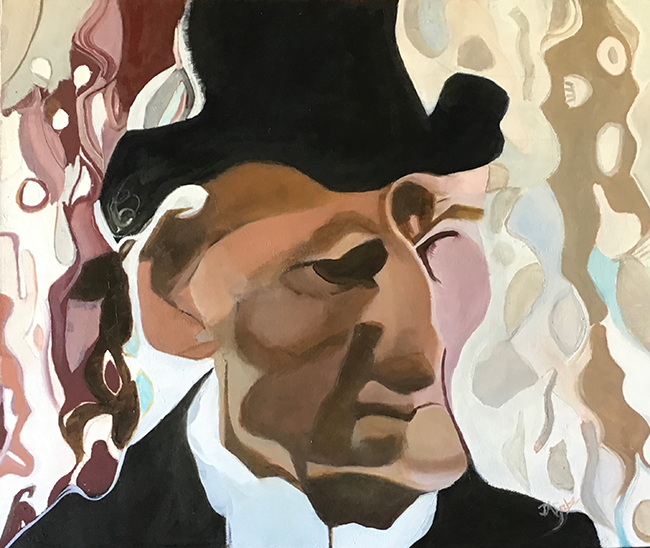
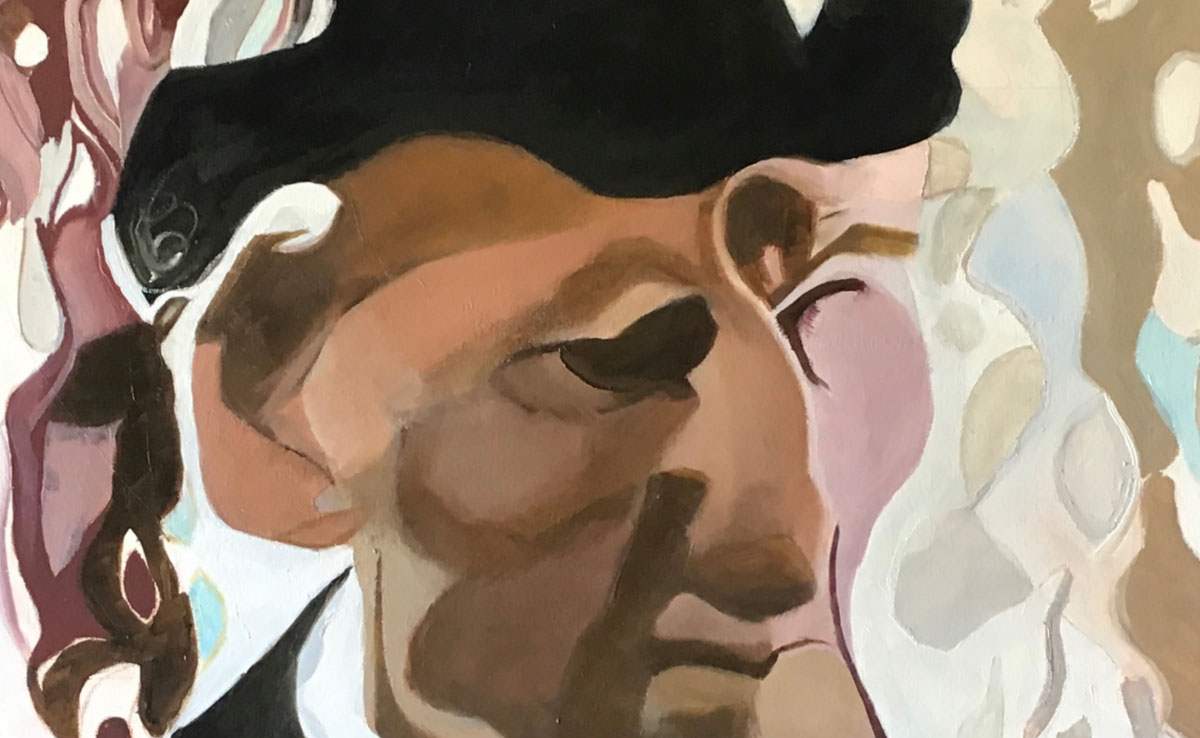
In The Voyeur, Gabe turns inward. The figure appears in profile, but the features resist definition. Edges soften, tones blend, and the face becomes difficult to fully grasp. The subject remains partially hidden, placing the viewer in a position of observation without clarity.
The title points toward watching, yet the painting complicates that dynamic. It is unclear who holds control—the viewer or the subject. The obscured eye blocks direct engagement, creating a subtle distance. That distance introduces tension, carried quietly through the composition.
Color becomes central to how the figure is built. Flesh tones shift through muted pinks, browns, and cooler shades, creating a surface that feels unstable. The background holds abstract forms that hint at figures without fully forming them. They linger as fragments or echoes, reinforcing the sense that the image sits between reality and imagination.
The paint handling remains measured but flexible. Edges dissolve, transitions remain soft, and forms seem to appear and disappear at once. The painting feels open, as if still in motion rather than complete. This lack of resolution is not accidental. It becomes part of the structure itself.
Across both works, Gabe avoids the idea of a fixed image. Landscape and figure are treated with the same approach—suggestion rather than definition. Forms shift, light moves unpredictably, and space expands or compresses through memory.
There is a steady restraint in this approach. The paintings do not rely on scale or intensity to hold attention. Instead, they draw the viewer in through subtle movement—through light that shifts, through forms that remain unresolved. The work stays open, allowing meaning to develop gradually rather than presenting it all at once.
