
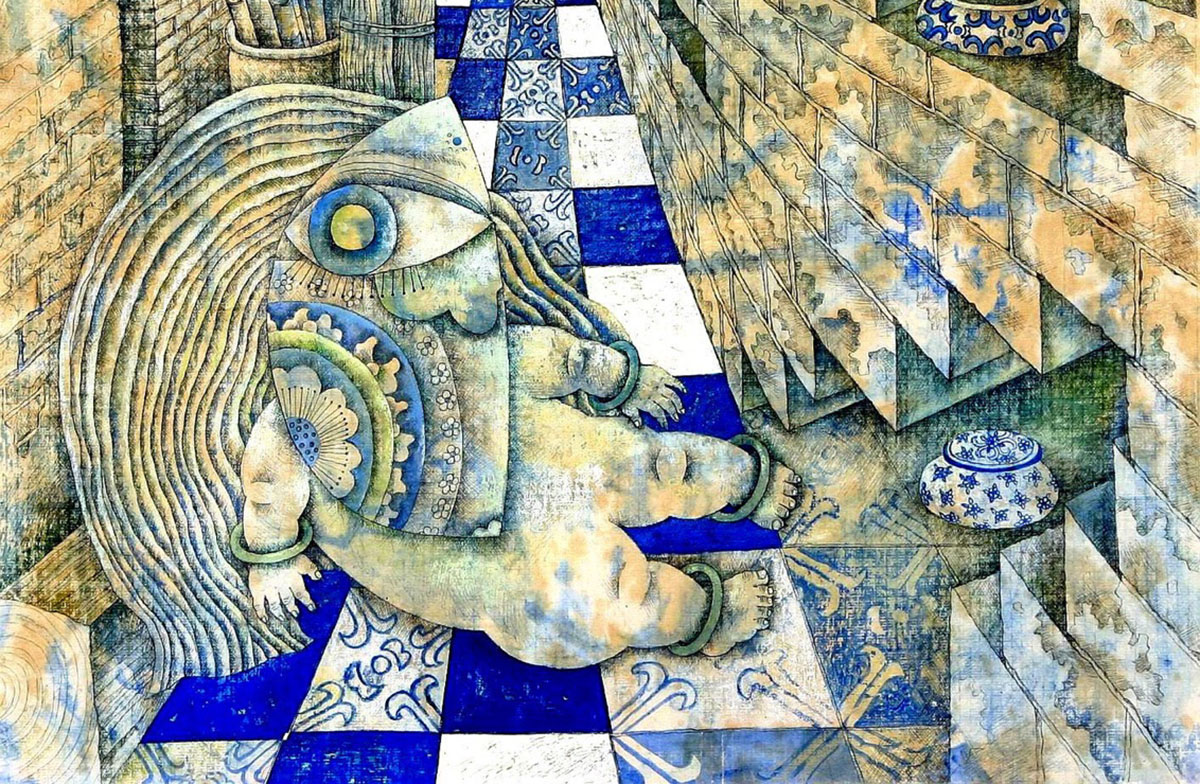
Huang YI Min’s life and artistic path are closely tied to the layered history of China. Born in 1950, she came of age during a period of profound social and cultural shifts, experiences that continue to echo through her work. Trained at the Department of Fine Arts at Beijing Normal University, Huang developed a strong foundation in both traditional and contemporary practices. When she moved to the United States in 1997, she carried with her not just technical skill, but a deeply rooted visual memory shaped by the streets, structures, and atmosphere of her homeland. Her work today reflects this dual perspective—one that looks both inward and across distance—blending recollection, observation, and imagination into intricate visual narratives.
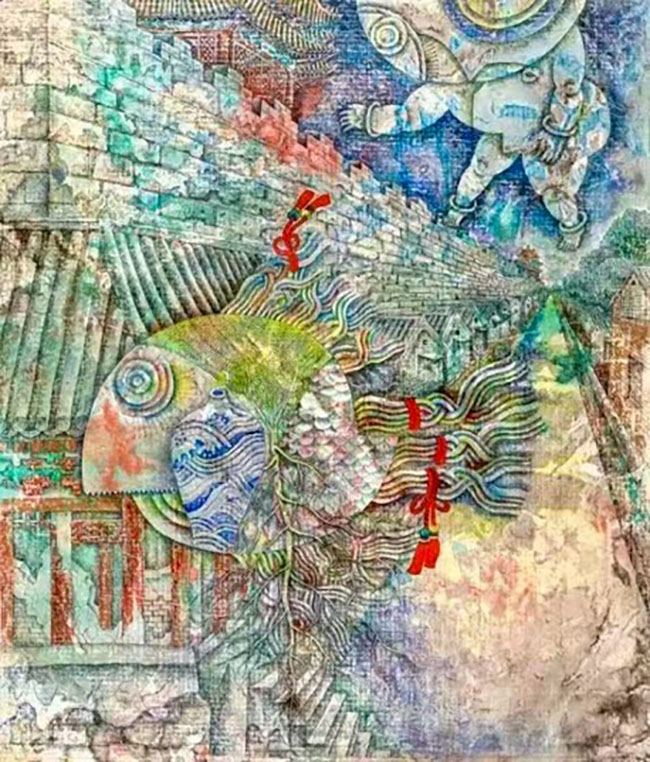
Her series Forbidden City Freedom unfolds like a fragmented diary of place and time, where architecture, memory, and daily life overlap. In The Moon Outside the Palace Museum Wall (80 x 86 cm, mixed media on paper), the composition feels suspended between reality and dream. A large, almost mythical fish dominates the foreground, its patterned body layered with textures that resemble scales, ceramics, and worn surfaces. The fish is not simply an object; it feels like a carrier of memory, drifting through space that merges palace walls with domestic structures. The rooftops and bricks behind it are rendered with careful detail, yet they dissolve into soft washes of color, suggesting erosion—both physical and historical.
Color plays a subtle but deliberate role here. Faded greens, reds, and muted earth tones echo the weathered surfaces of old Beijing walls. These tones are not decorative; they evoke age, time, and exposure. The presence of the fish, paired with architectural fragments, creates a tension between permanence and movement. Buildings are fixed, rooted in history, while the fish glides freely, almost defying gravity. This contrast suggests a quiet longing for release, or perhaps a reflection on how memory itself moves through static environments.
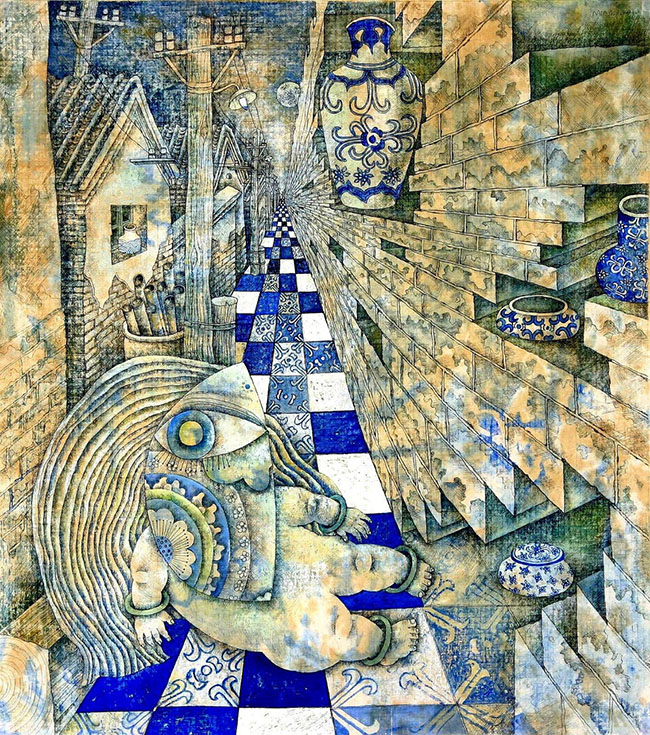
In Windless Day (82 x 90 cm, mixed media on paper), Huang shifts the atmosphere. The palette leans heavily into blue and white, immediately recalling traditional porcelain. A tiled floor stretches into the distance, forming a strong perspective that pulls the viewer inward. On either side, walls close in tightly, lined with vessels that float or rest in improbable positions. The space feels both architectural and surreal, structured yet unstable.
A seated figure appears in the foreground, merging human and symbolic elements. The form is compact, almost sculptural, and echoes the textures seen throughout the piece. This figure does not dominate the space but exists within it, as if shaped by the same forces that formed the walls and objects around it. The repetition of ceramic motifs creates a visual rhythm, reinforcing the idea of continuity—tradition repeating itself across time.
What stands out in this work is the sense of stillness. Despite the complex layering and intricate detail, there is no visible movement. The “windless” condition becomes more than a title; it defines the emotional tone. The scene feels paused, as if caught in a moment that cannot progress. This stillness can be read as reflection, but also as absence—an echo of spaces that once held life.
Across both works, Huang draws from lived experience tied to the areas surrounding the Forbidden City. The imagery reflects not only the grandeur of imperial architecture but also the intimate, everyday life that once existed alongside it. Narrow alleys, improvised living spaces, shared utilities, and small domestic details form an essential part of her visual language. These elements are not romanticized. Instead, they are presented with a quiet attention that allows their presence to speak for itself.
There is also a strong sense of disappearance embedded in the work. The references to demolition and change are not shown directly but are felt through the fragmentation of space and the layering of textures. Surfaces appear worn, broken, or partially erased. Objects seem displaced. The environment feels unstable, as if it could vanish at any moment. This reflects the transformation of historic neighborhoods, where long-standing communities were removed and replaced, leaving behind only traces.
Huang’s approach avoids overt narrative. Rather than illustrating events, she constructs environments where memory and imagination intersect. The viewer is invited to move through these spaces, noticing details, textures, and relationships between elements. The work does not explain itself; it unfolds slowly, revealing its meaning through observation.
Her use of mixed media is central to this effect. By combining drawing, painting, and textural layering, she builds surfaces that feel tactile and aged. The materials themselves seem to carry time within them. This physical quality reinforces the themes of history and memory, making the work feel grounded even when the imagery becomes surreal.
In Forbidden City Freedom, Huang YI Min creates more than visual compositions. She constructs spaces where past and present coexist, where personal memory intersects with collective history. Through her careful balance of detail and abstraction, she captures something that is difficult to define but easy to feel—the quiet persistence of places that no longer exist, and the way they continue to live on through memory.
