
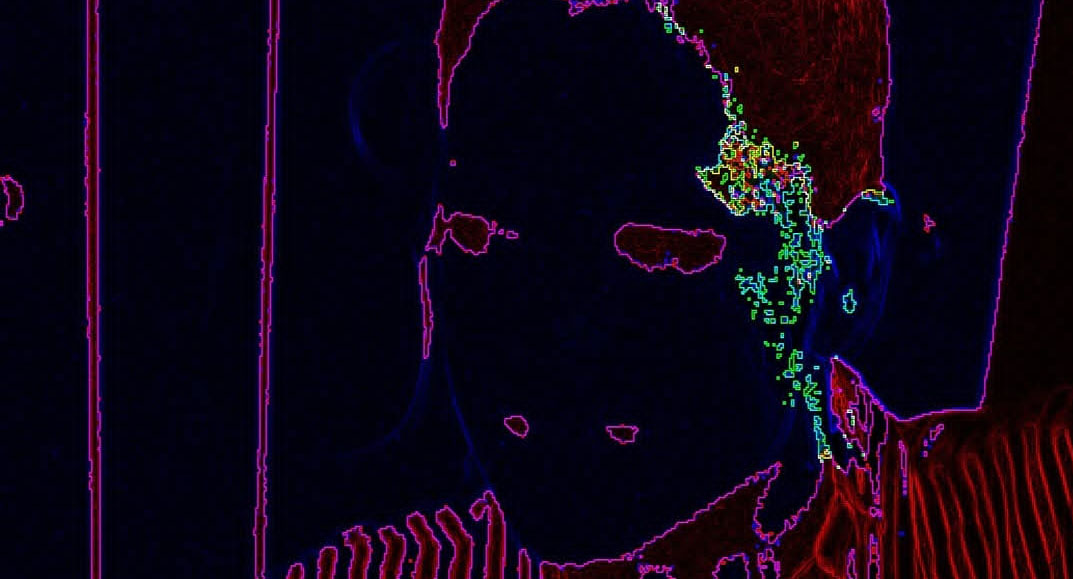
Allan Wesaquate’s image of Bernadine is rooted in a specific moment and place. The photograph was originally taken in 1993 in Vancouver, British Columbia, during a period when the artist was doing street photography. The subject, identified as Bernadine, appears in a candid setting, consistent with the nature of street-based work. There is no indication of staging or studio involvement; the image comes from direct observation in a public environment.
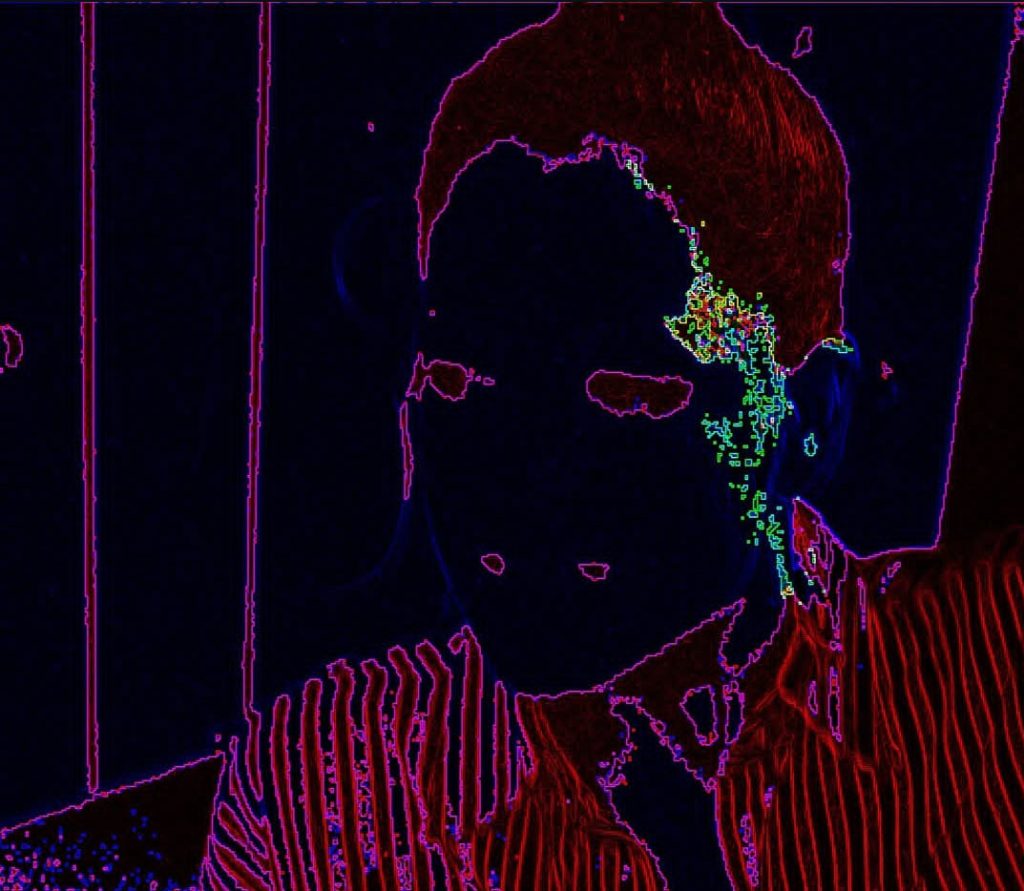
The image of Bernadine, captured in Vancouver, British Columbia, carries the directness of street photography. There is nothing staged about it. The subject appears caught in a quiet moment, her posture slightly turned, her expression unreadable. It reflects the instinctive nature of photographing strangers in public spaces, where timing matters more than control. In 1993, this would have been a straightforward photographic gesture—film-based, immediate, and rooted in observation.
But Wesaquate does not leave the image there. Nearly three decades later, he returns to it using digital tools, specifically a filter from GIMP. This shift introduces a second layer of authorship. The photograph is no longer just a record of a moment; it becomes material to be worked on, altered, and reconsidered.
The transformation is striking. The original image is pushed into a high-contrast, almost electric state. Edges glow in neon tones—reds, blues, greens—while large areas of the face fall into shadow. The eyes, nose, and mouth are reduced to minimal outlines. The result is both recognizable and obscured. Bernadine is still there, but she is also partially erased, translated into something closer to a digital trace than a physical presence.
This approach raises questions about visibility. What does it mean to see a person when their features are stripped down to outlines? The filter does not enhance detail; it removes it. It prioritizes structure over texture, contour over surface. In doing so, it shifts attention away from identity and toward form. The subject becomes less about who she is and more about how she is constructed within the image.
At the same time, the work reflects the passage of time. The original photograph belongs to a specific moment in the early 1990s. The digital treatment belongs to a different era entirely, one shaped by software, screens, and image manipulation. By combining the two, Wesaquate creates a dialogue between past and present. The image is no longer fixed in 1993; it exists across multiple points in time.
There is also an element of experimentation that runs through the work. Wesaquate mentions trying different filter programs before settling on the GIMP filter. This process is visible in the final result. The image does not aim for realism or refinement. Instead, it embraces distortion and unpredictability. The colors bleed into each other. The outlines flicker between clarity and fragmentation. It feels less like a finished product and more like an ongoing test—an exploration of what the image can become.
This openness is important. Rather than presenting a single, definitive version of the photograph, Wesaquate treats it as something flexible. The image can be reworked, reinterpreted, and re-seen. In this sense, the work aligns with a broader shift in how images function today. Photographs are no longer static objects; they are files that can be endlessly modified.
Yet, despite these changes, the presence of Bernadine remains central. Even in its altered state, the image retains a sense of encounter. There is still a person behind the abstraction. This tension—between recognition and disappearance—gives the work its edge. It asks the viewer to navigate between what is visible and what is hidden.
The use of color plays a key role here. The neon palette is not naturalistic. It does not attempt to replicate the tones of skin or clothing. Instead, it introduces an artificial layer that separates the image from reality. The colors feel almost synthetic, as if generated rather than captured. This adds to the sense that the photograph has been pulled away from its original context and placed into a different visual language.
At the same time, the vertical lines of the clothing and background remain visible, anchoring the image. These elements provide a structure that contrasts with the more chaotic treatment of the face. It creates a balance between order and disruption, between the recognizable and the abstract.
Wesaquate’s work, in this case, is not about perfecting an image. It is about revisiting it. The decision to return to a photograph from 1993 and process it in 2020 suggests a long-term relationship with the image. It is not discarded or forgotten. Instead, it is brought back into view, altered, and given a new form.
This act of revisiting also introduces a personal dimension. The photograph becomes a point of connection between different stages of the artist’s life. The person who took the photo in 1993 is not the same person who processed it in 2020. The work, therefore, carries traces of both.
In the end, what Wesaquate offers is not a single, fixed interpretation of Bernadine, but a layered one. The image holds multiple timelines, multiple processes, and multiple ways of seeing. It moves between photography and digital manipulation, between memory and present action.
There is a simplicity to the starting point—a street photograph—but the outcome is far more complex. It shows how an image can change over time, not just in how it looks, but in what it means.
