
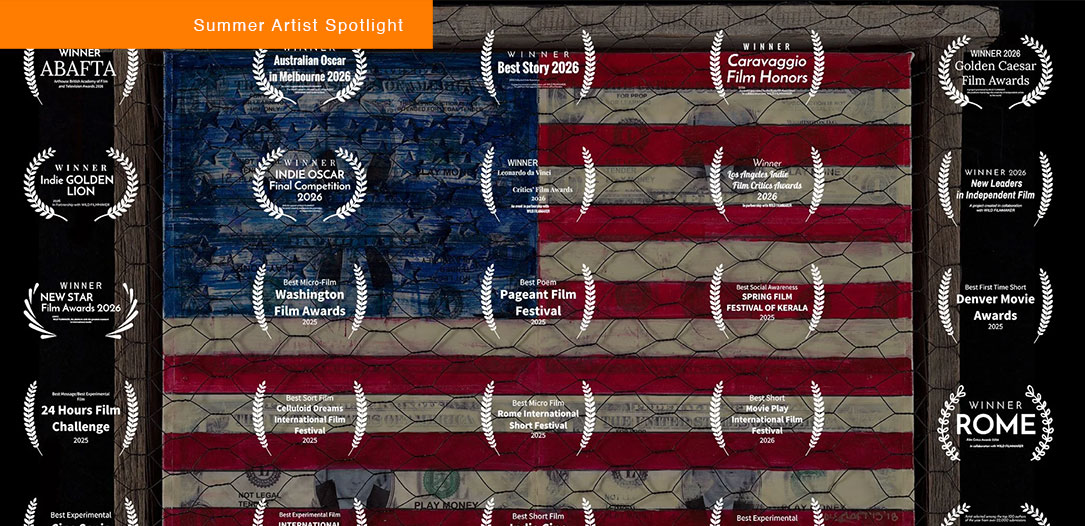
L. Scooter Morris creates work that refuses to sit passively in a space. Her practice moves beyond the idea of a flat image and enters something more physical, more immediate. Describing herself as a sensory illusionist, Morris constructs what she calls “Sculpted Paintings®,” layered works that shift depending on where the viewer stands, how light moves across the surface, and how the body responds to them in real time. Texture, shadow, depth, and reflection become part of the experience. Acrylic and mixed media are built outward from the canvas, creating forms that seem to hover between painting and object. The work is less concerned with perfection than with sensation. Morris wants the viewer to feel something before they fully understand it intellectually. Her artworks are designed to interrupt passive viewing and replace it with presence, asking people to slow down, look again, and physically experience the space between illusion and reality.
The Sculpted World of L. Scooter Morris
For more than twenty years, L. Scooter Morris has developed “Sculpted Paintings®” that exist between painting, sculpture, and sensory experience. Her works shift with movement, light, and perspective, creating an active relationship with the viewer rather than a passive image on a wall. Using layered acrylic, applied canvas, and mixed media, Morris builds textured surfaces that seem to move and transform as viewers approach them. Describing herself as a sensory illusionist, she explores the space between perception and reality. Beneath the immersive surfaces are themes of truth, freedom, memory, and collective human experience, inviting viewers to physically and emotionally engage with the work.
TIPPING POINT – THE FILM PHENOMENON
A Film Rooted in Collective Memory and Resistance
With TIPPING POINT – THE FILM PHENOMENON, L. Scooter Morris expands her artistic language into cinema while carrying forward many of the themes that define her visual practice. The project is both a political reflection and a call for collective awareness. It speaks directly to social fracture, historical repetition, environmental loss, and the question of what ordinary people are willing to defend when systems begin to fail.
At the center of the film is the idea that society has arrived at a critical threshold. Morris frames this moment not as isolated or accidental, but as part of a cycle humanity has encountered before. Her director statement repeatedly returns to the phrase “We are the people,” emphasizing collective responsibility rather than individual heroism. The film rejects the idea that change will arrive through distant institutions or singular saviors. Instead, it argues that transformation begins with ordinary people recognizing the urgency of the moment and acting together.
This sense of shared responsibility runs throughout the project. Morris speaks about remembering “the beauty of our land” and reclaiming what has been lost through division, injustice, and neglect. The language is emotional but also confrontational. It asks viewers to recognize what is disappearing culturally, socially, and spiritually. Rather than presenting hope as passive optimism, the film positions hope as action.
The visual foundation of TIPPING POINT grows directly from Morris’s Sculpted Paintings®. Many of the artworks featured in the project incorporate historical American documents embedded within the surfaces themselves. These materials are not used symbolically from a distance. They become physically integrated into the structure of the artwork, much like the principles they represent became embedded within the foundation of the country.
This connection between material and meaning is essential to Morris’s artistic philosophy. Her work often blurs the line between representation and emotional experience. The same approach appears to shape the film. Rather than aiming for strict realism, TIPPING POINT appears focused on emotional truth—creating imagery that resonates instinctively while carrying layered political and historical meaning underneath.
Morris’s background as the creator of Sculpted Paintings® also shapes the film’s visual identity. Her technique, developed over more than twenty years, creates dimensional surfaces through applied canvas and mixed media. The resulting works feel suspended between painting and sculpture, realism and illusion. That visual tension translates naturally into cinematic storytelling, where movement, texture, light, and perspective can deepen emotional impact.
What makes the project distinct is its refusal to separate aesthetics from message. Morris believes beauty can carry difficult truths more effectively than direct confrontation alone. Her goal is not simply to criticize injustice, but to create imagery that reaches viewers emotionally enough to make them care. Whether through painting, fashion, object design, or film, she continues pursuing the same ambition: creating work that cuts directly to what feels true.
TIPPING POINT also reflects Morris’s long-standing interest in collective human experience. The project does not focus narrowly on politics in the conventional sense. Instead, it examines larger questions about identity, memory, responsibility, and survival. The repeated use of “we” throughout her statement reinforces the idea that the film belongs to everyone experiencing this historical moment together.
In many ways, the film functions as an extension of her studio practice. Her artworks have always invited viewers into an active emotional exchange rather than passive observation. TIPPING POINT appears to pursue the same goal through cinematic form, using visual immersion to create urgency, reflection, and connection.
At its core, the project asks a direct question: what happens when people finally recognize that waiting for someone else to fix the world is no longer enough? Morris’s answer is clear. The heroes people have been searching for are already here. They are the people themselves.
