
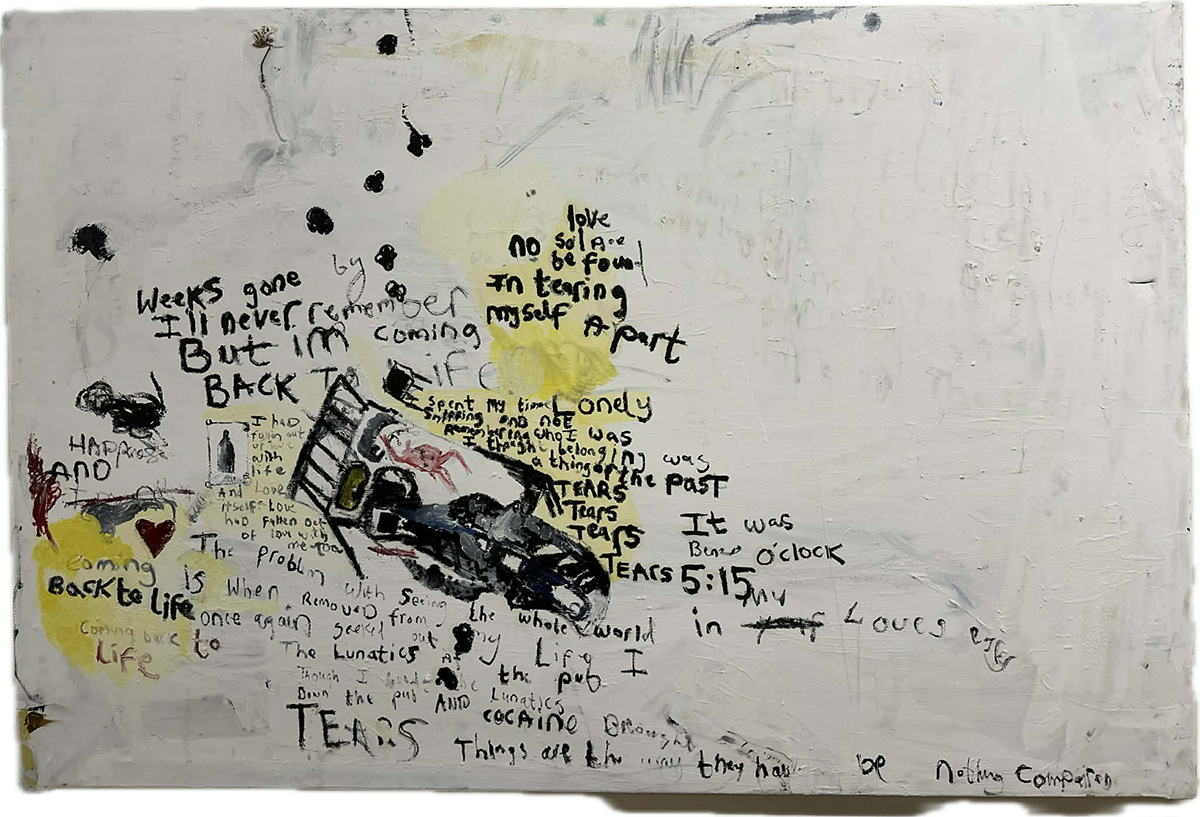
Based in the North West of England, Kat Holmes approaches painting as a way of remaining connected to lived experience rather than observing it from a distance. A graduate of the University of the West of England and a studio resident at Document, Holmes has built a practice rooted in repetition, revision, and emotional honesty. Her paintings return to recurring themes of love, loss, memory, and absence, not as fixed narratives but as shifting emotional states. Moving between instinct and structure, she allows each work to develop gradually through reworking and reflection. In this interview, Holmes discusses process, persistence, and the emotional terrain that continues to shape her work.
Background/What first inspired you to pursue art?
I didn’t know what art really was until I was 19. Before that, I spent most of my early
years obsessively playing football. I didn’t attend mainstream education and was
more likely to receive an ASBO than get into art school.
I grew up on a council estate in Ribbelton, Preston alongside 4 of my siblings.
At 19, I read my first ever book: How to Build a Girl by Caitlin Moran. I connected
with the idea of “fake it until you make it” and carried that mentality with me. I
discovered drum and bass, ecstasy and went raving however I have reigned that in
now and live a completely solo lifestyle, focusing heavily on my practice.
An experience of taking ecstasy made me realise I can be happy, I say that in a
comedic au. Not long after, I met someone who completely changed the trajectory of
my life. We came from similar backgrounds, and our friendship was intense, chaotic,
and tumultuous She was fearless — she would walk into a stranger’s house and
head straight for the fridge I admired her audacious nature.
She was the first loves in my life, completely platonic.One memory I have of us is in
Blitz nightclub in Preston, arguing over a bottle of vodka we’d snook in. It was
escalating and we were becoming physical and someone that worked at the club
came in asking if everything was ok and we hugged one another and say “yeah”
simultaneously. This sumarises the dynamic.
I now live a fully sober lifestyle. One day, by chance, we walked into a small hippy
café on Friargate in Preston. That moment altered everything for me. Through that
space I met artists, poets, activists, folk musicians, and free thinkers. It introduced
me to an entirely different way of living and thinking — something anarchic, creative,
and alive. For the first time, I felt like I had found my people. At that point I still wasn’t
an artist. I’d only read one book in my life. A painter, Ell Vincent encouraged me to
apply for a Fine Art foundation course at UCLan. I wasn’t particularly skilled at the
time, but with help from a friend on my portfolio, I got in. It took years for me to
understand the context behind the paintings that initially captured my attention, and
even longer to develop my own conceptual language and visual languge. In the
context of painting.
Can you describe the ideas, emotions, or experiences that most influence your
work?
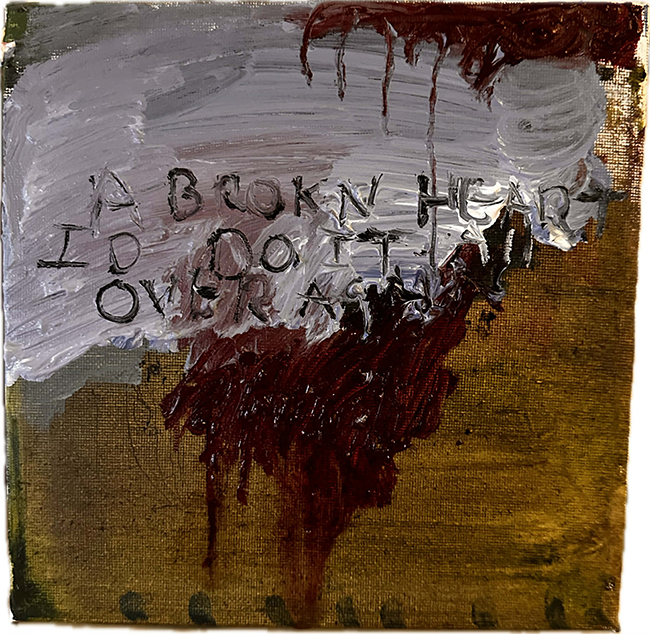
My work comes from an ongoing dialogue with myself and the world around
me. Themes of nostalgia, unresolved emotions, old relationships, friendships, and
memories from my formative years continue to surface throughout my practice. Over
time, I’ve developed a stronger conceptual understanding of my work and now feel

more capable of creating coherent bodies of work. Earlier in my career, I found the
idea of revisiting or reworking paintings intimidating, but I’ve moved beyond that and
have grown more confident in my process and abilities. I often alternate between
self-doubt and what I jokingly describe as “50/50 delusion” — but I think both are
necessary parts of developing conceptually ans visually.. ⸻
What does your creative process usually look like from the beginning of a piece to
completion?
My process is slow and layered. Text usually comes first — fragments
of writing, word association, memories, or phrases. Music also plays an important
role, and I often have songs and phrases llooping in my head. The meanings within
my paintings are not always immediately obvious. I’m interested in building
compositions that feel visually striking while holding emotional or psychological
weight beneath the surface. That process involves a lot of frustration, undoing,
reworking, and resolving before the piece finally arrives where it needs to be. I
finished my degree at UWE.
Are there any recurring themes or subjects that continue to appear throughout your
artworks?
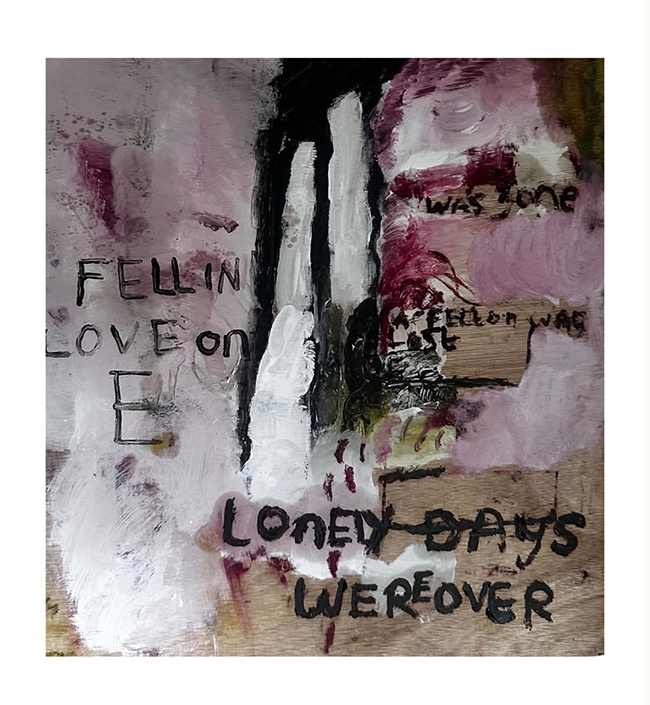
Recurring themes in my work include memory, identity, class, nostalgia,
emotional conflict, and human relationships. The characters and environments from
my early life often appear indirectly within the paintings, either throuhh atmosphere
and ineense brushstorkes, or fragments of narrative. My paintings carry intimacy
and intensity,
What do you hope people feel or reflect on when they experience your work?
More than anything, I want people to respond to the work, open conversattons, and
utimateltelt give life, I believe as artists we are emotional architects.
I’m interested in engagement and conversation. Recently, I overheard five people
discussing one of my paintings at an exhibition. I went over and asked them what
they thought, and they were questioning whether it was art at all. I wasn’t offended
by that. In fact, I appreciated that the work was provoking discussion and making
people respond emotionally or intellectually I have had an educator describe some
pieves as ‘unlike anything she’d ever seen.
I have gained recognition in the contemporary art world since my first solo show
‘coming home;, have been championed by women im art, Paint Britain, Artist Talk
Magaine,
My practice continues to evolve and I feel at this stage my work Is distinguishable
and has its own visual language, however that does not mean I don’t have periods of
doubt.
My second Solo Show, I Have Loved Them All, will take place at SHOP, Preston .
PV: June 12th qnd my third solo show will take place in October , in the North West
of England.
