
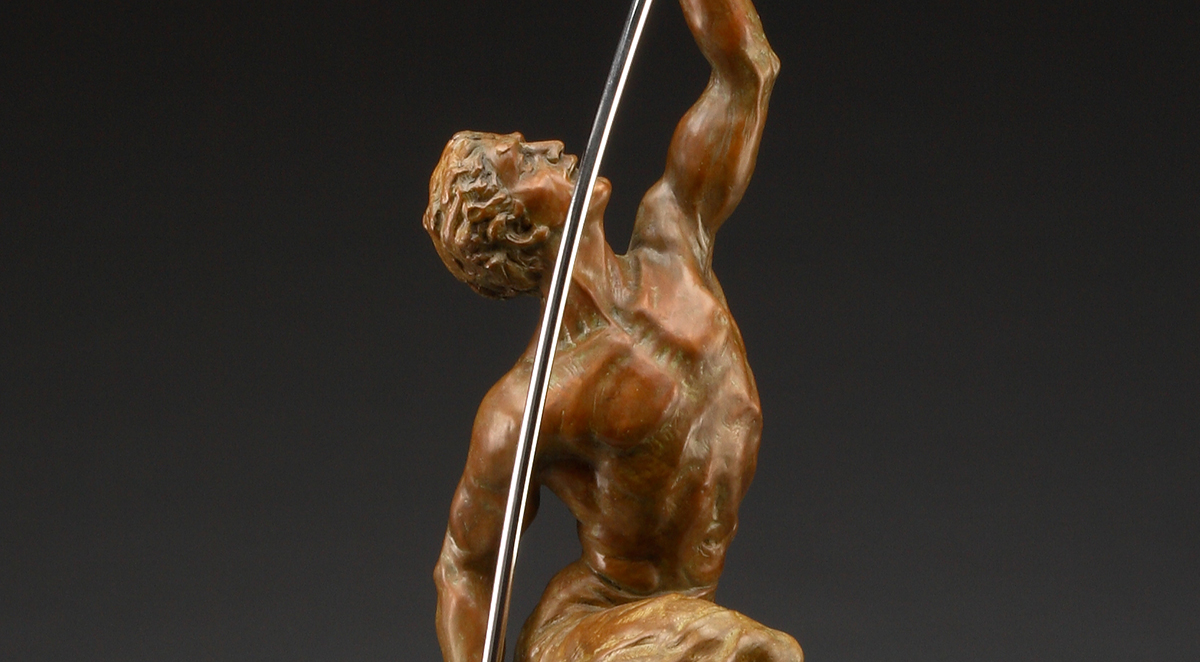
Sculptor Bobbie Carlyle creates bronze figures that examine the strength, vulnerability, and ambition at the heart of human experience. Rather than treating bronze as a static material, she gives it a compelling sense of motion and emotional presence. Her figures appear caught between thought and action, as though responding to an inner force that urges them forward. Classical sculptural traditions can be recognized in Carlyle’s attention to anatomy and form, yet her work communicates ideas that remain distinctly contemporary.
Through carefully considered gestures, expressive poses, and richly textured surfaces, Carlyle transforms the human body into a visual language. Her sculptures address courage, determination, reflection, and the desire to move beyond familiar limits. In her work, physical movement often becomes a metaphor for psychological or spiritual development. This approach is particularly evident in Endeavor, a sculpture inspired by space exploration and humanity’s enduring impulse to discover what lies beyond the known world.
Reaching Beyond the Known
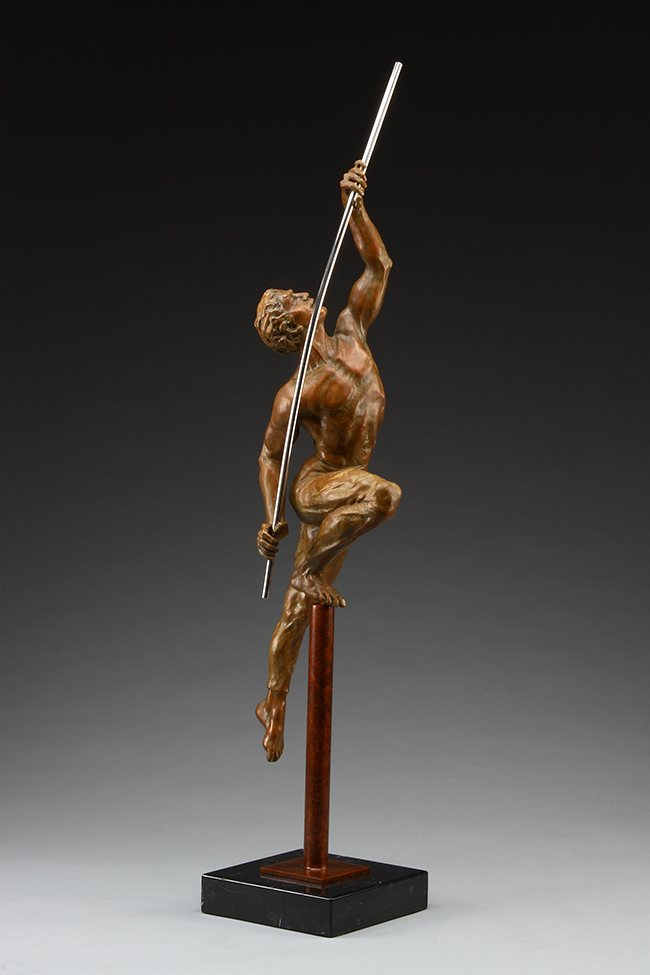
Carlyle created Endeavor during the period when NASA was launching the space shuttle Endeavour. Both the spacecraft’s name and the powerful imagery surrounding its mission influenced the development of the sculpture. Yet Carlyle’s work is not a literal representation of a shuttle launch or an astronaut. Instead, she interprets the emotional meaning of exploration through the human figure, concentrating the ambition of space travel into a personal and recognizable form.
The title is central to the sculpture’s meaning. To endeavor is to make a determined effort, particularly when the outcome is uncertain. The word suggests purpose, discipline, and the willingness to confront difficulty. Carlyle’s sculpture embodies these qualities through a figure that appears to rise, stretch, or propel itself upward. The body becomes a symbol of movement beyond ordinary restrictions, expressing the moment when determination begins to overcome hesitation.
The upward direction of the composition immediately creates a sense of aspiration. While gravity connects the figure to the earth, its energy seems focused elsewhere. This contrast produces much of the sculpture’s emotional tension. The figure belongs to the physical world, yet its posture expresses a longing to transcend it. Carlyle therefore connects the scientific ambition of space exploration with a broader human desire: the wish to grow, discover, and imagine possibilities that have not yet been realized.
Bronze gives this idea both permanence and weight. Traditionally associated with monuments and historical memory, the material allows Carlyle to present exploration as a lasting part of the human story. At the same time, her modeling prevents the sculpture from feeling rigid. Variations in the surface capture and redirect light, making the form appear to change as the viewer moves around it. Highlights emphasize the figure’s outward movement, while shadows add depth and reinforce the physical effort implied by the pose.
This relationship between weight and motion is especially significant. Bronze is dense and grounded, but Carlyle uses it to describe lift, momentum, and possibility. The apparent contradiction mirrors the experience of spaceflight itself: immense technological weight must overcome gravity before entering the openness beyond Earth. Within the sculpture, the human body carries a similar symbolic struggle. It must rise against resistance, transforming effort into forward motion.
Although Endeavor was inspired by a specific moment in the history of space exploration, its meaning extends beyond NASA and the shuttle program. The work can also be understood as a reflection on the many ways people confront the unknown. Scientific discovery, artistic creation, personal change, and emotional growth all require the courage to move without complete certainty. Carlyle’s figure gives physical form to that difficult but necessary step.
The sculpture does not present courage as effortless. Its power comes from the visible sense of exertion within the body. Strength is expressed not simply through muscular form, but through commitment. The figure appears fully engaged in its movement, suggesting that meaningful progress depends upon both imagination and sustained action. In this way, Carlyle avoids reducing aspiration to an abstract ideal. She presents it as something enacted through discipline, risk, and perseverance.
There is also a collective dimension to the work. Space exploration may involve individual astronauts, engineers, and scientists, but each mission represents the combined labor of many people and the accumulated knowledge of previous generations. The solitary figure in Endeavor can therefore stand for humanity as a whole. Its upward motion reflects a shared curiosity that has driven people across oceans, into the skies, and eventually beyond the atmosphere.
By translating the spectacle of a shuttle launch into the language of figurative sculpture, Carlyle creates an artwork that is both monumental and intimate. The viewer does not need technical knowledge of space travel to understand its central emotion. The reaching body communicates its purpose directly: it wants to move farther, rise higher, and discover what may exist beyond the present boundary.
Ultimately, Endeavor celebrates exploration as both an external journey and an internal state of mind. It honors the courage required to pursue the unfamiliar while acknowledging the effort behind every meaningful advance. Through bronze, gesture, and upward movement, Bobbie Carlyle captures a defining human impulse: the determination to imagine a future beyond current limitations and to reach toward it.
