
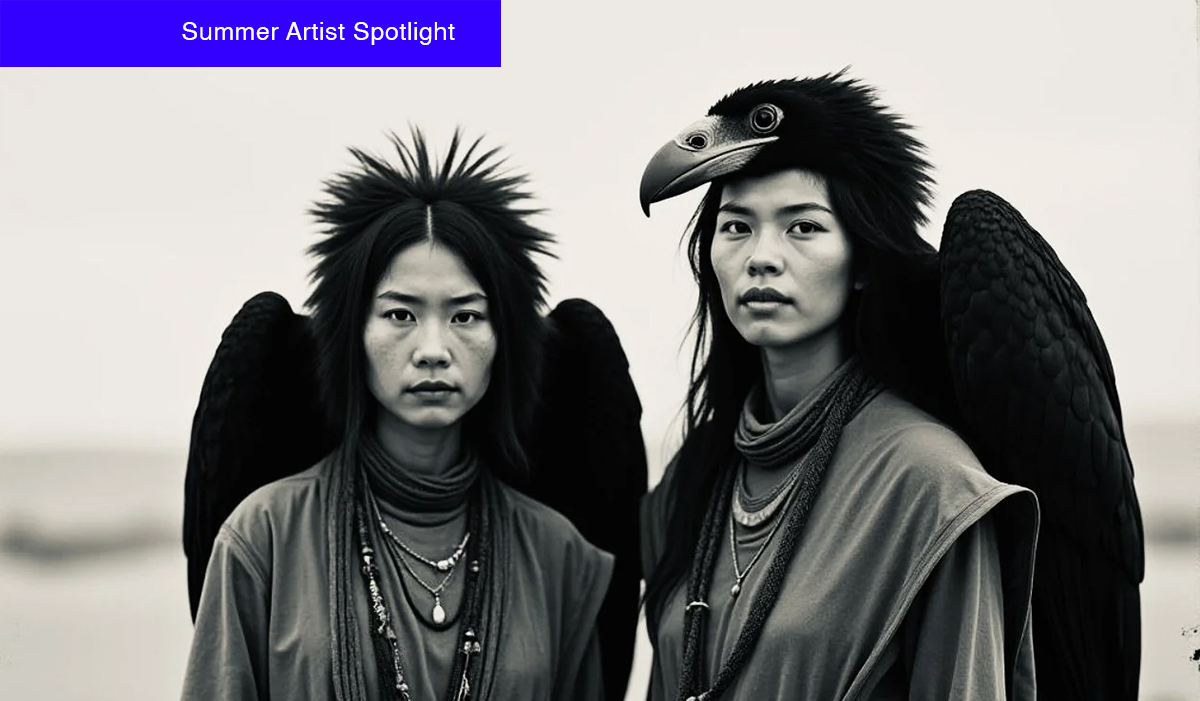
Camille Ross is an American photographer and visual artist whose work emerges from questions of heritage, identity, and belonging. Born in San Francisco in 1964, she spent her childhood between two dramatically different settings: the progressive energy of 1970s Berkeley and the rural traditions of Mississippi. Moving between these environments introduced her at an early age to different experiences of race, culture, community, and history.
Ross’s biracial identity and Cherokee ancestry have become significant foundations of her artistic practice. Working with photography and digitally constructed imagery, she explores the ways family history continues to shape the present, even when parts of that history have been lost, interrupted, or passed down only through fragments.
Roads, birds, spiritual figures, and distant landscapes recur throughout her compositions. These elements form a deeply personal visual language through which Ross considers ancestry not as something fixed in the past, but as a continuing force capable of offering protection, insight, and direction.
Reconstructing an Ancestral Passage
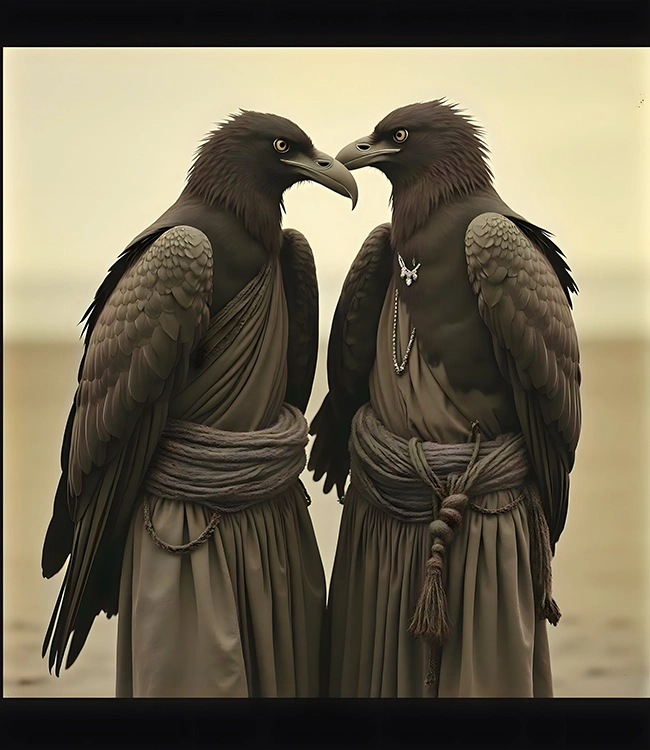
Ross created this series as a symbolic homage to the generations whose journeys preceded her own. Rather than attempting to illustrate their history as a precise sequence of events, she imagines it as a passage through geography, memory, and inherited experience.
The route she traces begins in Mongolia and continues through Siberia, across the strait into Alaska, and eventually toward the coastal regions, the Great Plains, Oklahoma, and the Cherokee Nation. Together, these places form an ancestral landscape shaped by movement, upheaval, endurance, and adaptation.
According to Ross’s exploration of her lineage, some of her ancestors traveled from Siberia into Alaska and became connected with a small coastal fishing tribe. Within the traditions that inform the series, the raven represents intelligence, healing, and guidance. It is believed to help travelers navigate uncertainty and find their way back home.
In Ross’s images, the raven therefore carries meaning beyond its physical form. It becomes a guardian of memory and a witness to journeys extending across centuries. Its ability to move between land and sky also makes it an appropriate figure for work that exists between documented history and spiritual imagination.
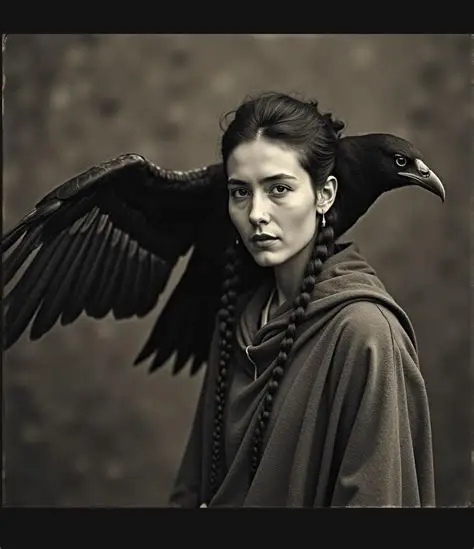
Her search into her family’s past also brought her to the Great Plains. There, Ross says she located a relative connected to the Lakota Sioux Reservation who fought at Wounded Knee. The route then continues to Oklahoma, historically described as “Indian Country,” and ultimately to the Cherokee Nation.
This portion of her family history contains stories of severe injustice. Ross identifies her great-grandmother, her great-grandmother’s siblings, and their parents as Cherokee slaves. Much of what they experienced cannot be fully recovered through official documents. Instead of attempting to fill every historical absence with certainty, Ross responds to those silences through symbolic images that recognize the suffering, dignity, and perseverance of her ancestors.
Her great-grandmother eventually had two daughters, Ojanna and Oleta. Ojanna, Ross’s grandmother, was born in the early twentieth century but died before the artist had an opportunity to know her. That absence gives the series a particularly intimate quality. Ross approaches her grandmother through family knowledge, intuition, dreams, and the emotional inheritance carried across generations.
Art becomes a place where such a meeting can occur. Through image-making, Ross creates a space in which the separation between past and present briefly narrows, allowing an imagined relationship to emerge where a direct one was never possible.
The Spiritual Language of Birds
Ravens, hawks, and eagles repeatedly enter Ross’s compositions as protectors, messengers, and carriers of knowledge. While these birds hold broader cultural associations, their importance within the series is also connected to the artist’s personal dream life.
Ross describes an especially vivid dream in which she encountered her ancestors while walking along a seemingly endless red road. The path led her away from the city and deeper into an unfamiliar landscape. During the journey, an enormous red-tailed hawk descended and landed on her shoulder.
Although the bird appeared powerful, Ross did not experience it as a threat. Its presence felt calm and protective. As the dream continued, the hawk transformed into a Native American chief, creating an image that remained with her long after she awakened.
This vision became an important source for the hybrid spiritual figures found throughout the series. Ross connects these beings to sacred traditions in which human and animal forms merge. In her compositions, birds appear alongside female healers, shamans, and falconers. Their relationships suggest companionship, mutual recognition, and the sharing of ancient knowledge.
The red road may be seen as both a physical route and an inner passage. It carries the traveler away from the distractions of contemporary life and toward a more profound encounter with heritage. The hawk’s transformation turns that journey into a moment of ancestral communication, giving visible form to wisdom that might otherwise remain unseen.
Ross has long sensed that she is watched over by those who came before her. The dream strengthened this belief and provided a visual foundation for expressing it. Through her art, protection becomes something tangible: a bird on the shoulder, a figure beside the road, or a presence waiting at the edge of perception.
Giving Form to Dreams and Inherited Stories
Photography remains central to Ross’s practice, but her methods have expanded to include digital processes and emerging image-making tools. These methods give her the freedom to create scenes that could not easily be photographed or physically staged.
The technology itself, however, is secondary to the ideas guiding the work. Ross begins with ancestral research, personal memory, family stories, dreams, and intuition. Digital tools help her give those internal experiences a visible form, but the emotional meaning and artistic direction remain rooted in her own perspective.
Her compositions combine elements of photography, portraiture, mythology, and digital collage. They do not present themselves as literal illustrations of historical events. Instead, they operate as imaginative responses to histories that have survived incompletely.
This approach allows Ross to address the limits of conventional archives. A photograph cannot restore every missing name, conversation, or experience. It can, however, create a new point of contact with the past. Where written documentation becomes uncertain or disappears entirely, the imagination offers another way to acknowledge what has been inherited.
Throughout the series, roads extend beyond the horizon, birds occupy the role of spiritual guardians, and human figures appear suspended between earthly and dreamlike realms. Migration is represented not only as movement across continents but also as a psychological journey toward understanding oneself.
Ross’s work asks how ancestral experiences continue to live within people who did not witness them directly. Her images honor generations affected by displacement, cultural disruption, and hardship while emphasizing the strength required to survive and continue.
By joining ancestral memory with contemporary visual practice, Camille Ross creates a space where different periods of time can meet. Her tools may belong to the present, but the longing behind the work is far older: the desire to recognize one’s origins, remain connected to those who came before, and follow the signs that point toward home.
