
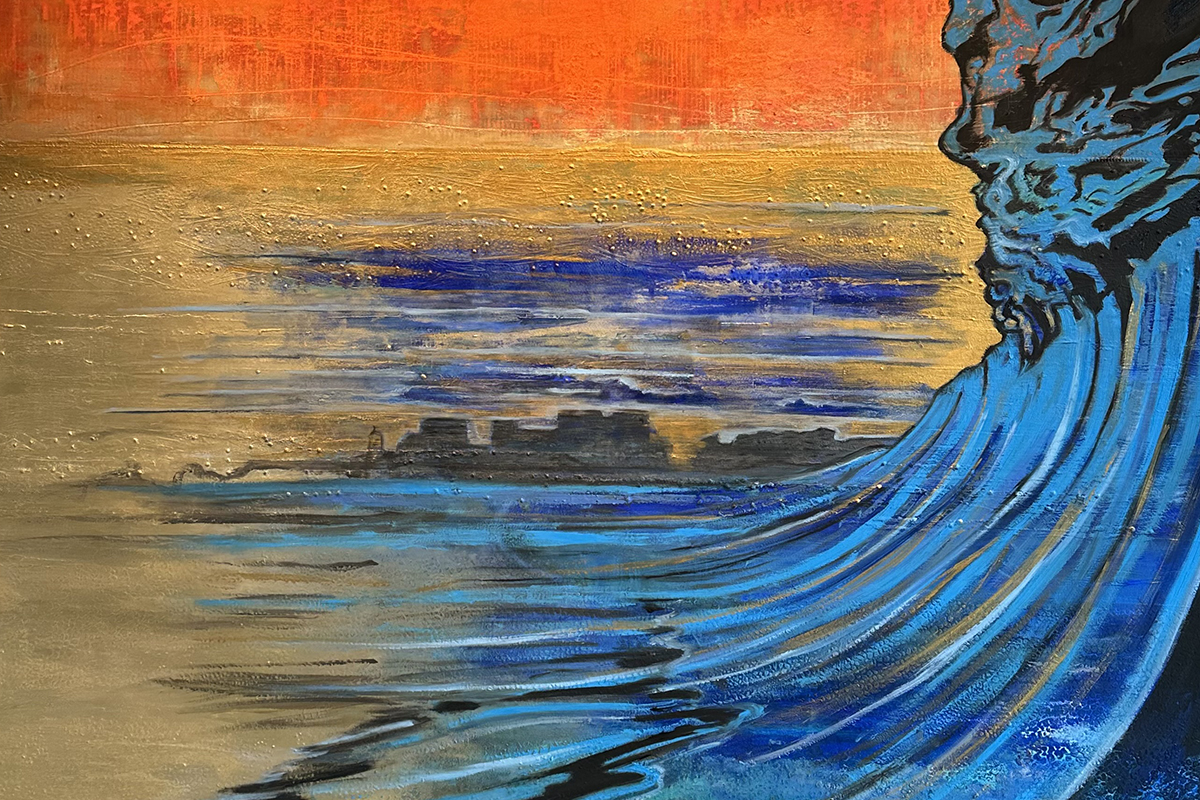
German contemporary artist Eda Groneberg creates paintings shaped by expressive color, textured surfaces and symbolic narratives. Her work considers how memory and identity influence the way people experience beauty, change and emotional renewal. Rather than presenting a single fixed interpretation, Groneberg builds visual environments in which color, movement and material invite personal reflection.
Since beginning to present her work publicly in 2024, Groneberg has exhibited in Germany, the Netherlands and Italy. Her paintings have also become part of private collections in several countries, extending her practice beyond her home in Germany. Within a relatively short period, she has developed a visual language that moves between recognizable imagery and emotional abstraction. Natural elements, atmospheric contrasts and layered surfaces often become carriers of human feeling. Through these qualities, Groneberg approaches painting as a space where inner experience can be expressed without being fully explained.
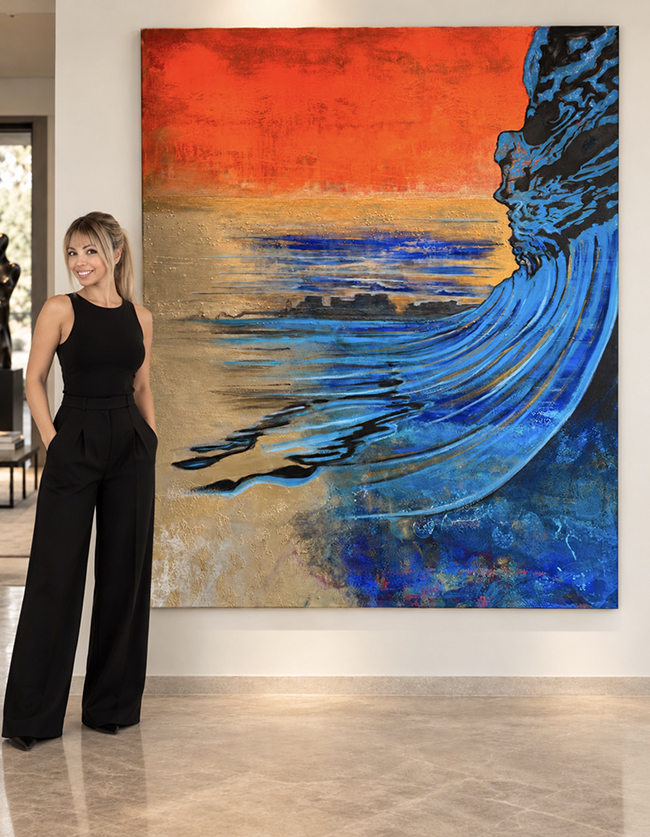
Der Wellentanz (The Dance of the Waves)
Der Wellentanz (The Dance of the Waves) is a large acrylic painting on canvas measuring 160 by 200 centimeters. Its expansive dimensions give the oceanic scene a physical presence, allowing the viewer to encounter the wave almost at bodily scale. The painting is not simply an image of the sea. It presents water as an emotional and symbolic force, balancing energy, uncertainty and the possibility of renewal.
A commanding blue wave rises beneath a red-orange sky. The contrast between these areas immediately establishes the painting’s emotional temperature. Blue may suggest depth, reflection or calm, yet the movement of the water prevents it from becoming entirely peaceful. Above it, the warm sky carries associations with heat, urgency and transition. The meeting of these colors creates a visual tension that holds the composition between opposing states.
The wave appears caught during a brief moment of suspension. It has gathered force but has not yet completed its movement. This pause gives the image a sense of anticipation. The viewer understands that the water will continue, break and change form, but the painting preserves the instant before that transformation occurs. Groneberg uses this suspended movement to explore the uncertain space between control and surrender.
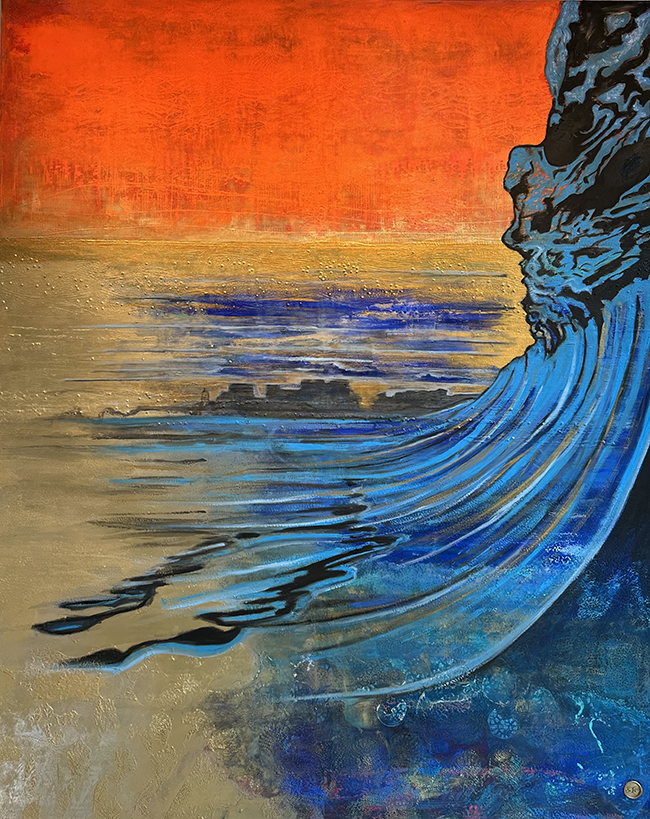
Layered texture strengthens the physical character of the water. The surface suggests currents moving in different directions, with variations in color creating depth within the wave. Darker blues imply weight and shadow, while lighter areas carry the feeling of reflected light, foam and motion. These shifts prevent the ocean from appearing static. Even within the stillness of the painted image, the water seems to breathe, gather and turn.
The title introduces another way of understanding the composition. By describing the movement as a dance, Groneberg gives the wave a rhythmic and almost human quality. A dance depends upon balance, momentum and response. It includes moments of direction as well as moments when the body must follow an established rhythm. The ocean behaves in a similar manner. Its movement is forceful, yet it remains part of a larger natural cycle.
This relationship between freedom and structure lies at the center of the painting. The wave appears independent and unpredictable, but it is also governed by tides, gravity and weather. Human emotion can follow a similar pattern. Feelings may seem sudden or uncontrollable, while still being shaped by memory, experience and circumstances. Groneberg uses the natural world to reflect this emotional complexity without reducing it to a direct explanation.
The red-orange sky adds another symbolic dimension. It could suggest sunset, approaching weather or a landscape altered by intense light. Its warmth presses against the coolness of the sea, creating an atmosphere that feels both beautiful and unsettled. The horizon becomes a boundary where contrasting emotional forces meet. It separates water from sky while also joining them within the same field of color and movement.
There is turbulence in Der Wellentanz, but the painting is not solely about conflict. The wave’s curved form carries grace alongside strength. Its movement suggests that disruption can also be part of renewal. Water breaks, disperses and returns; its shape disappears, but its substance remains. In this way, the ocean becomes an image of emotional transformation rather than destruction.
The painting may also be understood as a meditation on vulnerability. Control is often temporary, particularly when individuals confront forces larger than themselves. The ocean makes that limitation visible. Yet surrender does not necessarily mean defeat. It can represent acceptance, adaptation and the willingness to move through uncertainty.
Through scale, texture and concentrated color, Groneberg transforms a seascape into an encounter with changing emotional states. Der Wellentanz holds calm and unrest within the same image, allowing neither condition to dominate completely. The work asks viewers to remain within that tension and consider how change can carry fear, beauty and possibility at once. The dancing wave ultimately becomes a symbol of endurance: always moving, repeatedly transformed and continually returning in another form.
