
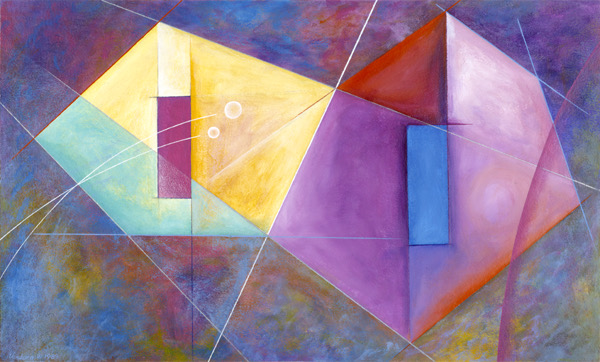
For nearly five decades, multidisciplinary artist Vandorn Hinnant has explored consciousness, intuition, ancestral knowledge, and realities that exist beyond ordinary perception. His visual art and writing emerge from personal experiences he associates with the spiritual realm, including encounters with non-physical consciousness. Rather than treating such experiences as mythology, Hinnant regards them as part of humanity’s enduring effort to understand what cannot be perceived through the five senses.
Hinnant’s philosophy is inseparable from his creative practice. His works, which he sometimes describes as “spirit whisperings,” attempt to make invisible energies visually present. Through organic forms, layered colors, symbolic structures, and intuitive mark-making, he creates images that function as records of inner experience. For Hinnant, art is more than an aesthetic object. It can become a bridge between physical existence and dimensions of consciousness that remain unseen.
Creating a Visual Language for the Unseen
In Flash of the Spirit, Hinnant considers a time when humanity’s relationship with the invisible was understood differently. Long before life and death were interpreted primarily through scientific or mechanical frameworks, ancestral cultures often recognized the spiritual world as an active part of existence. The living, the departed, and other forms of consciousness were not always viewed as completely separate. Ritual leaders, visionaries, and shamans served as intermediaries capable of moving between visible and invisible realities.
This historical relationship between humanity and the spirit world provides an important foundation for Hinnant’s artistic practice. His work does not attempt to illustrate a specific religion or offer a fixed explanation of spiritual existence. Instead, it invites viewers to recognize that consciousness may extend beyond the boundaries of the physical body and the familiar world.
Hinnant began developing this visual language at an unusually early age. He had been intentionally making marks since he was five years old, but his practice changed significantly when he reached thirteen. At that time, he began drawing what he understood as inner visions. These early images became the beginning of an extended creative investigation that would continue for approximately fifty years.
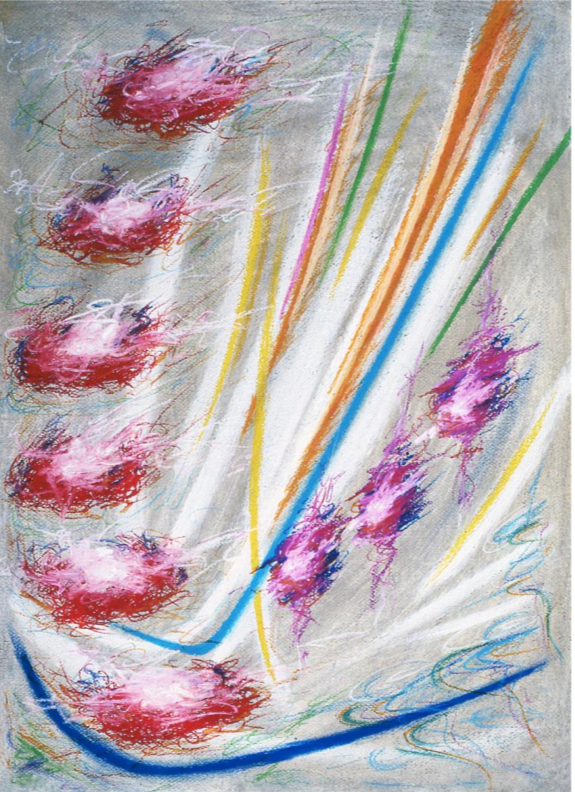
Over time, the drawings evolved into a substantial body of work that Hinnant calls his “organic abstractions.” Some compositions contain loosely arranged areas of color that suggest energetic or sentient presences. Others feature more organized structures resembling biological forms enlarged beneath a microscope. Although the images may appear connected to cellular organisms, natural systems, or imagined landscapes, they do not originate solely from observing the physical environment. They are visual interpretations of sensations, impressions, and forms encountered internally.
The spontaneity of Hinnant’s mark-making is therefore accompanied by a deeper purpose. Each line, shape, and field of color becomes part of an evolving vocabulary through which he records experiences that resist literal representation. The works do not depict the invisible in a documentary sense. Instead, they offer possible visual equivalents for energies and forms of consciousness that cannot be photographed or observed with the physical eye.
Hinnant later encountered the writings of Carlos Castaneda, whose books introduced a wide Western audience to accounts of shamanic knowledge associated with an alleged lineage of Yaqui sorcerers. Castaneda’s references to “inorganic beings” gave Hinnant a new conceptual framework for understanding the figures and presences that had appeared throughout his art. He began to consider whether the forms he had recorded for years might represent non-physical but sentient entities.
This recognition did not initiate Hinnant’s imagery; rather, it provided language for a practice that had already developed intuitively. His art frequently appeared before an intellectual explanation for it was available. In this sense, intuition preceded analysis. The creative act allowed Hinnant to document experiences first and interpret their meaning later.
His affinity with Hilma af Klint further strengthened this understanding. Encountering her work and life story during the Guggenheim Museum’s 2018–2019 exhibition Hilma af Klint: Paintings for the Future brought Hinnant a powerful sense of recognition. Af Klint’s spiritually informed abstractions demonstrated how an artist might create an extensive visual record long before the broader culture possesses the language needed to understand it. For Hinnant, discovering her practice felt like a homecoming and helped him accept his own position within an artistic timeline that had sometimes left him feeling displaced.
The full scope of Hinnant’s organic abstractions remains difficult to summarize. Numerous drawings were developed into completed works, while others continue to exist as black-and-white studies on paper. Together, they form an archive spanning much of his life. Works such as Serendip and Analogue, which remain in his private collection, hold particular significance as markers of his sustained engagement with this investigation.
Today, Hinnant serves as both creator and caretaker of this extensive body of work. Flash of the Spirit reflects a lifelong attempt to preserve encounters with the intangible and to restore attention to humanity’s intuitive capacities. His abstractions ask viewers to look beyond recognizable subjects and consider whether a painting can carry traces of consciousness, memory, and presence. Through these images, the invisible is not presented as fantasy, but as a reality waiting to be felt.
