
Keith McHugh approaches art as an opening into the private territories of the self. Guided by honesty and instinct, he transforms thoughts, emotions, memories, and spiritual questions into visual and written forms. His work does not simply reveal what can be seen on the surface. It reaches toward the hidden aspects of identity that often remain unspoken. Through imaginative symbolism and poetic language, McHugh creates a space where personal reflection becomes a shared human experience.
This sense of openness is central to his creative voice. Art becomes both a doorway into his inner life and a key capable of unlocking feelings that may otherwise be difficult to express. Rather than separating poetry from imagery, McHugh allows words and pictures to flow together. Each contributes to an unfolding meditation on consciousness, time, creativity, and the unpredictable journey of being alive.
Thought Streams From the River of Life
In Thought Streams From the River of Life, Keith McHugh presents creativity as a natural current moving through the mind. The poem begins at the instant an idea surfaces and the artist searches for a pen. That modest action signals the beginning of an inward journey. A fragile sheet of paper waits while the artist’s fingers move, thoughts gather, and ink begins to dance. Writing is portrayed not as a carefully controlled procedure but as an organic event shaped by mood, emotion, and intuition.
The recurring image of water gives the poem its rhythm and philosophical depth. Thoughts emerge from an ocean before joining the larger “River of Life.” This metaphor suggests that an individual mind is part of something far greater than itself. A single idea may feel private, yet it arises from experiences shared across humanity: uncertainty, growth, memory, hope, fear, and the desire to understand where life is leading.
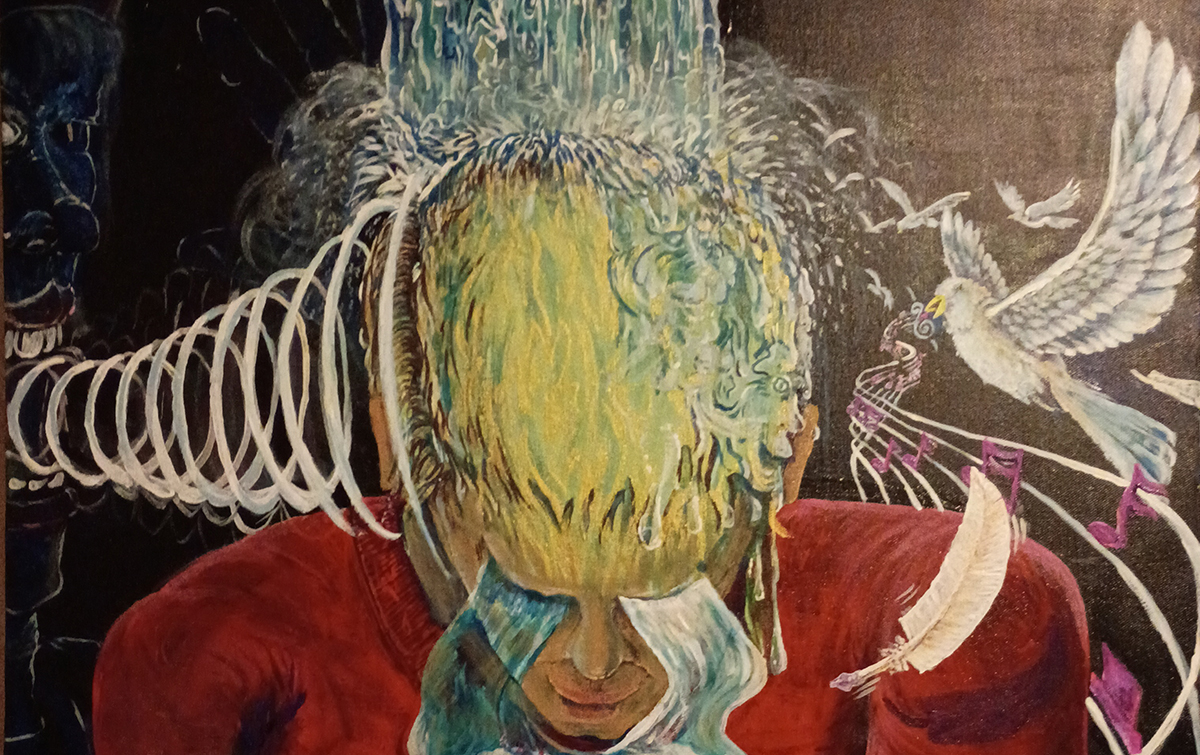
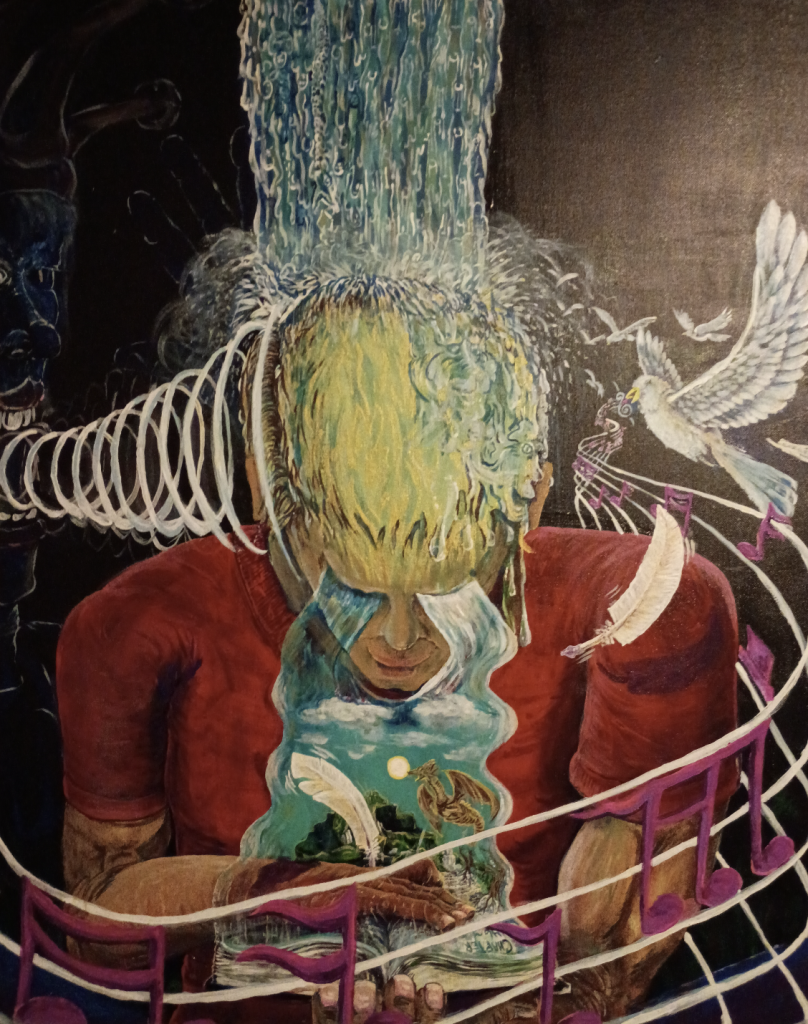
McHugh’s accompanying artwork expands this metaphor into a surreal visual narrative. At its center, a seated figure leans over a page, apparently absorbed in writing. His downward gaze and enclosed posture communicate intense concentration. Water appears to pour through and over his head, transforming the mind into a channel through which thoughts continuously pass. The boundaries separating consciousness, body, landscape, and imagination begin to dissolve.
A river-like opening travels through the figure’s face and torso, revealing another world within him. Clouds, water, moonlight, vegetation, and a fantastic winged creature occupy this interior space. These images suggest that creative expression contains many levels of awareness. Memory and fantasy coexist, while the ordinary act of writing becomes a passage into a vast internal landscape.
Around the figure, curving musical lines and vivid notes move across the composition. Birds fly through the dark surrounding space, while feathers appear to drift between the physical and imaginative realms. Together, these elements give visual form to the poem’s description of words “creating motion.” Thought is not represented as silent or stationary. It has rhythm, sound, direction, and the ability to travel beyond the person who first gives it shape.
The contrast between the dark background and the luminous blues, greens, whites, and purples intensifies the sensation of ideas emerging from the unknown. The surrounding darkness may be understood as the unconscious, the unexplored mind, or the uncertainty that accompanies every creative beginning. Against it, the white birds and flowing lines introduce movement and possibility. Creativity becomes a force capable of bringing light, music, and meaning into an undefined space.
The poem gradually turns from the mechanics of writing toward a broader meditation on time. McHugh acknowledges that people are always growing without knowing exactly where they are going. Life moves forward like a river, carrying the individual through experiences that cannot be fully predicted or controlled. Yet within this constant movement, the artist identifies one point of stability: “NOW.”
The present moment is described as the only time truly visible. By slowing down and entering it fully, the artist recognizes the present as a gift. Writing preserves this brief instant, turning something temporary into an imprint. A feeling that might have disappeared becomes a line; a thought becomes a rhyme; an experience becomes a theme capable of reaching another person.
This idea gives Thought Streams From the River of Life its emotional center. The work is not merely about inspiration or the act of composing a poem. It concerns the way art allows people to become conscious of their own existence. Creativity pauses the river without stopping it. It captures one moment while acknowledging that life will continue to change.
McHugh ultimately portrays the artist as both witness and vessel. Thoughts move through him, but he must choose to receive them, record them, and give them form. Through this union of poetry and imagery, the inner world becomes visible. Thought Streams From the River of Life invites viewers to listen to their own mental currents, value the present, and recognize creation as a living record of who they are becoming.
