
Born in Moscow, Idaho, in 1959, Linda Hyatt Cancel developed an awareness of the Pacific Northwest landscape at an unusually early age. One of her first encounters with the emotional power of light occurred when she was only fifteen months old, as she watched fireworks illuminate the sky above the Snake River. That childhood experience became an enduring point of connection between memory, atmosphere, and the natural world. Throughout her painting practice, Cancel has continued to observe how illumination can transform familiar surroundings, making ordinary places appear mysterious or momentarily unfamiliar. Rather than describing a landscape through precise detail, she focuses on what light permits the eye to see and what darkness allows the imagination to complete. Her paintings are shaped by subtle transitions, softened forms, and a sensitivity to changing weather and time. Through these qualities, Cancel presents nature as both a visible environment and a space for reflection, emotion, and memory.
The Whole World Was Blue Velvet
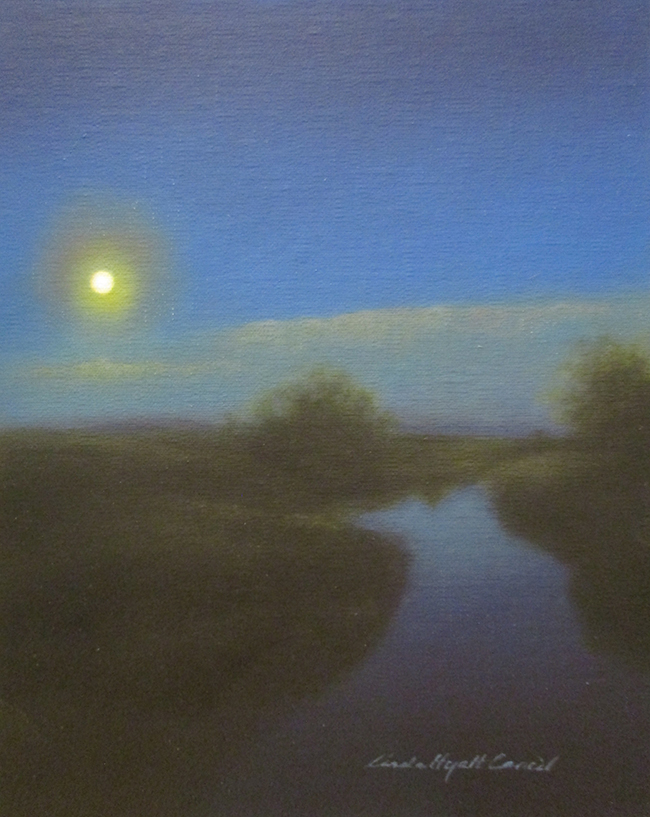
Linda Hyatt Cancel’s The Whole World Was Blue Velvet was created for a recent exhibition titled CAERULEUM, named after the Latin word associated with the color blue. While other participating artists considered the personal or symbolic meanings of blue pigment, Cancel approached the subject through the experience of twilight. The choice reflects her ongoing fascination with transitional light and with landscapes that seem to exist between visibility and obscurity.
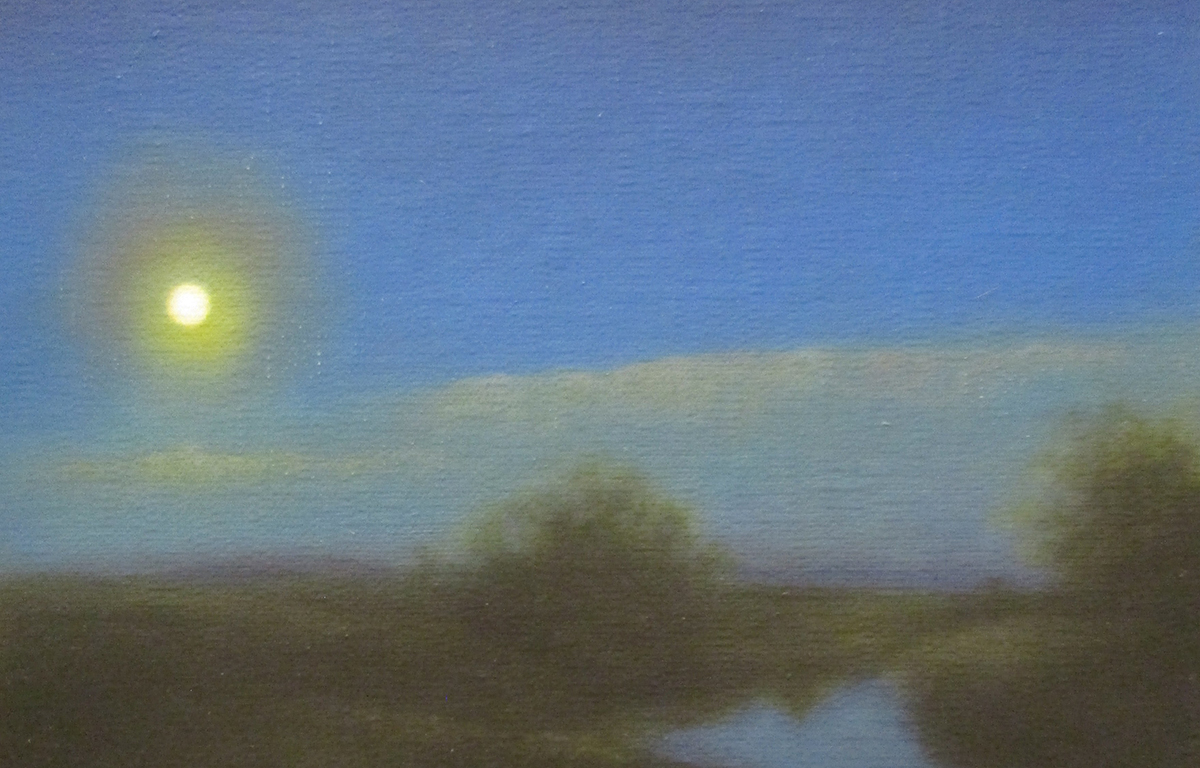
Painted in oil on a 10-by-8-inch linen panel, the work portrays a quiet body of water beneath an expansive blue sky. A glowing orb appears toward the left side of the composition, suspended above a low horizon. It may initially suggest a moon, yet the unusual yellow-green radiance surrounding it creates uncertainty. Cancel does not insist upon a single reading. The light could belong to early morning, approaching night, or a moment when the distinction between the two becomes difficult to determine.
This uncertainty is central to the atmosphere of the painting. Twilight occurs at both dawn and dusk, making it a threshold rather than a fixed time. One version announces the day, while the other gradually withdraws it. In Cancel’s work, these opposites appear to overlap. The landscape seems to be awakening and disappearing at once, holding the viewer within a brief interval when familiar forms lose their definition.
A narrow channel of water begins near the lower right and travels into the distance, guiding the eye toward the horizon. Its muted blue surface reflects the sky but does not reproduce it exactly. Lavender and violet tones emerge near the foreground, while pale blue appears farther away. These subtle changes give the water emotional depth and demonstrate how Cancel understands blue through its relationships with neighboring colors.
The artist has described blue as a mystery, explaining that she recognizes it most clearly in relation to green and lavender. That idea is visible throughout the painting. Blue never appears entirely isolated. It moves into smoky turquoise, softened violet, gray, and touches of green. Through these transitions, Cancel avoids presenting color as something stable or easily named. Blue becomes an atmosphere created through comparison, proximity, and shifting perception.
The land surrounding the water is deliberately indistinct. Dark vegetation gathers along the banks, while trees and shrubs appear as blurred silhouettes rather than carefully described botanical forms. Their softened edges suggest distance, mist, or the limitations of vision in low light. They also allow the landscape to operate like a memory. One recognizes its general character without being able to recover every detail.
Across the horizon, a pale band of clouds stretches horizontally through the composition. These clouds gently divide the luminous sky from the darker earth below, establishing a quiet structural balance. The upper portion feels open and weightless, while the lower half is dense, shadowed, and enclosed. The water connects these contrasting areas, carrying the blue of the sky downward into the darkness.
Although the panel is intimate in scale, the scene feels spacious. Cancel creates this sense of openness through the broad sky and the receding waterway. The small dimensions encourage close viewing, as if the observer were looking through a window or holding a private landscape in their hands. Its restraint prevents the image from becoming theatrical. The painting’s power instead develops gradually through stillness and sustained attention.
The title, The Whole World Was Blue Velvet, adds a tactile and poetic dimension to the scene. Velvet suggests softness, richness, and a surface that changes according to the direction of light. These qualities closely parallel Cancel’s treatment of the landscape. Her blue atmosphere appears smooth yet variable, concealing forms while revealing delicate shifts in color. The word “whole” expands this modest scene into something immersive, suggesting a moment when blue seems to surround everything.
Ultimately, the painting is less about identifying a particular location than experiencing a change in perception. Cancel uses twilight to show that concealment can heighten awareness rather than diminish it. As details fade, color, light, and feeling become more pronounced. The Whole World Was Blue Velvet captures a world poised between day and night, where nature becomes quiet enough for mystery to enter.
