
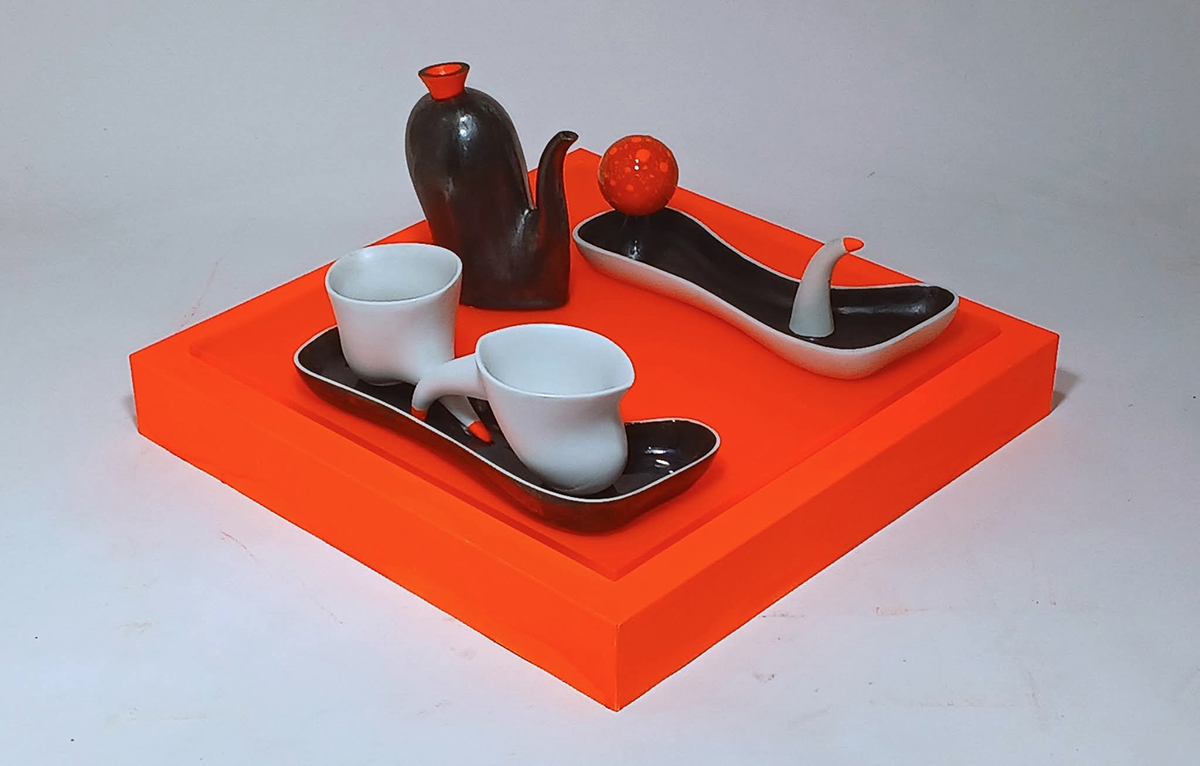
Sylvia Nagy works at the intersection of skilled craftsmanship, industrial processes, and personal expression. Her ceramic forms carry an emotional presence while reflecting broader questions about technology, production, and a world defined by continual movement. Nagy’s education encompasses both industrial design and fine art, giving her a distinctive understanding of how an idea becomes a physical object. She earned an MFA in Silicet Industrial Technology and Art from Moholy-Nagy University of Art and Design in Budapest, where she developed an extensive knowledge of fabrication and material structure. Her practice later expanded through her association with Parsons School of Design in New York, where she taught and developed a course devoted to plaster mold model-making. By bringing this traditional process into conversation with contemporary artistic thinking, Nagy established an approach that is technically disciplined yet open to experimentation. Her work remains grounded in direct studio practice while connecting materials, methods, environments, and experiences.
Collision
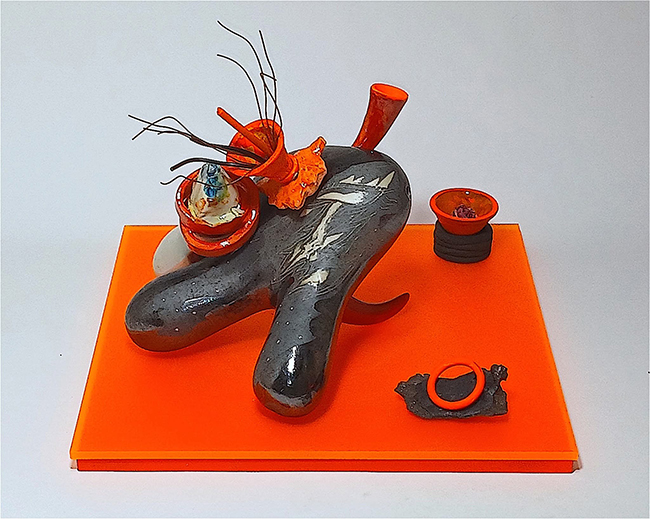
In Collision, Sylvia Nagy transforms slip-cast porcelain into an animated gathering of forms. The sculpture appears to capture a moment when separate objects meet, overlap, and become temporarily locked together. Some elements resemble familiar domestic vessels, yet their identities remain uncertain. A central black form recalls a pitcher, kettle, or elongated container, while surrounding shapes suggest trays, bowls, spouts, handles, and lids. Nagy draws upon the visual language of functional ceramics but frees these forms from practical use.
The title immediately introduces a sense of impact. A collision can be destructive, accidental, productive, or transformative. Here, however, the event does not appear violent. Instead, it has been suspended and carefully organized. The individual components press into one another without losing their distinctive outlines. This creates a tension between disorder and control. The sculpture may initially resemble the aftermath of an accident, but its considered arrangement reveals a highly deliberate composition.
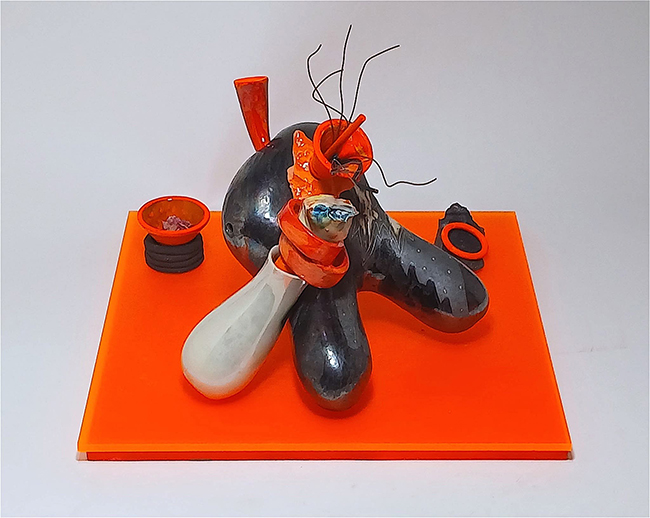
At the center, the tall black vessel provides the work with its strongest vertical presence. Its rounded body and narrow rising curve suggest movement, as though the form is leaning or reaching through the surrounding objects. A small red-orange piece sits at its top, creating a sharp accent against the dark surface. Nearby, a pale curved element rises from the long container in front. These upward gestures establish an active rhythm, leading the eye through the work rather than allowing it to rest on a single object.
The horizontal elements perform an equally important role. A long, shallow porcelain form stretches across the foreground, grounding the arrangement and defining its lower boundary. Behind it, angular containers create a compressed architectural setting around the central figure. The entire group rests on a bright orange rectangular platform. This base does more than support the sculpture: it becomes part of the image, introducing a vivid field of color that unifies the separate forms.
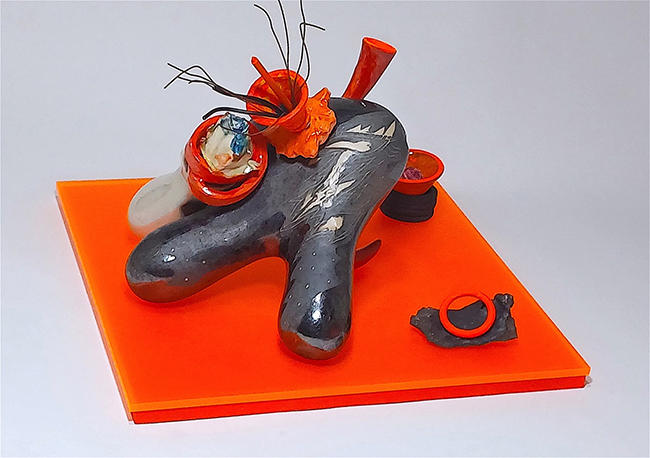
Color intensifies the sculpture’s sense of confrontation. Black, white, red, and orange are distributed across the composition in bold contrasts. The glossy black surfaces absorb and reflect light, giving the darker objects visual weight. White porcelain provides moments of openness, while the red and orange areas generate heat, urgency, and energy. A circular red form positioned toward the left resembles a displaced lid or wheel, adding another suggestion of movement. Its rounded geometry interrupts the surrounding angles while echoing the curved body of the central vessel.
Slip-casting is particularly significant to the meaning of Collision. The process involves pouring liquid clay into plaster molds, allowing forms to be reproduced with consistency and precision. It is closely connected to industrial production, yet Nagy employs it within a singular sculptural arrangement. This relationship between repetition and individuality reflects her background in both technology and fine art. Each component may possess the clarity of a manufactured object, but its placement introduces unpredictability, narrative, and emotion.
Porcelain also carries its own contradictions. It can appear refined and durable, yet it remains vulnerable to fracture. In Collision, that fragility heightens the tension implied by the title. The viewer understands that these objects could break if they truly crashed together. Nagy turns that possibility into a permanent state of anticipation. The collision has occurred, or is perhaps still occurring, but the material holds everything in place.
The sculpture can also be read as a reflection on contemporary experience. Daily life brings people, technologies, memories, and environments into constant contact. Boundaries blur as different systems overlap. Nagy’s clustered objects suggest this condition without illustrating it literally. Familiar forms become participants in a larger network, each retaining part of its identity while being altered by proximity to the others.
Despite its conceptual depth, Collision remains playful. Its energetic colors and almost character-like objects invite curiosity. The work shifts between still life, sculpture, and staged event, transforming ceramic vessels into active presences. Through her careful balance of structure and intuition, Nagy demonstrates that porcelain can communicate far beyond function. In Collision, it becomes a language of pressure, connection, instability, and change—a material record of separate forces meeting and forming something entirely new.
