
Close Menu
    What's Hot

    October 30, 2026

    Alan Brown: A Portrait with a Pear

    September 25, 2026

    Allan Wesaquate: Returning to an Image

    September 25, 2026
    Facebook X (Twitter) Instagram
    Art MusexpressArt Musexpress
    • Home
    • 
Exhibitions
    • Architecture

    • Museums

    • Culture

    • 
Reviews
    Art MusexpressArt Musexpress
    Home»Museums
»the best series of exhibitions
    Museums


    the best series of exhibitions

    Facebook Twitter Pinterest LinkedIn Tumblr WhatsApp Reddit Email
    Share
    Facebook Twitter LinkedIn Pinterest Email

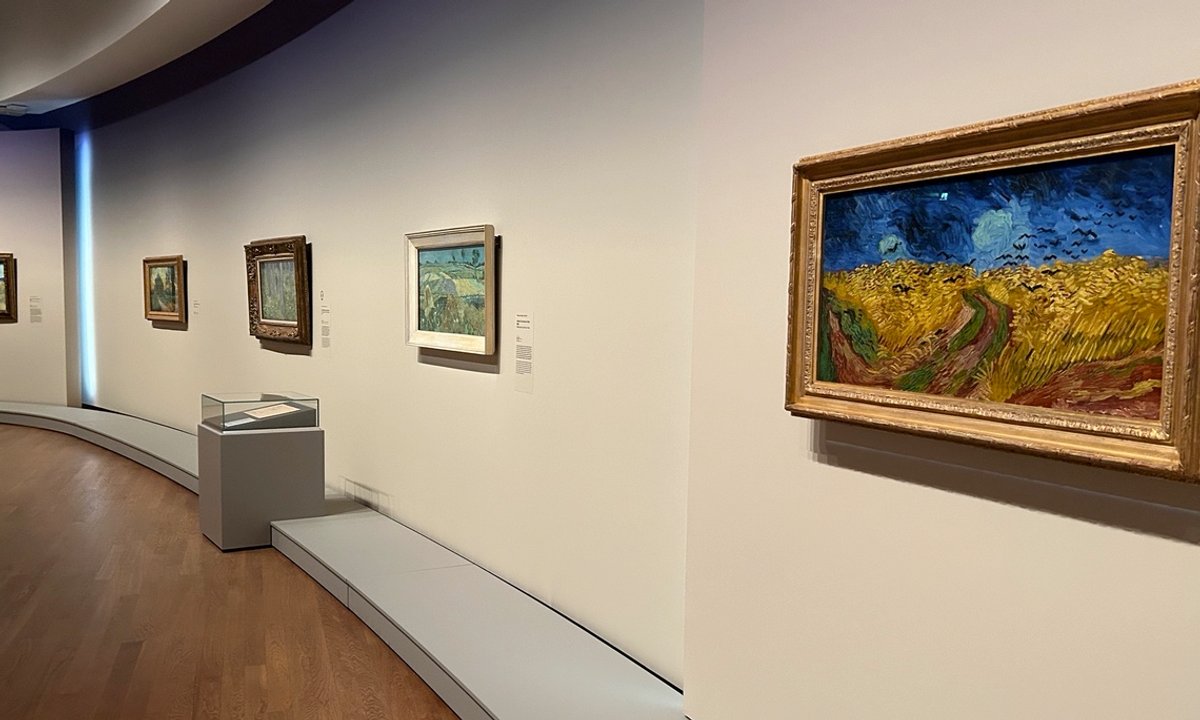
    This was the best year for Van Gogh exhibitions in decades, with a number of shows breaking new ground. If I had to highlight the most important thing, it would be Van Gogh in Auvers-sur-Oise: his last months, which opened in Amsterdam and still has a month of execution in Paris, at the Musée d’Orsay (until February 4, 2024). Featuring 47 of the 74 paintings made during this short period, it provides a comprehensive view of Vincent’s art just before his untimely death.

    Van Gogh’s cypresses, at the Metropolitan Museum of Art in New York, focused on the artist’s time in Provence, where he lived before moving to Auvers. It was there that the cypress trees became one of his favorite motifs. The show included his most popular landscape, starry night (August 1889), on loan from the Museum of Modern Art in New York.

    Van Gogh along the Seine, presenting landscapes made during Vincent’s period in Paris, opened at the Art Institute of Chicago and then moved to Amsterdam, where it still has a few weeks left to run (until January 14, 2024). Explore Van Gogh’s links with other avant-garde artists who painted along the Seine in the Parisian suburbs.

    Other outstanding shows of the year were: Choosing Vincent: Portrait of a Family Story (Van Gogh Museum, Amsterdam); Traveling with Vincent: Van Gogh in Drenthe (Drents Museum, Assen, until January 7, 2024); Van Gogh and the still life: from tradition to innovation (Sompo Museum, Tokyo, until January 21, 2024); e Vincent van Gogh: artist and reader (Museo delle Culture, Milan, until January 28, 2024).
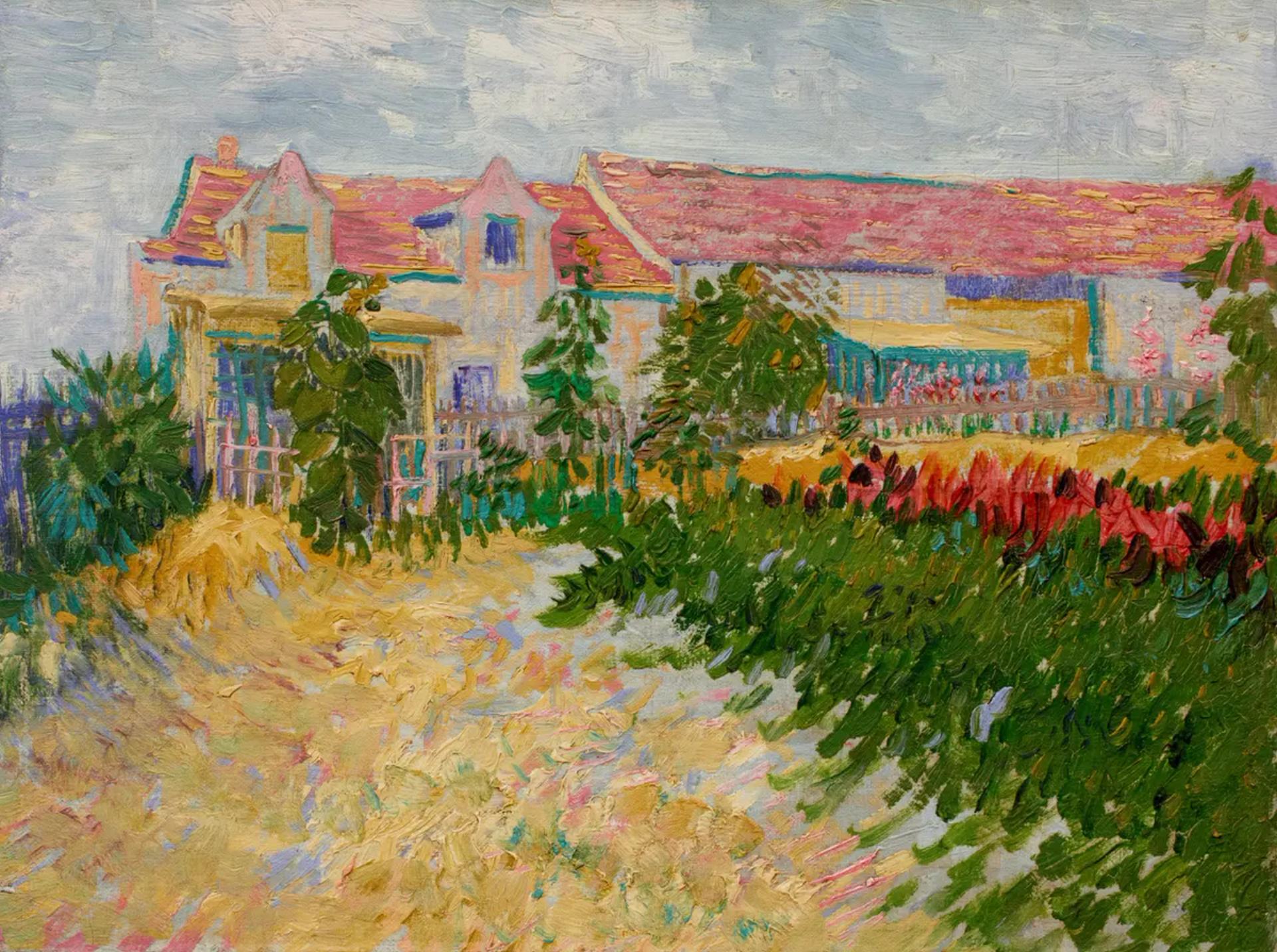
    by Van Gogh Garden in front of Debray Farm (July-August 1887)

    Credit: Sotheby’s

    When it comes to sales of Van Gogh works, the most expensive sold at auction this year was Garden in front of Debray Farm (July-August 1887), which went for $23 million at Sotheby’s on May 16. This was painted in Paris, at the top of Montmartre hill. The price may seem relatively modest compared to Garden with cypresses (April 1888), which had sold for $117 million in 2022, but that work was painted a year later when Van Gogh was in Provence and at the height of his powers.

    Two other paintings came up for auction this year, both earlier works done in the Dutch village of Nuenen, where Vincent had been staying with his parents. Weaver looking right (February 1884) sold for $5,495,000 and Woman’s Head (Gordina de Groot) (March-April 1885) for £4,842,000.

    Van Gogh’s first four drawings (1882-85) fetched lower sums: Peasant girl next to the tub (US$1,455,000), Orphan man in a top hat ($529,000), A fisherman’s head ($508,000) and Young girl with a loaf of bread ($504,000). Three versions of the engraving Portrait of Dr. Paul Gachet (June 1890) were also sold.
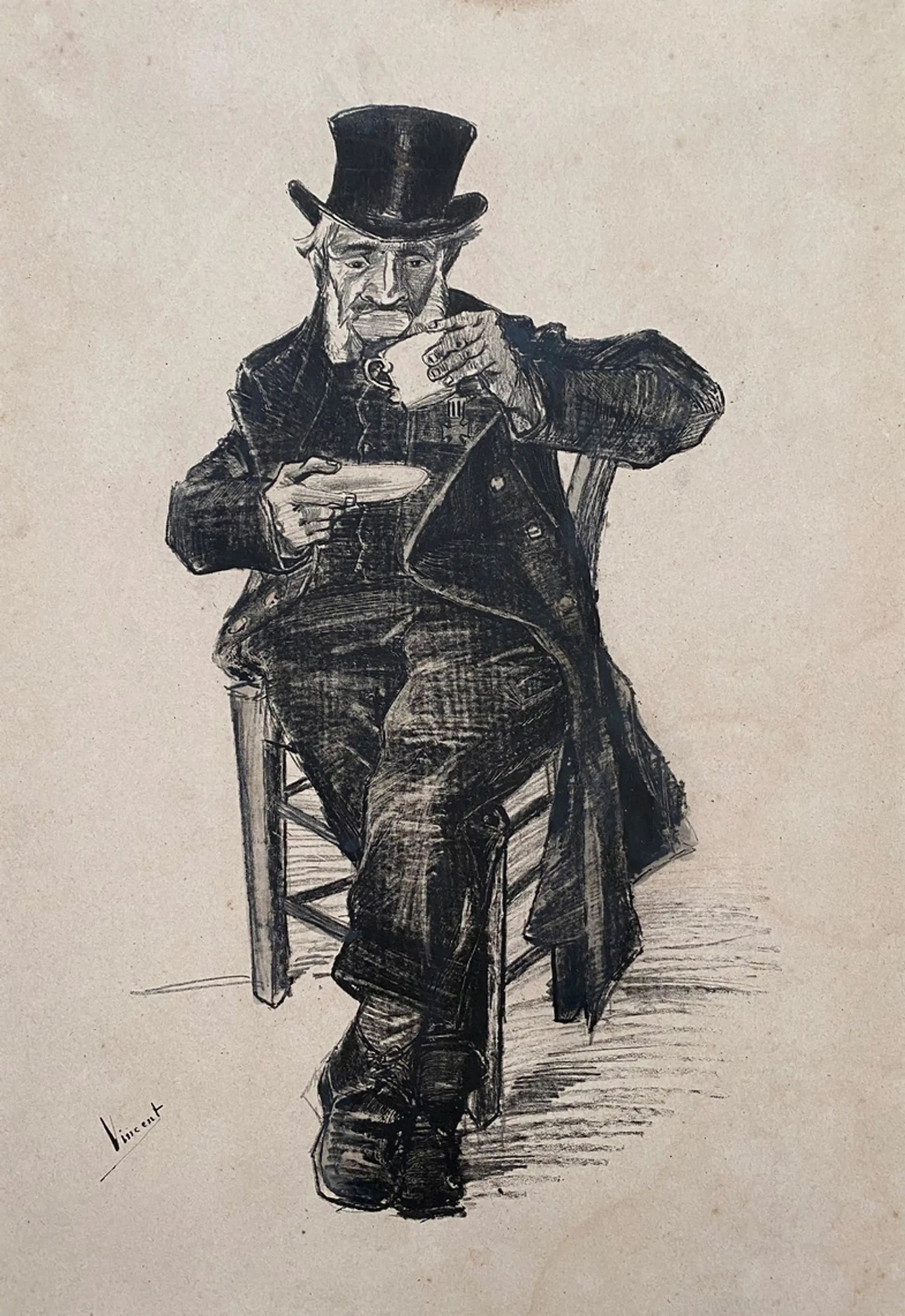
    by Van Gogh Old man drinking coffee (November 1882)

    Credit: Monique Hageman, on long-term loan to the Van Gogh Museum, Amsterdam

    But what ended up being the most surprising sale of the year was the very rare lithograph of Old man drinking coffee (November 1882). It was sold on May 10 at Leiden-based auction house Burgersdijk & Niermans, where it fetched €275,000. In an act of extraordinary generosity, the print with small watercolor additions was purchased by Monique Hageman, research assistant at the Van Gogh Museum. Hageman has given it to the Van Gogh Museum on a long-term basis, where it has just been put on temporary display, and will eventually become a legacy.

    The other uplifting news of the year was the recovery of a stolen Van Gogh, The Nuenen parish garden in spring (March 1884), which had been seized when it was on loan from the Groninger Museum to the Singer Laren museum east of Amsterdam. It had been taken in Laren during a raid in 2020. The recovery operation was organized by Dutch private art detective Arthur Brand.
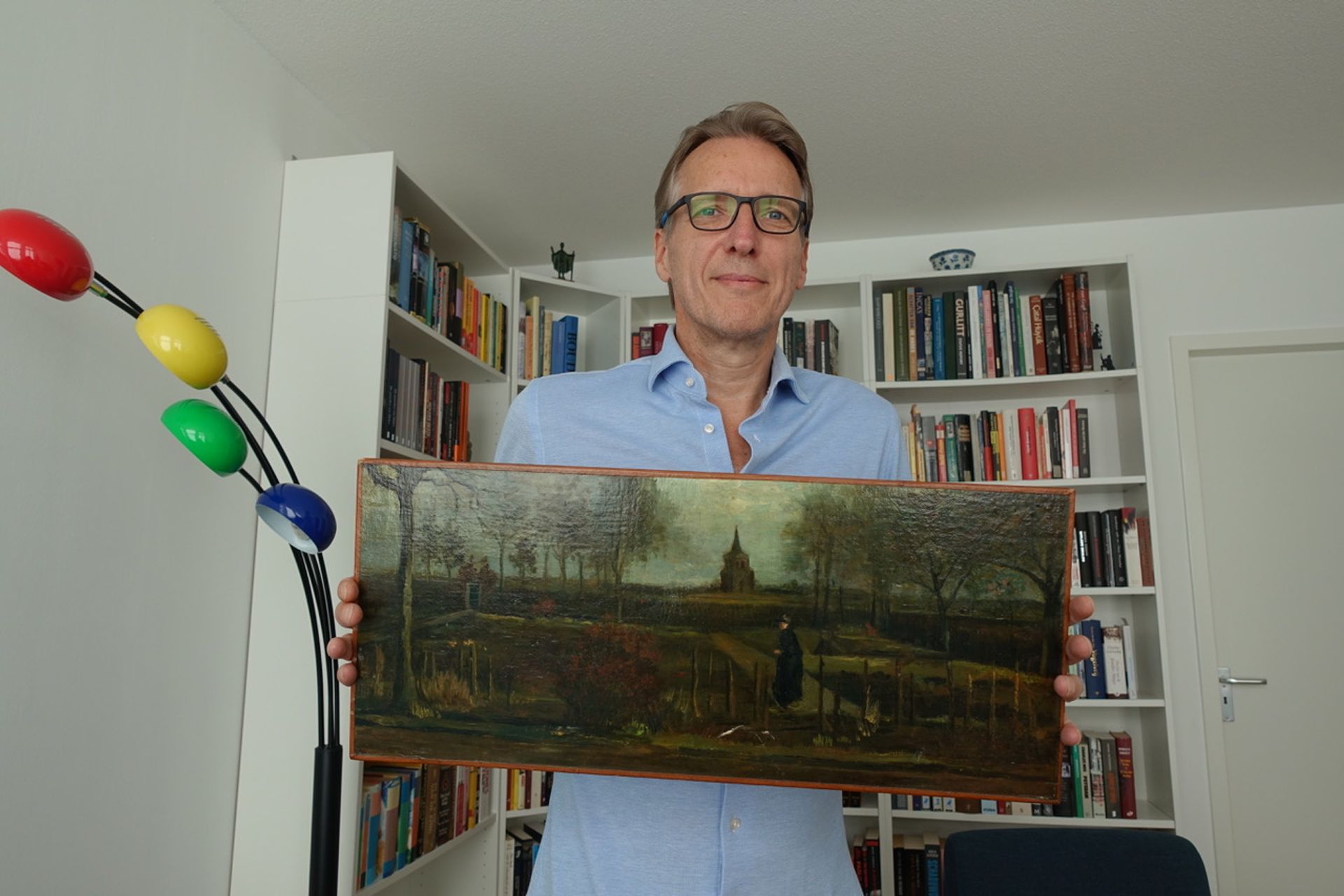
    Arthur Brand with The Nuenen parish garden in springminutes after its recovery on September 11, 2023

    Credit: Arthur Brand, Amsterdam

    Last year, two important Van Gogh buildings in the Netherlands reopened after renovations. These were the inn where the artist stayed in Nieuw Amsterdam (in Drenthe) and the visitor center/museum opposite the parsonage of the artist’s father in Nuenen.

    Among the prominent books on Van Gogh published this year was Christopher Lloyd’s The drawings of Vincent van Gogh. But nowadays much of the important new research on the artist is published in exhibition catalogues, which makes this year’s large number of shows particularly welcome.

    Other Van Gogh news:
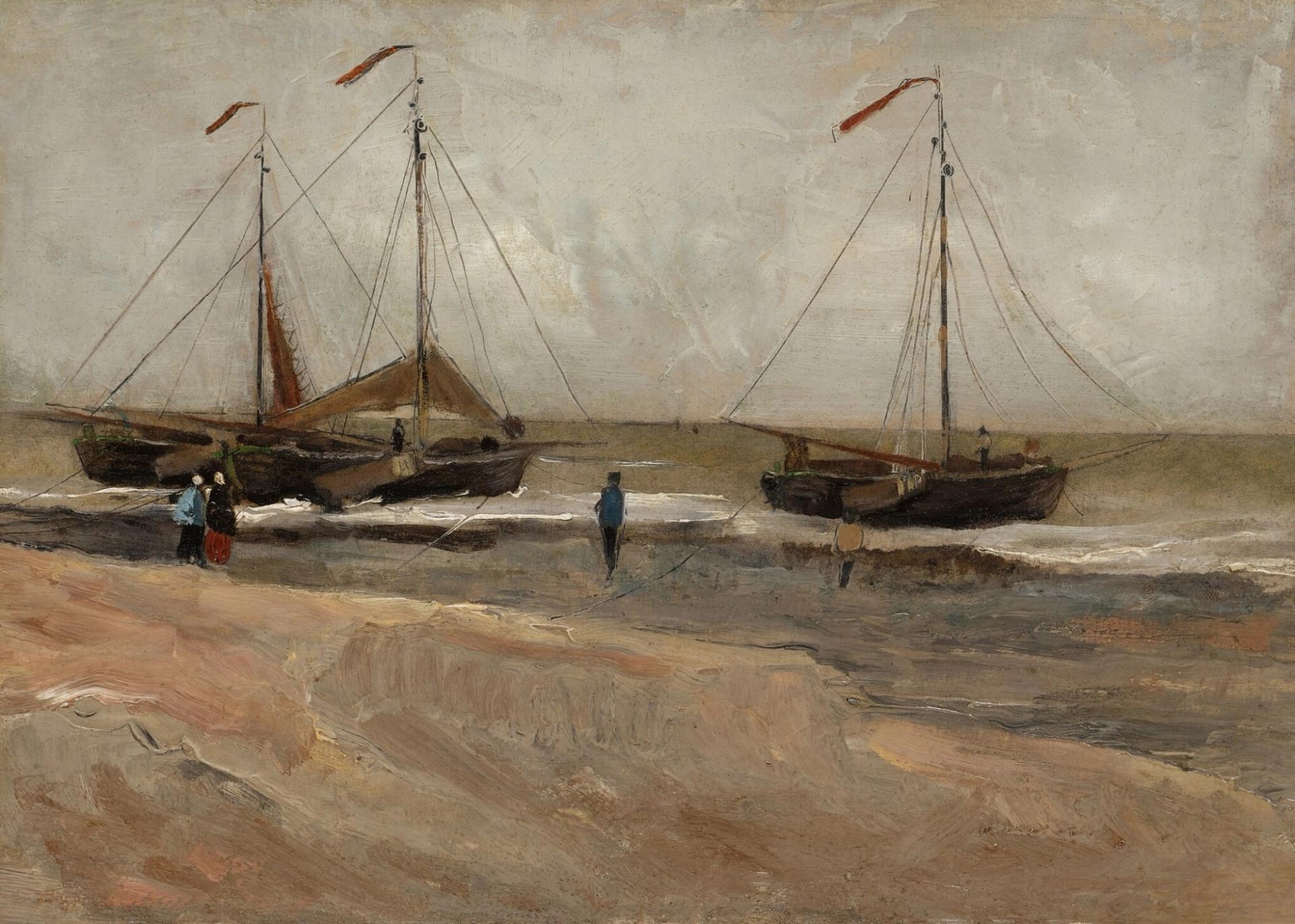
    by Van Gogh Scheveningen beach in calm weather (August 1882)

    Credit: Metropolitan Museum of Art, New York

    American television producer Dick Wolf has just donated 200 works to the Metropolitan Museum of Art in New York. These include Van Gogh’s Scheveningen beach in calm weather (August 1882), which is one of the artist’s first oil paintings. It will join what is the best museum collection of Van Gogh’s work outside of the Netherlands and France.

    Source link

    Share. Facebook Twitter Pinterest LinkedIn Tumblr Email
    Seraphina Calder
    • Website

    Related Posts

    Art World Figures share their places to go in Miami

    December 29, 2023

    How Arab artists revolutionized Paris’ modern art scene: new exhibition focuses on influx to France over past century

    December 26, 2023

    How British Museum trustees grappled with ethical and safety implications of £50m BP deal

    December 26, 2023
    Add A Comment
    Leave A Reply Cancel Reply

    Top Posts

    October 30, 2026

    How editing propels mid-career artists to new heights

    December 23, 2023

    Musician Nick Cave will present new ceramics at Xavier Hufkens in 2024.

    December 23, 2023

    Why we are drawn to “hysterical” art.

    December 23, 2023
    Don't Miss

    Sonja Kalb: Whispering Forest III — Exploring the Poetry of Nature Through Abstraction Born in Stuttgart, Germany, contemporary abstract artist Sonja Kalb brings together a refined understanding of design and an expressive approach to painting. Holding a Dipl. Ing. degree in Textile and Design, she developed a strong appreciation for material experimentation, structural harmony, and the relationship between color and form. These influences remain evident in her artistic practice, although her work has gradually moved beyond technical precision toward a more spontaneous and emotionally driven visual language. Based in Düsseldorf, Germany, Kalb creates paintings that explore the shifting qualities of nature through rich textures, fluid gestures, and vibrant color combinations. Her compositions balance moments of intensity with passages of quiet reflection, revealing an ongoing fascination with the natural environment. Through abstraction, she transforms familiar impressions of landscapes into immersive visual experiences, encouraging audiences to discover their own emotional connections with the worlds she creates. A Journey Through Color, Light, and the Natural World In Whispering Forest III, mixed media on canvas, 120 × 80 cm, Sonja Kalb presents an evocative interpretation of the natural world, where color, texture, and movement come together to suggest the mysterious atmosphere of a forest. Rather than portraying a recognizable landscape, the artist creates an imaginative environment that captures the sensations of being surrounded by dense vegetation, shifting light, and organic forms. The composition offers a compelling balance between visual complexity and atmospheric tranquility, inviting viewers to explore its many layers. A rich spectrum of greens dominates the painting, ranging from deep forest shades to brilliant turquoise and softer emerald tones. These colors establish an immediate connection with the vitality of nature, suggesting flourishing vegetation and the constant renewal of the environment. Kalb introduces darker passages throughout the composition, creating a sense of depth and mystery. These shadowed areas contrast with lighter turquoise sections, producing the impression of sunlight filtering through a dense canopy of leaves. The painting’s vertical orientation reinforces its connection to the forest. Elongated marks and downward gestures resemble tree trunks, hanging branches, and the natural patterns formed by vegetation. Yet these associations remain deliberately ambiguous. Kalb allows recognizable suggestions to emerge without defining them completely, preserving the freedom of abstraction and encouraging viewers to participate in the interpretation of the work. One of the painting’s most captivating qualities is its intricate surface. Broad, energetic brushstrokes intersect with delicate marks, translucent passages, and areas of concentrated pigment. These contrasting techniques establish a visual rhythm that moves between spontaneity and careful consideration. Certain sections appear densely layered, while others reveal glimpses of lighter colors beneath the surface. This interaction creates a sense of continuous transformation, reflecting the complexity and unpredictability of natural growth. Toward the lower portion of the canvas, pale blue and turquoise tones introduce a softer atmosphere. These luminous areas suggest an opening within the forest, perhaps a clearing, a reflection of water, or a moment when daylight reaches the ground. Scattered accents of pink, violet, and reddish orange provide unexpected points of contrast, recalling the presence of flowers, fallen leaves, or other fleeting details within the landscape. Their placement adds warmth and visual interest without disrupting the painting’s overall harmony. Kalb’s use of color extends beyond the description of natural surroundings. Green becomes a vehicle for expressing vitality, regeneration, and emotional balance, while darker tones introduce introspection and uncertainty. The luminous turquoise passages suggest openness and renewal, creating a subtle dialogue between the familiar and the unknown. Through these relationships, the painting communicates an atmosphere that feels simultaneously peaceful and alive with movement. The title Whispering Forest III introduces an additional poetic dimension. The idea of a whisper suggests something intimate, almost imperceptible, encouraging viewers to consider the quieter expressions of nature. The forest is not presented as a static setting but as a living environment filled with subtle activity. Each brushstroke seems to contribute to an imagined conversation between light, foliage, atmosphere, and the changing seasons. There is also an intriguing relationship between concealment and discovery. Certain shapes appear to emerge from the layers of paint before dissolving into surrounding colors. This visual uncertainty encourages prolonged observation, as different details become apparent with each encounter. The painting rewards curiosity, allowing its atmospheric qualities to unfold gradually rather than revealing a single, fixed interpretation. Ultimately, Whispering Forest III demonstrates Kalb’s ability to translate the sensory richness of nature into a distinctive abstract language. Through expressive gestures, luminous color relationships, and richly developed textures, she creates an environment that feels both expansive and deeply personal. The work celebrates the forest not simply as a physical place, but as a source of imagination, emotional resonance, and quiet contemplation. It invites viewers to experience nature through feeling and perception, discovering beauty within the ever-changing relationships between color, movement, and light.

    Alan Brown: A Portrait with a Pear

    September 25, 2026

    Allan Wesaquate: Returning to an Image

    September 25, 2026

    Mike Garibay: Watercolor in Motion

    September 19, 2026
    Stay In Touch
    • Facebook
    • Twitter
    • Pinterest
    • Instagram
    • YouTube
    • Vimeo
    Our Picks

    October 30, 2026

    Alan Brown: A Portrait with a Pear

    September 25, 2026

    Allan Wesaquate: Returning to an Image

    September 25, 2026
    Most Popular

    October 30, 2026

    How editing propels mid-career artists to new heights

    December 23, 2023

    Musician Nick Cave will present new ceramics at Xavier Hufkens in 2024.

    December 23, 2023
    Legal Pages
    • About Us
    • Contact Us
    • Disclaimer
    • DMCA Notice
    • Privacy Policy
    • About Us
    • Contact Us
    • Disclaimer
    • DMCA Notice
    • Privacy Policy
    © 2026 ThemeSphere. Designed by ThemeSphere.

    Type above and press Enter to search. Press Esc to cancel.