
Helena Kotnik works at a point where emotion, observation, and imagination meet. Trained across major European institutions, she brings both discipline and curiosity into her practice. She holds a Bachelor’s Degree in Fine Arts from Barcelona University and the Akademie der bildende Künste in Vienna, followed by a Master’s degree. Her background is evident, but it never feels rigid. Instead, it supports a body of work that moves freely between thought and instinct.
Her paintings function as open spaces rather than fixed statements. They invite reflection rather than deliver conclusions. Each piece feels like a fragment of a larger story, one that is shaped by memory, culture, and the shifting nature of identity. Kotnik does not separate the personal from the social. She allows both to exist on the same surface, often in tension, sometimes in harmony. The result is work that feels immediate but also layered, simple at first glance but gradually more complex the longer one stays with it.
Kotnik describes her paintings as “psychological human landscapes,” and this phrase captures the core of her approach. She is not only painting people. She is painting what surrounds them internally and externally. Emotions, social roles, cultural references, and fragments of daily life all appear together. These elements are not arranged in a strict order. They overlap, collide, and coexist, much like real experience.
Color plays a central role in how these ideas are communicated. Her palette is often bright, even playful, yet the subject matter carries weight. This contrast creates a quiet tension. The viewer is drawn in by color, then held by the content.
Her work engages with art history without becoming dependent on it. Influences can be felt, but they are absorbed and reshaped. She draws from a wide range of visual languages, creating a dialogue between past and present. This dialogue is not nostalgic. It is active. It asks how earlier ideas continue to shape current realities, and how those realities can be reinterpreted through painting.
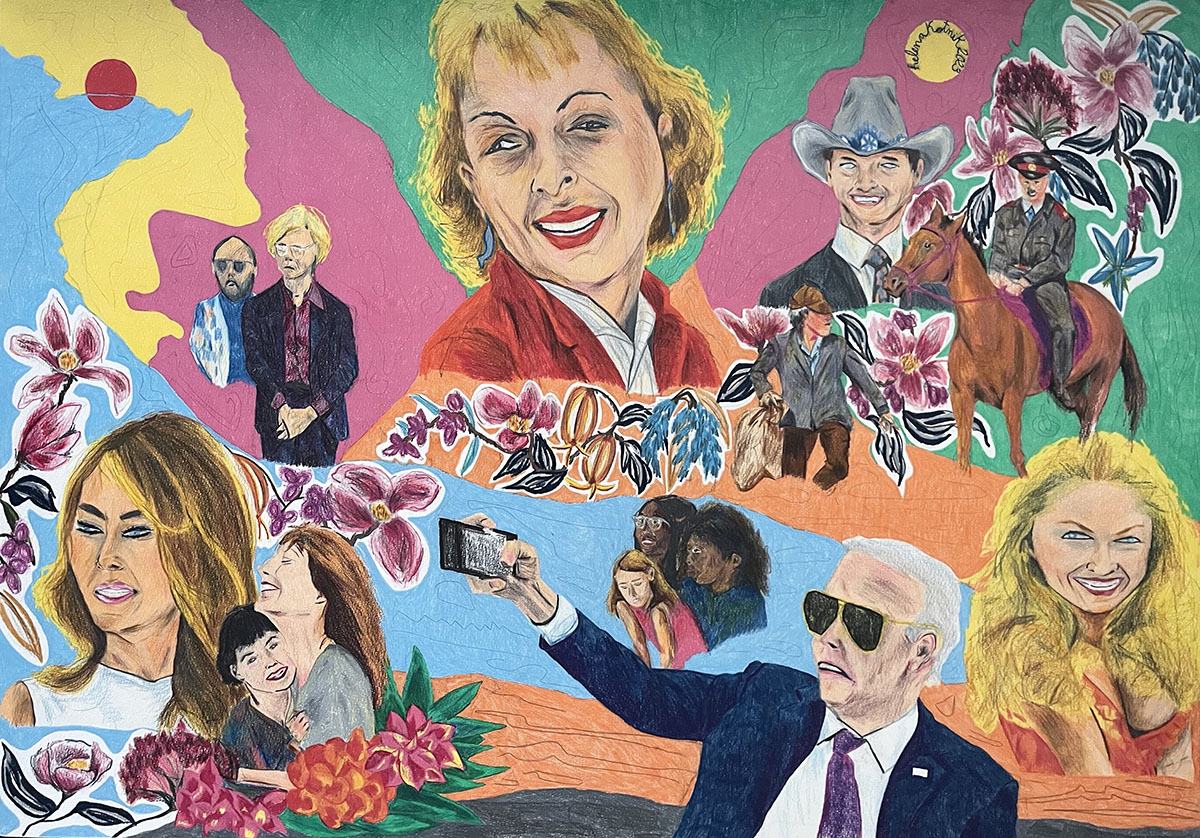
“Cultural Diversity,” created for The Other Art Fair in Dallas, offers a clear example of this approach. The painting brings together a wide range of figures and symbols associated with American culture. Recognizable personalities appear alongside cowboys, flowers, and fragments of landscape. These elements are arranged in a way that feels both structured and fluid. There is no single focal point. Instead, the eye moves across the surface, discovering connections along the way.
The painting reflects on identity, not as something fixed, but as something constructed from many influences. Dallas becomes more than a location. It becomes a stage where different narratives meet. The figures do not exist in isolation. They interact visually, even when they do not directly engage with each other. This creates a sense of shared space, where differences are visible but not separated.
The title guides the reading, but it does not limit it. “Cultural Diversity” suggests inclusion, but the painting also raises questions. How do these identities coexist. What defines a shared culture. Where do individual stories fit within a larger narrative. Kotnik does not answer these questions directly. She leaves them open, allowing the viewer to form their own interpretation.
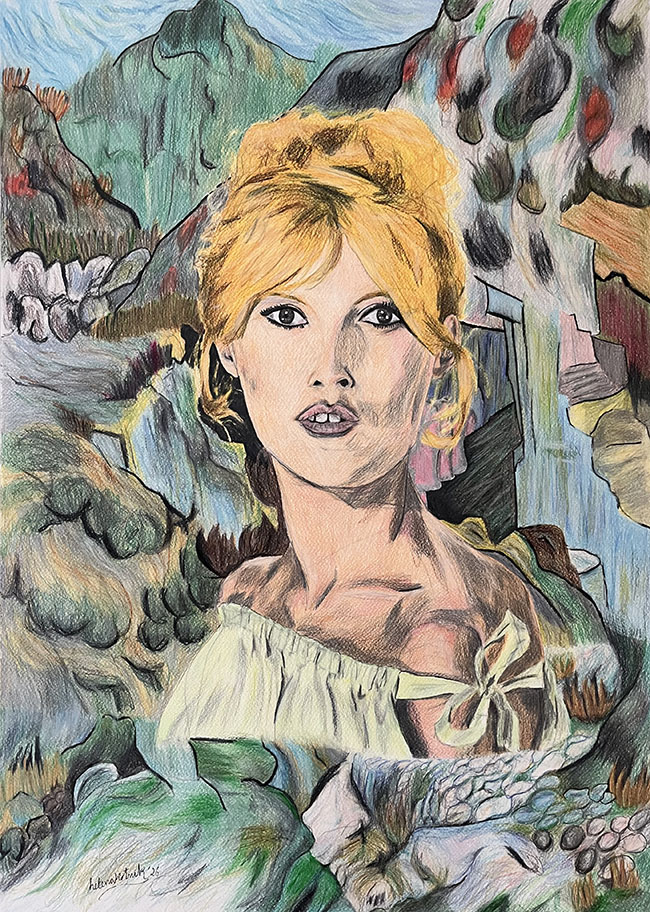
In contrast, the work titled “Shit” shifts the focus inward. It presents a more intimate and direct encounter. A single figure dominates the composition, surrounded by a fragmented, almost unstable environment. The landscape feels psychological rather than physical. Forms dissolve into one another. Colors shift unpredictably. There is a sense of pressure, as if the external world is pressing into the internal one.
The title is blunt, almost confrontational. It removes any distance between the viewer and the subject. This is not a polished or filtered version of experience. It is raw and immediate. The figure appears caught in a moment of reflection or tension, neither fully at ease nor entirely overwhelmed. This ambiguity is central to the work. It resists simple interpretation.
Here, Kotnik’s use of line becomes more pronounced. The drawing feels exposed. It reveals the process rather than hiding it. This adds to the emotional tone of the piece. The viewer becomes aware not only of what is depicted, but also of how it is constructed. The act of making becomes part of the meaning.
Across both works, and throughout her practice, Kotnik maintains a balance between clarity and openness. Her paintings are accessible, but they are not simplistic. They carry multiple layers without becoming obscure. She trusts the viewer to engage, to look closely, and to bring their own perspective into the experience.
Her work does not aim to resolve the complexities of human life. Instead, it reflects them. It offers a space where contradictions can exist without needing to be fixed. In this way, her paintings remain active. They continue to shift, depending on who is looking and when.
