

Carlotta Schiavio, also known as YaTii Talisman, moves through her work with a sense of openness shaped by a life lived across cultures. Born in Italy and raised in Ethiopia, her background draws from Italian, Russian, Syrian, Austrian, and Ethiopian roots. These influences don’t sit on the surface—they quietly inform how she sees, feels, and creates.

Her path into art didn’t begin with painting. She started in jewelry design, working with form on a smaller, more intimate scale before shifting into painting in 1998. That transition marked the beginning of a broader exploration, one that has taken her across countries and into different creative environments. Over time, her work has found resonance with a wide range of viewers, including a permanent placement at the National Library “Abrehot” in Addis Ababa in 2022.
What defines Schiavio’s practice is not just movement across geography, but movement across states of mind. Her work often carries a sense of curiosity, as if it is searching for something just beyond reach. There is playfulness, but also intention—a balance between spontaneity and care. Through her alter identity, YaTii Talisman, she builds spaces where imagination is not only welcomed but necessary.
Bugibatuki: Where Art, Joy, and Imagination Meet Healing
For the second year in a row, Carlotta Schiavio returned to the Mount Sinai Kravis Children’s Hospital with a clear intention: to bring moments of light into a place where they are deeply needed.
Invited again to take part in the hospital’s KidZone TV experience, a fully interactive broadcast studio designed for young patients, she introduced her Bugibatuki universe into the space. What followed was not just an art session, but a shift in atmosphere. The room became something else—less clinical, more open. A place where color, storytelling, and imagination could take shape.
The Bugibatuki are central to this transformation. These bright, expressive characters—part alien, part emotional language—are designed to invite participation. They are not fixed figures. Instead, they act as starting points. During the sessions, children were encouraged to go beyond watching or listening. They created. They imagined. They built their own versions of these characters, stepping into the role of storyteller and artist at the same time.
Schiavio describes these moments simply. Returning to the hospital, she shared that it continues to feel meaningful to bring small pockets of joy, creativity, and lightness into the lives of children navigating difficult circumstances. That sense of lightness is not accidental. It is embedded in the structure of the Bugibatuki world itself.
There is something direct about the way this work operates. It does not attempt to distract from reality. Instead, it adds another layer to it—one where expression becomes possible, even in environments defined by routine and treatment. Children are not asked to leave their experience behind. They are given tools to reshape it, even briefly.
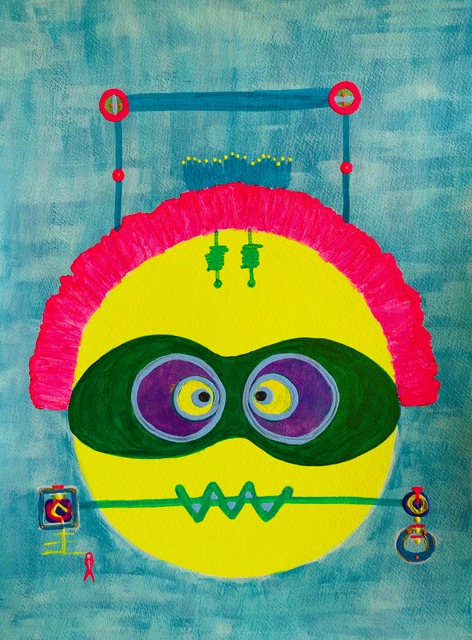
As part of this year’s visit, Schiavio extended the presence of this world beyond the session itself. She gifted an original work, Bugibatuki Xiomara, to the hospital’s Department of Arts and Medicine. The piece now lives within the space, continuing to offer its quiet presence long after the event has ended.
Bugibatuki Xiomara carries its own narrative. The character is said to have appeared in the green mountains of Chiapas, Mexico, with a purpose tied to healing—restoring the land, purifying water, and bringing renewal to the people around her. The name Xiomara, associated with strength and courage, reflects that role.
Within the hospital setting, that story shifts slightly but remains intact. The idea of healing expands. It is no longer only physical. It becomes emotional, imaginative, and shared. The character stands as a reminder that care can take many forms, and that art can exist alongside medicine without needing to justify its presence.
What stands out in Schiavio’s approach is the way she treats these interactions. They are not framed as performances or demonstrations. They are exchanges. The children contribute as much as she does. Their drawings, ideas, and interpretations become part of the experience.
Documentation from the event—photos and video—shows a consistent thread. The room fills with color. Faces shift. There is focus, but also ease. For a moment, the hospital setting recedes into the background. What remains is the act of making something.
Schiavio’s return to the program speaks to something ongoing. This is not a one-time gesture. It is a relationship that continues to build over time, shaped by repeated visits and shared experiences. Each session adds to that connection.
Through Bugibatuki, YaTii Talisman is not just creating characters. She is creating situations where imagination becomes active again. In places where control is often limited, that matters. These moments may be brief, but they hold weight.
They stay with the children who take part, sometimes in ways that are not immediately visible. A drawing, a character, a story—these can extend beyond the day they are made. They can return later, offering a sense of continuity in an otherwise disrupted routine.
Schiavio’s work here points to something simple but often overlooked. Healing spaces do not have to be defined only by treatment. They can also hold creativity, curiosity, and moments of shared attention.
And in those moments, something shifts. Not dramatically, but enough.
