
Vicky Tsalamata is an Athens-based artist and Professor Emerita of Printmaking at the Athens School of Fine Arts. Working across printmaking and mixed media, she approaches art as a space for philosophical, ethical, and political reflection. Her practice examines how individuals respond to the systems surrounding them and how personal responsibility can persist within an increasingly overwhelming society. Rather than making images that function only as decoration, Tsalamata creates visual conversations shaped by tension, irony, resistance, and an enduring search for truth. Color, texture, repetition, and light become instruments through which she addresses both collective conditions and private states of awareness. Her work frequently moves between vulnerability and strength, silence and protest, revealing the instability beneath seemingly permanent structures. Through this layered visual language, Tsalamata asks viewers to look more carefully at the world they inhabit and to reconsider their relationship with nature, society, and one another.
Interweaving Nature and Art
Tsalamata’s 2025 series Interweaving Nature and Art developed from her journey to Cambodia and her experience of the Khmer temple complexes at Angkor. Among these historic structures, monumental architecture exists in a powerful and uneasy union with the surrounding jungle. Immense tree roots descend across walls, enter openings, encircle stones, and gradually reshape buildings created to endure for centuries. The encounter became the conceptual foundation for From the Series: Interweaving Nature B and From the Series: Interweaving Nature C, two intaglio and mixed-media works measuring 100 by 100 centimeters.
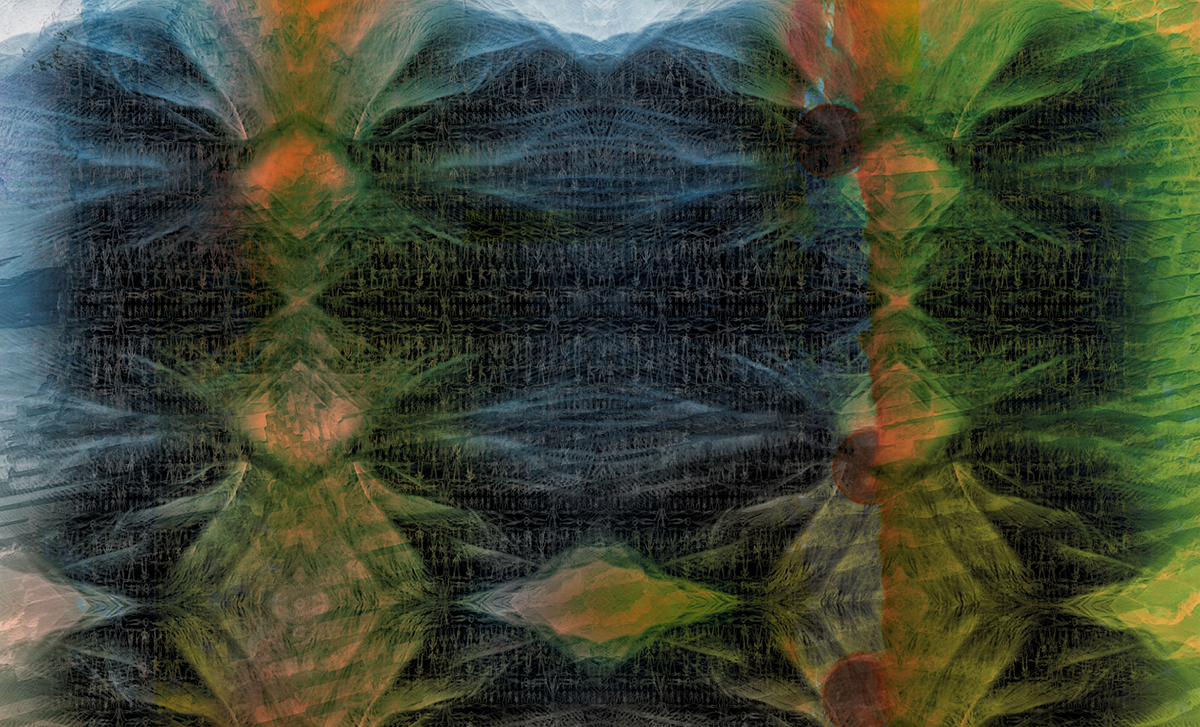
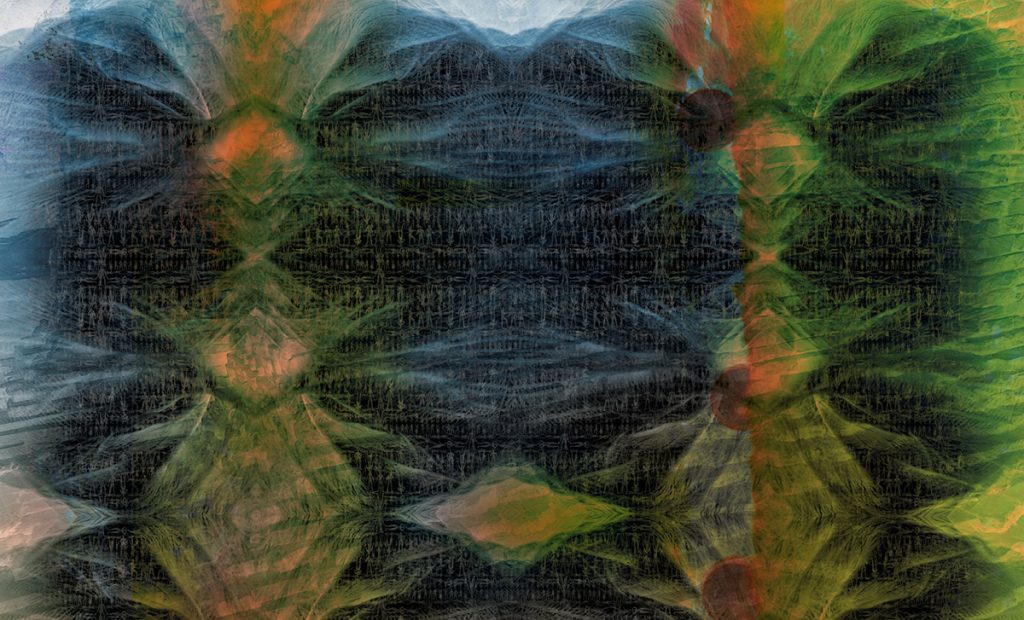
In these works, Tsalamata does not attempt to reproduce Angkor as a recognizable landscape. Instead, she translates its atmosphere and underlying forces into dense, abstract compositions. The pictured work is organized through repeated forms that appear mirrored, folded, and woven together. Dark areas suggest shadowed architectural interiors, while green, blue, orange, and earthen tones evoke vegetation, stone, moisture, and changing light. Certain shapes resemble roots, leaves, wings, chambers, or bodily structures, yet none settle into a single identity. They remain in transformation.
The square format strengthens the sense of concentration. Rather than directing the eye toward one central subject, the composition encourages movement across a connected visual field. Fine linear marks recall the physical language of intaglio printmaking, while translucent layers of color soften the boundaries between individual forms. These layers create the impression that several moments are occupying the same space. The past appears beneath the present, human construction merges with organic growth, and solid structures begin to feel temporary.
Tsalamata describes the roots of Angkor as possessing an almost reptilian presence. Slowly and persistently, they wrap around the temples and place pressure upon the architecture. This observation introduces an important contradiction. The roots may appear threatening because they can damage or even crush what people have built, but they also create new sculptural formations of extraordinary beauty. Destruction and creation therefore take place simultaneously. Nature is neither presented as gentle nor reduced to catastrophe. It becomes an active force whose timescale extends far beyond an individual human life.
Within Interweaving Nature and Art, this force is communicated through rhythm. Repeated patterns resemble pulses moving across the surface. Curving forms expand and contract, while areas of brightness emerge from darker passages. The image feels alive without depicting life literally. Its energy comes from the constant interaction of colors, textures, and shapes, each influencing the way the others are perceived.
The series also carries a broader philosophical meaning. Faced with the scale and age of Angkor, the human individual becomes physically small. Buildings once intended to represent power, order, and spiritual permanence are gradually altered by roots, rain, heat, and time. Tsalamata does not treat this realization simply as evidence of human weakness. Instead, it becomes an invitation to humility. Recognizing that human beings cannot stand outside nature may lead to a more responsible understanding of their place within it.
Interdependence is central to this idea. The temple and the tree can no longer be understood as entirely separate entities. Each has changed the appearance and meaning of the other. In a similar way, individuals, communities, histories, and environments are connected through relationships that may not always be immediately visible. Awareness of these relationships can support social connection as well as greater environmental responsibility.
The works were presented in the 2026 International Exhibition of Contemporary Printmaking: The Face of Nature – Imprint of the Global, organized in collaboration with the 23rd AAmA in Hangzhou, China. Conceived, organized, and curated by Tsalamata, the exhibition brought together 33 invited international artists at Lofos Art Projekt in Athens from June 14 through July 31, 2026.
Through her roles as both artist and curator, Tsalamata extends the principle of interconnection beyond the image itself. Her work becomes part of a larger international exchange about nature, human presence, and shared responsibility. In Interweaving Nature and Art, she transforms a profound encounter with Angkor into a meditation on time and coexistence, reminding us that even the strongest human structures belong to a living world that is continually reshaping them.
