
Helena Kotnik is a multidisciplinary artist whose work brings psychological inquiry together with a vivid and carefully constructed visual language. She earned a Bachelor’s Degree in Fine Arts through studies at the University of Barcelona and the Academy of Fine Arts Vienna, followed by a Master’s degree. This international education helped shape an artistic practice grounded in observation, experimentation, and critical thought. Kotnik does not treat painting simply as a means of reproducing the visible world. Instead, she uses it to investigate how images influence memory, perception, and our understanding of contemporary society. Her works often invite viewers to look beyond their immediate aesthetic qualities and examine the ideas contained within them. Through color, composition, and layered references, Kotnik transforms familiar scenes into spaces for reflection. Her paintings become visual inquiries into the relationship between individual experience, collective culture, and the increasingly complex world of images surrounding us.
Contemporary Landscape
Gouache, pencil, colored pencil, and watercolor
70 × 50 cm, 2025
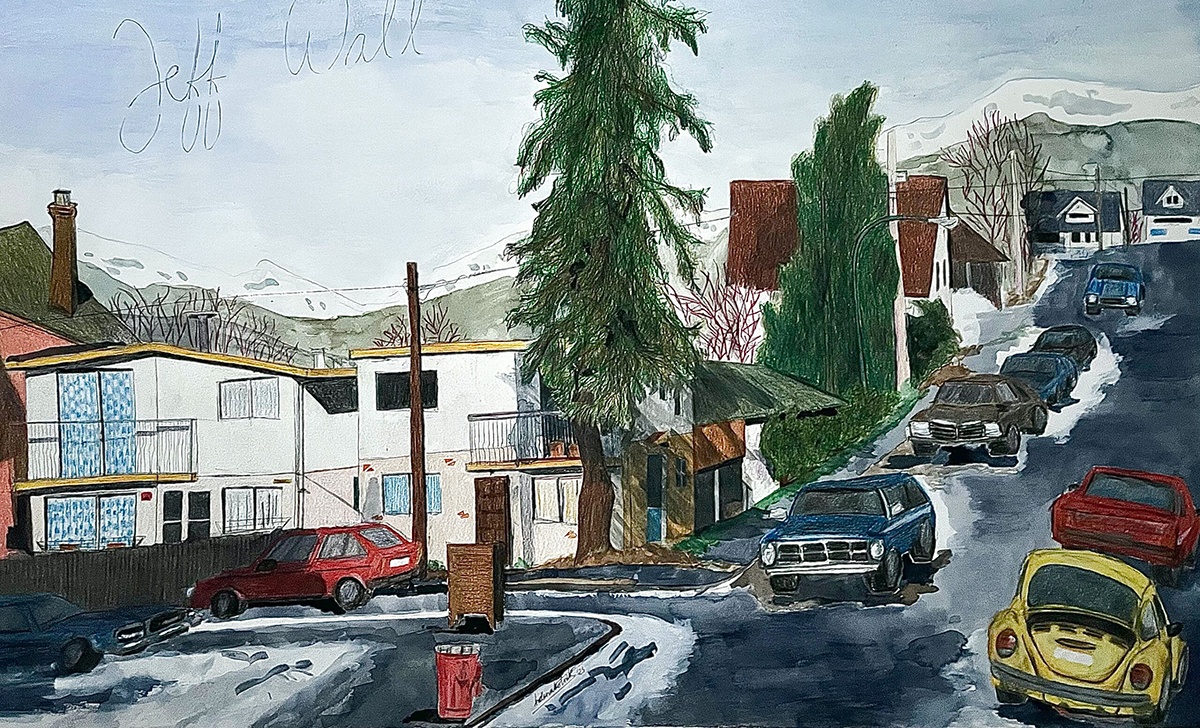
Created in 2025, Contemporary Landscape is Helena Kotnik’s tribute to Canadian artist Jeff Wall, whose influential practice is known for carefully staged photographic scenes and complex reflections on contemporary life. Kotnik’s work responds to one of Wall’s photographs depicting a Canadian landscape, but it does not merely copy the original image. By translating a photograph into painting, she opens a conversation about how reality is observed, recorded, interpreted, and reconstructed through different artistic media.
The composition presents a snow-covered residential neighborhood shaped by steep roads, parked cars, modest homes, tall trees, and distant mountains. Kotnik creates a strong sense of place through recognizable details. A yellow Volkswagen Beetle occupies the lower-right corner, while red, blue, black, and brown vehicles are distributed throughout the streets. These points of color enliven the subdued winter environment and guide the viewer’s attention across the composition.
The work’s mixed-media construction gives every part of the scene a distinct texture. Gouache and watercolor establish broad areas of sky, snow, architecture, and roadway, while pencil and colored pencil introduce sharper lines and concentrated details. The tall evergreen tree near the center is rendered through restless, layered marks that contrast with the smoother sky behind it. Houses are defined by irregular outlines, delicate architectural features, and areas of color that preserve the directness of drawing.
These visible marks are important because they prevent the painting from disappearing into photographic illusion. We recognize that the image has been made by hand. Kotnik’s lines sometimes appear controlled and descriptive, while elsewhere they remain loose and expressive. The surface therefore records not only a landscape but also the artist’s process of looking at another image and deciding how to reinterpret it.
Near the upper-left area, the handwritten words “Jeff Wall” appear against the pale sky. This inscription functions as both acknowledgment and visual element. Rather than concealing the source of her inspiration, Kotnik places it openly within the composition. The gesture turns the work into a dialogue between two artists and between two forms of representation. Wall’s photograph becomes the subject of Kotnik’s painting, while the painting encourages us to think again about the photograph.
This relationship raises several questions. Can a photograph become a painting when it is reconstructed with pigment and pencil? Is painting simulating photography, or is photography already simulating reality? Neither medium provides an entirely neutral record. A photographer chooses the viewpoint, frame, timing, and presentation of a scene. A painter makes additional decisions about line, color, texture, emphasis, and omission. Every representation passes through a sequence of choices.
Kotnik highlights this process by preserving the photograph’s recognizable spatial structure while translating it into a more subjective visual vocabulary. Cars, houses, trees, and mountains remain identifiable, yet their hand-drawn forms carry a sense of fragility and personal attention. The snow is not simply white, and the road is not a uniform black surface. Subtle shifts in blue, gray, green, and brown reveal how perception is shaped through material interpretation.
The landscape also expresses the coexistence of nature and suburban life. Mountains rise in the distance, but streets, vehicles, utility poles, and buildings dominate the foreground. The central evergreen visually connects these two environments. It towers above the houses as a natural presence, yet it is firmly embedded within the constructed neighborhood. This tension makes the scene feel both ordinary and strangely theatrical.
Ultimately, Contemporary Landscape is less concerned with documenting a Canadian neighborhood than with examining the journey an image takes. Reality becomes a photograph; the photograph becomes a painting; and the painting becomes a new experience in the viewer’s mind. Through this layered transformation, Kotnik demonstrates that representation is never a passive mirror. It is an active process shaped by medium, memory, interpretation, and imagination.
