
Orion Cho is a queer painter, writer, and graphic designer based in New Orleans whose multidisciplinary practice examines identity, survival, and the lived experience of the body. Working primarily through layered, texture-driven mixed media, Cho creates surfaces that appear marked by pressure, change, and persistence. Her work has been presented in group exhibitions, including ArtMOOR: Joy and Entropy, while she continues to expand her visual language through an AAS in Graphic Design at Delgado Community College. This training brings another dimension to her practice, connecting the expressive freedom of painting with a strong awareness of composition, shape, and visual structure. Cho lives with her partner, Jeremy, whose decision to give her a room in which to paint became a meaningful gesture of encouragement and possibility. At the center of her creative life is the belief that art and design are not simply professional disciplines. They are essential forms of survival.
Layers of Conflict, Memory, and Renewal
Cho’s mixed-media work transforms the painted surface into a physical record of emotion and experience. Rather than presenting a polished or passive image, she builds compositions through accumulated layers, exposed textures, irregular edges, and contrasting areas of color. The material itself appears to carry memory. Paint is applied, covered, scraped, interrupted, and allowed to remain visibly imperfect. These processes give her work a sense of history, as if each decision records a moment of resistance, vulnerability, or change.
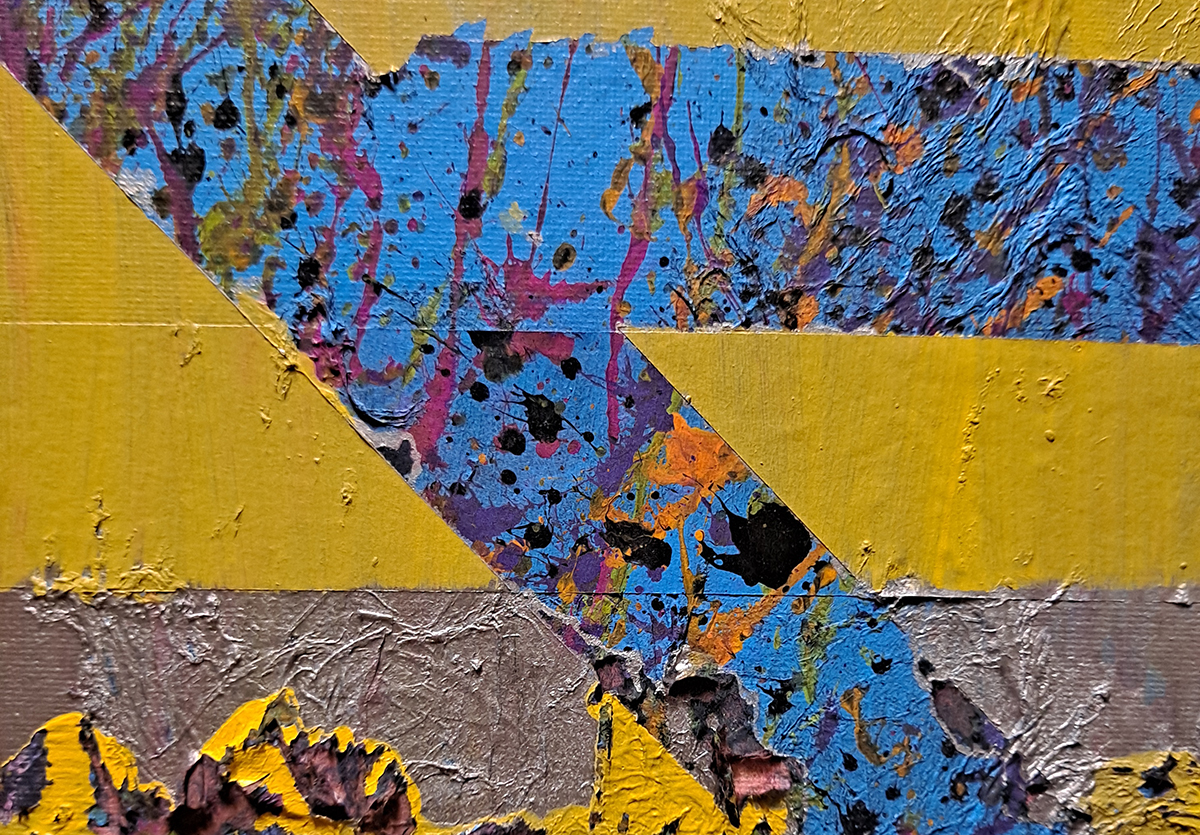
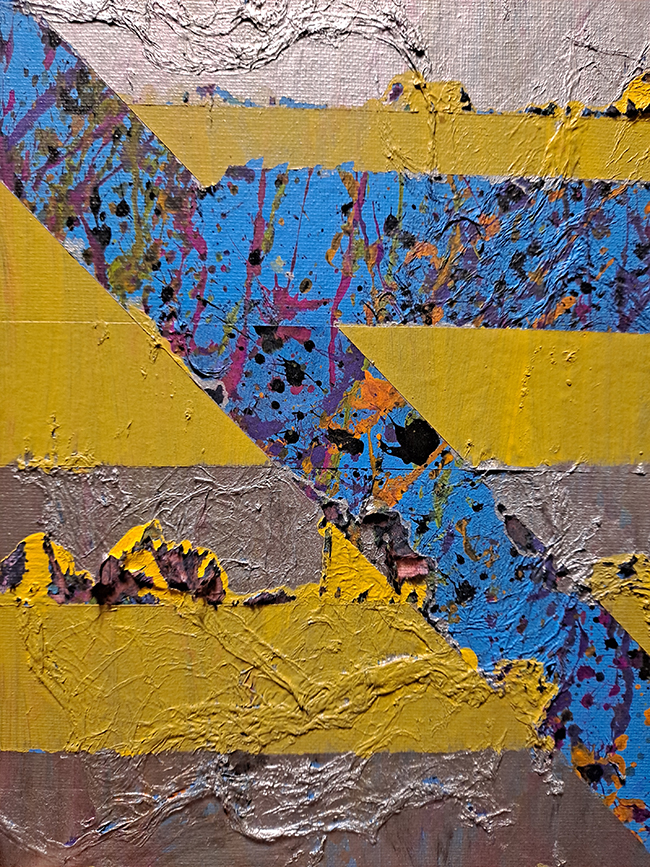
In Axis of Ash, a 2026 mixed-media work measuring 10 by 10 inches, broad geometric divisions bring order to a surface filled with expressive movement. Mustard yellow bands and angular forms stretch across vivid blue passages splattered with black, magenta, orange, purple, and green. Above and below them, muted fields of gray, silver, and dusty rose create quieter spaces, although their heavily worked textures prevent them from becoming entirely calm.
The composition suggests an unstable landscape or an abstract map divided by shifting boundaries. A diagonal blue passage travels through the image, connecting separate regions while cutting across the horizontal bands. It can be seen as a path, a fracture, or a stream of energy moving through resistance. Because the form changes width as it descends, it does not behave like a fixed geometric structure. It feels active and unpredictable, finding its way through the surrounding blocks of color.
Cho’s understanding of graphic design is visible in the strong architecture of the composition. The yellow shapes create a decisive framework and guide the viewer’s eye across the painting. Yet this visual order is repeatedly disrupted by drips, splatters, torn-looking edges, and thick ridges of material. The relationship between structure and disorder becomes one of the work’s central tensions. Design attempts to organize the surface, while painting introduces movement, accident, and emotional intensity.
The title Axis of Ash adds another layer of meaning. An axis suggests a central line around which something turns, balances, or finds its direction. Ash, by contrast, is what remains after burning. Bringing these ideas together creates an image of orientation formed through destruction or transformation. The painting may be read as a search for stability after an experience has already altered the landscape. Its textured areas resemble damaged walls, weathered ground, scar tissue, or fragments uncovered beneath layers of time.
Cho’s use of color prevents the work from becoming solely an image of ruin. The electric blue and scattered marks introduce vitality into the restrained palette. Bright pigments emerge through and between the heavier yellow and gray sections, suggesting that energy can remain present even in fractured conditions. The painting does not erase difficulty, but neither does it surrender to it. Its beauty comes from the coexistence of abrasion and brightness.
This relationship closely reflects Cho’s interest in identity and survival. Identity is not treated as something seamless or permanently resolved. Instead, it appears layered, embodied, and continually reconstructed. The work acknowledges that a person may carry conflicting histories and emotional states at the same time. Strength can exist beside uncertainty, while joy can appear within a surface marked by disruption.
The tactile quality of Cho’s art is especially important. Thick paint and visible ridges make the surface feel almost bodily. It appears bruised, repaired, protected, and exposed. Through this physicality, abstraction becomes deeply personal without relying on literal portraiture. The body is present through sensation, pressure, and material evidence rather than through a recognizable figure.
Cho’s practice ultimately presents creation as a way of continuing. Painting becomes a place where fragments can be gathered without being forced into perfect harmony. Graphic structure offers direction, while expressive marks preserve complexity. In Axis of Ash, these forces meet in a composition that feels both wounded and alive. The work embodies Cho’s belief that art and design can be forms of survival, allowing experience to be examined, reorganized, and transformed into something that endures.
