
Tinashe DeWolf, born in Mutare in 2001, creates art shaped by movement between Zimbabwe and the United States. Living across these two cultural landscapes has given him a perspective grounded in both intimacy and distance. His work explores identity, culture, race, and gender without reducing these subjects to simple explanations. Instead, he constructs layered images that feel inhabited by memory, conflict, vulnerability, and care. Personal experience is central to his practice, but it often opens onto larger social and historical questions. In Mushonga, Tinashe turns his attention to Zimbabwe’s artisanal gold-mining communities, drawing upon the period he spent working beside miners near Odzi. The resulting painting is not merely an observation of mining. It is a meditation on belief, survival, inherited traditions, economic pressure, and the powerful hopes people place in the earth beneath them.
Mushonga: A Story Narrated in Gold
For many artists, the studio provides a controlled space in which ideas gradually take form. For Tinashe, however, the beginnings of Mushonga were found hundreds of feet underground, inside narrow mining shafts where daylight vanished and human behavior was stripped of performance.
After returning to Zimbabwe from the United States, he chose to enter the artisanal goldfields surrounding Odzi rather than observe the mining boom from a distance. He helped construct timber supports and descended alongside miners whose safety depended upon the strength of those structures, their trust in one another, and forces that could not always be controlled or explained.
The experience was exhausting and dangerous, but it exposed Tinashe to an intense concentration of human emotion. Fear, humor, faith, hope, and desperation existed together in the darkness. He came to understand that mining was not simply the physical act of extracting gold. It was also sustained by everything people imagined gold might provide: food, education, security, dignity, and a different future.
This understanding became the emotional foundation of Mushonga.
The title comes from a Shona word commonly translated as “medicine,” although its meaning reaches beyond the conventional Western definition. Depending on its use, mushonga may suggest healing, protection, remedy, spiritual intervention, or a substance believed to affect fortune. Stories within mining communities sometimes describe people seeking such protection or guidance before searching for gold.
Tinashe does not present these beliefs as curiosities. He places them within a broader cultural and economic reality. In the painting, Zimbabwe’s mineral wealth becomes a form of mushonga in itself: something approached as a possible cure for hardship, yet capable of demanding an enormous human and environmental price.
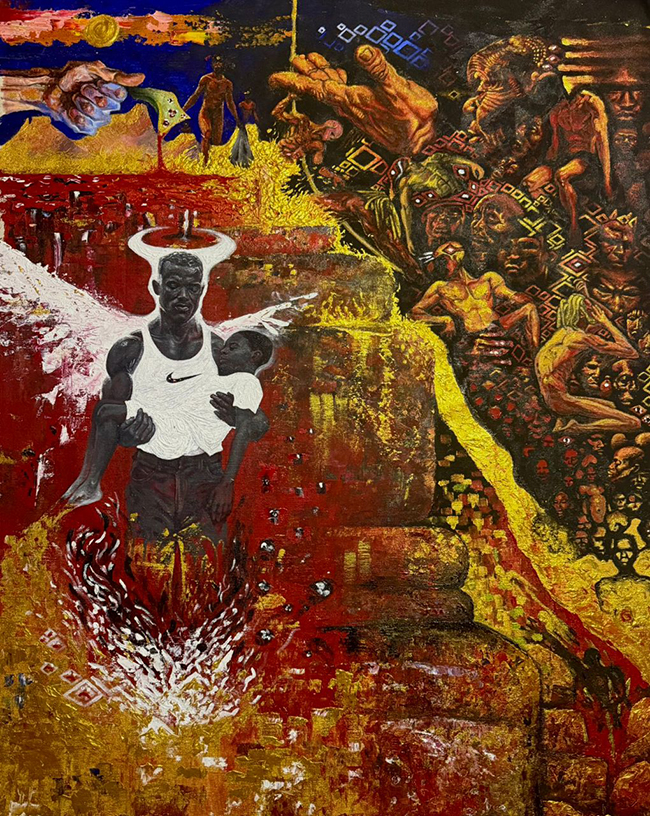
The composition develops like a visual history. In the lower-right area, minerals appear as natural elements belonging to the landscape. As the viewer’s gaze travels across the canvas, the palette deepens into urgent reds while bodies become more crowded and fragmented. This progression suggests a gradual transformation in the meaning of the land. What begins as a natural resource becomes entangled with power, commerce, survival, and social aspiration.
A particularly striking section brings a traditional healer into proximity with an immense Western hand recalling Michelangelo’s The Creation of Adam. These images embody forces that have shaped Zimbabwe’s relationship with mineral wealth. The healer evokes ancestral knowledge and inherited systems for understanding uncertainty. The monumental hand suggests the influence of Western culture and global economic structures. Rather than treating the two as absolute opposites, Tinashe shows how they overlap within contemporary life.
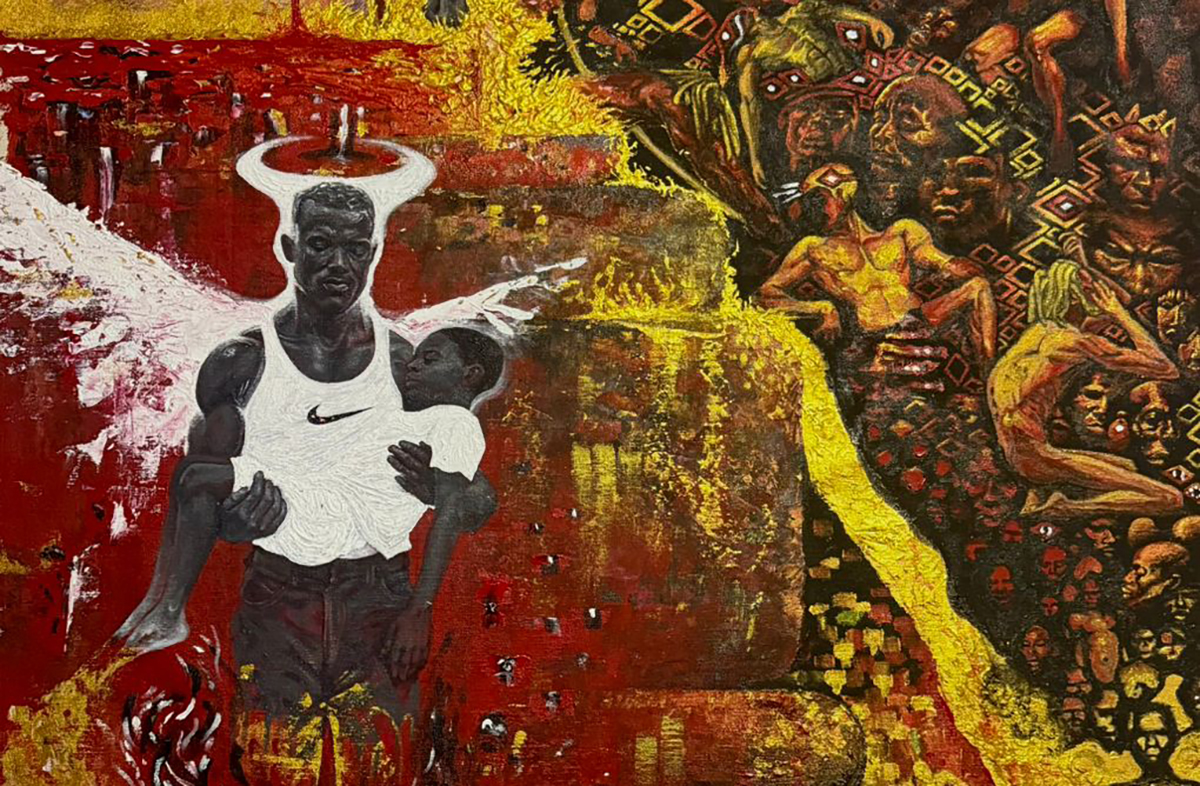
At the center stands a father carrying a child. His Nike shirt places him unmistakably in the present, connecting his ambitions to desires recognized around the world. He wants to provide for his family and create greater possibilities for the next generation. Yet the child appears increasingly vulnerable as the composition progresses. Through this figure, the painting asks a painful question: What happens when the effort to protect one’s family begins to endanger the relationships and future that the sacrifice was meant to preserve?
Environmental damage remains visible but deliberately secondary. Disturbed earth, altered waterways, and scarred hillsides form the setting inherited by younger generations. Tinashe’s principal concern here, however, is cultural transformation. Landscapes are changed by machinery, but they are also changed by desire, necessity, and the stories communities tell about survival.
Because Tinashe worked underground, the miners in Mushonga are not distant symbols of poverty or exploitation. They are people he knew and relied upon: neighbors, friends, fathers, and sons. This closeness allows the painting to resist familiar, simplified narratives about African mining. It neither romanticizes the work nor condemns those who depend upon it. Instead, it recognizes people navigating limited choices with courage, faith, humor, and determination.
Ultimately, Mushonga is less about gold than about belief. It examines humanity’s search for remedies—not only for illness, but also for insecurity, poverty, grief, and uncertainty. Beneath Zimbabwe’s hills, Tinashe discovered that the most revealing things hidden underground were not minerals. They were the truths people carried with them into the darkness.
