
Born in Lisbon in 1962, Miguel Barros has built a body of work shaped by movement between cultures, places, and personal histories. Having lived in Portugal, Angola, and later Canada, he carries with him a rich collection of experiences that continue to inform his artistic perspective. In 2014, Barros relocated from Angola to Calgary, creating a geographical distance from Lisbon, the city that remains deeply embedded in his imagination. Rather than weakening his connection to his birthplace, this separation has intensified it. Lisbon frequently appears throughout his work as a remembered landscape reconstructed through emotion, memory, and reflection. For Barros, painting becomes a way of bridging physical and emotional distances, transforming personal experiences into universal narratives. His work often explores themes of identity, belonging, spirituality, and resilience, inviting viewers into spaces where memory and imagination converge to reveal deeper truths about the human experience.
Angels and Demons — Allegories of Human Protection
In Angels and Demons — Allegories of Human Protection, Miguel Barros presents a series that examines one of humanity’s oldest themes: the ongoing tension between opposing forces. Through a collection of expressive and symbolic paintings, he explores the struggle between hope and despair, protection and destruction, light and darkness. Rather than approaching these ideas through traditional religious imagery alone, Barros transforms them into reflections on contemporary life and the complexities of the human condition.
The series draws inspiration from centuries of sacred art, particularly the symbolic language found in Renaissance and Baroque painting. Yet Barros does not simply revisit historical traditions. Instead, he reinterprets them through a contemporary lens, creating images that speak to modern anxieties, uncertainties, and aspirations. His angels are not merely spiritual beings descending from the heavens. They become universal symbols of compassion, courage, guidance, and moral strength. They represent the forces that encourage humanity to endure even in the face of overwhelming adversity.
In contrast, the demons that populate the series are not presented as literal monsters. They function as metaphors for the darker aspects of human existence. Fear, violence, intolerance, greed, despair, and destructive impulses take visual form within these paintings. By moving beyond conventional depictions of evil, Barros encourages viewers to recognize these forces not as distant threats but as realities that exist within societies and, at times, within individuals themselves.
What makes the series particularly compelling is the way Barros balances conflict with hope. While each painting contains elements of tension and struggle, the works never surrender to pessimism. The central message remains rooted in resilience. The angelic presences consistently emerge as protectors, defending innocence, preserving life, and offering the possibility of renewal. Their presence suggests that goodness is not fragile or passive but enduring and transformative.
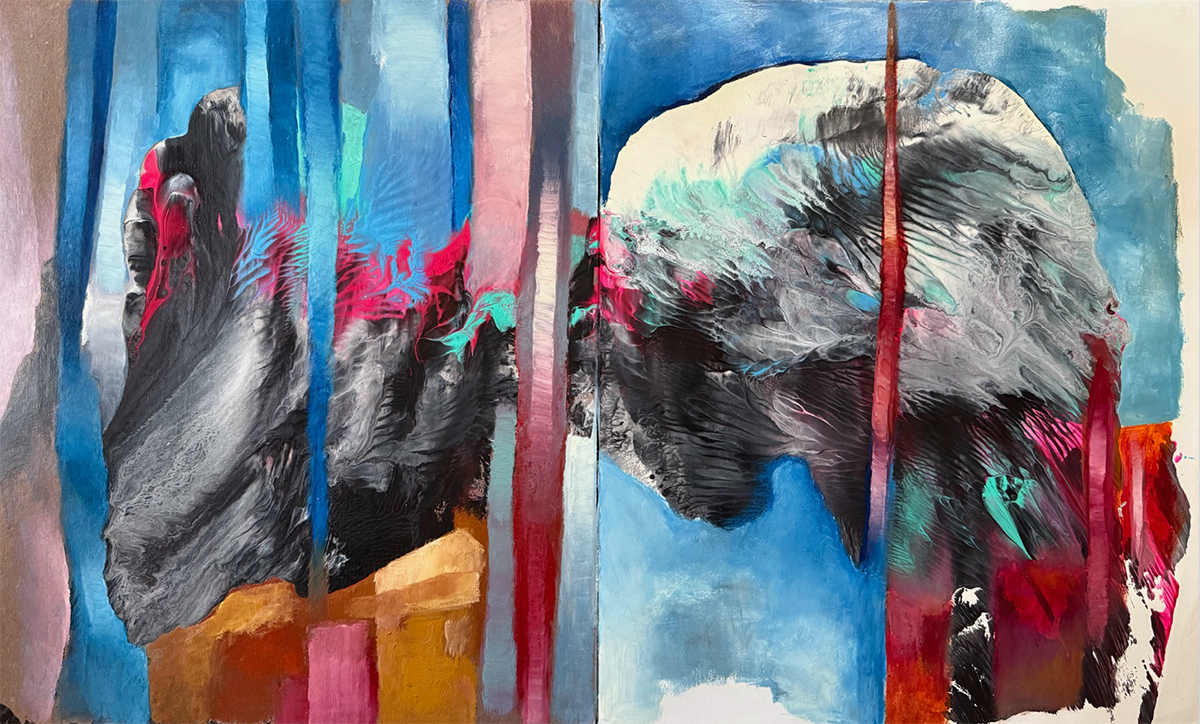
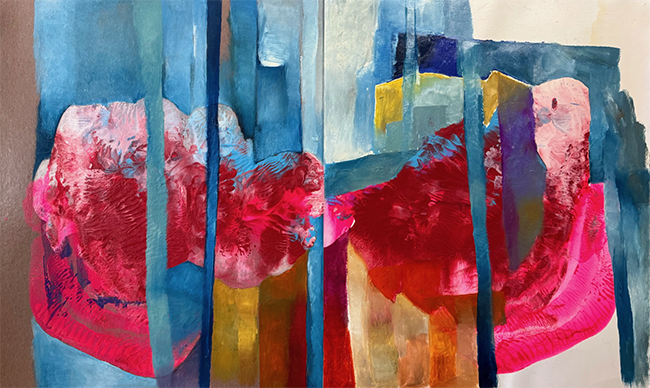
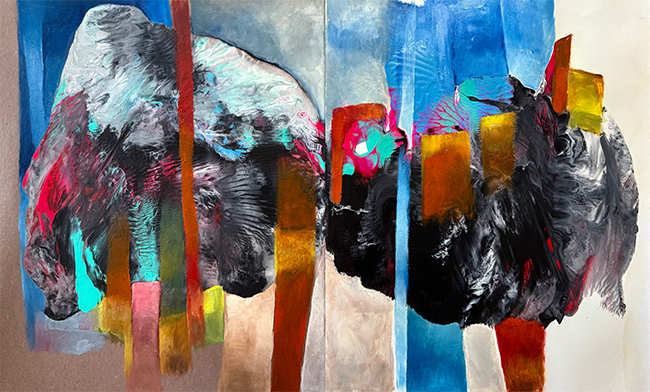
Visually, the paintings possess a dramatic intensity that reinforces their themes. Working in oil on both fabric and paper, Barros builds rich surfaces through layers of paint, expressive brushwork, and textured passages. Light plays a crucial role throughout the series. Luminous forms often emerge from darker surroundings, creating a sense of revelation and spiritual presence. These contrasts evoke the theatrical qualities of classical painting while also generating a contemporary emotional impact.
Color is used not only for visual effect but also as a narrative device. Deep shadows and darker tones establish atmospheres of uncertainty and conflict, while radiant areas of light introduce moments of hope and transcendence. The resulting compositions feel both expansive and intimate, inviting viewers to contemplate the symbolic drama unfolding before them.
The scale and presence of the angelic forms further contribute to the emotional weight of the series. They often appear monumental, occupying the pictorial space with authority and calm determination. Their abstraction allows them to move beyond specific identities, becoming archetypal representations of protection itself. This openness encourages personal interpretation, allowing viewers to bring their own experiences and beliefs into dialogue with the work.
Part of the Angels and Demons series will be presented in a collective exhibition in Rio de Janeiro, Brazil, in June 2026. This exhibition offers an opportunity for the works to engage with new audiences and cultural contexts while expanding the conversation surrounding spirituality, human vulnerability, and the enduring search for meaning.
Ultimately, Angels and Demons — Allegories of Human Protection is not simply a series about supernatural beings. It is a meditation on humanity’s capacity to confront adversity and preserve hope. Through symbolic imagery, expressive painting, and emotional depth, Miguel Barros creates a body of work that speaks to universal experiences of struggle and resilience. The paintings remind us that even amid uncertainty and darkness, the forces of compassion, courage, and goodness continue to endure. In Barros’s vision, light remains present—not loud or triumphant, but steady, persistent, and capable of guiding humanity forward.
