
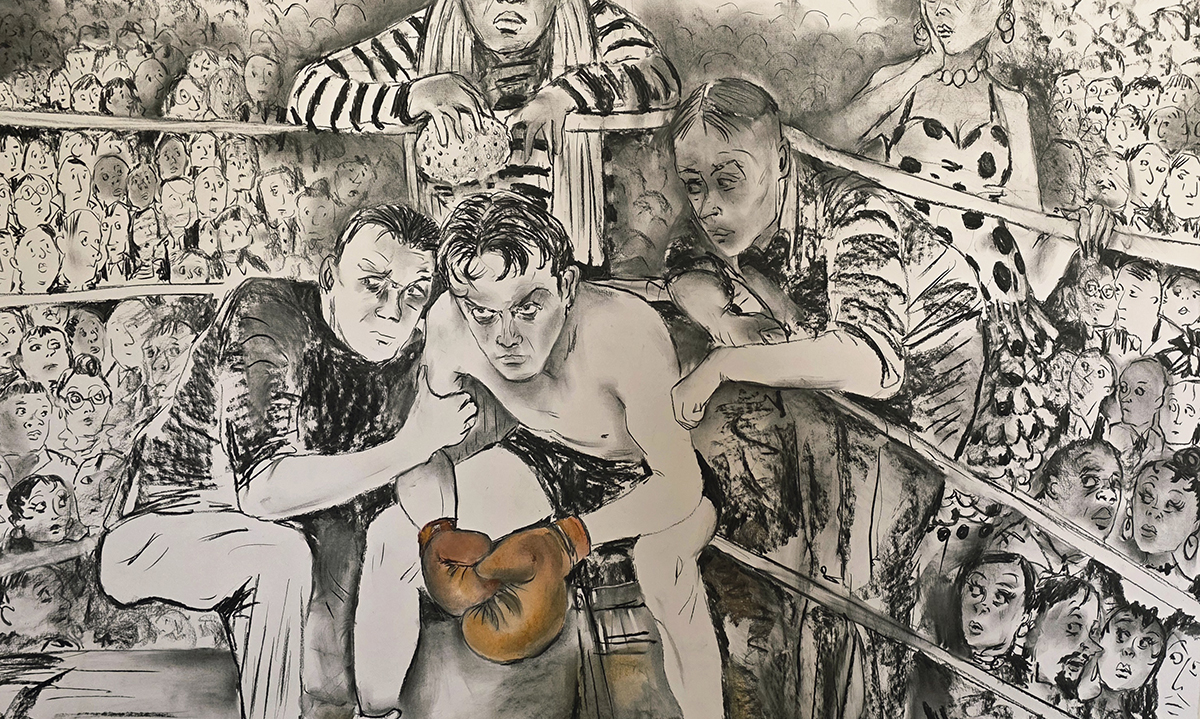
Anna Mazzotta does not allow passing trends to determine the direction of her art. Instead, she studies the world around her, absorbs its atmosphere, and translates what she discovers through the physical language of drawing and painting. Born in the United Kingdom and shaped by her Italian heritage, Mazzotta divides her time between London and Bristol. The character of both cities can be felt in work that combines urban energy with a strong sense of history, drama, and personal identity.
Her studies at the Royal College of Art provided an important technical foundation, but technique alone does not define her distinctive visual language. Mazzotta’s work appears to emerge from a more theatrical place: an imagined world of smoky rooms, velvet curtains, heightened emotion, and decadent interiors. Within this atmosphere, her figures become more than portraits. They appear as performers, characters, and symbols of human confidence, vulnerability, ambition, and survival.
“I’m So Mean, I Make Medicine Sick”
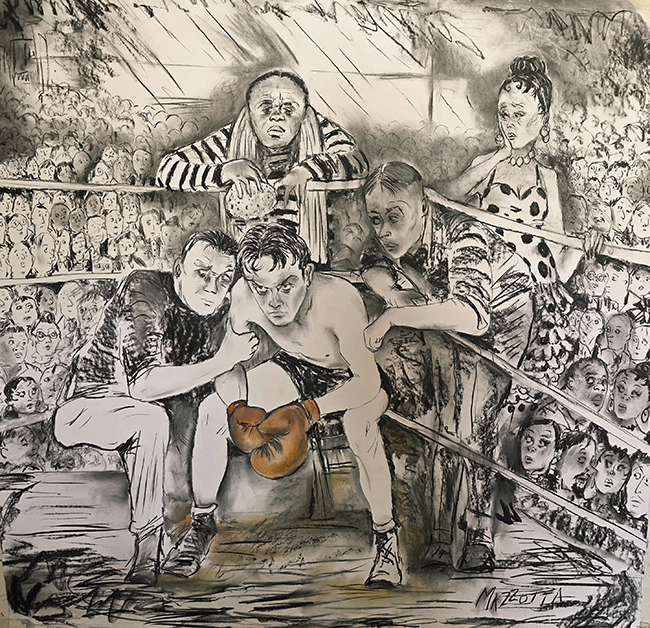
Charcoal and chalk on paper
In I’m So Mean, I Make Medicine Sick, Mazzotta turns to Muhammad Ali, one of the most magnetic and psychologically complex figures in boxing history. Ali delivered the famous line in 1974 as he prepared to face George Foreman in the Rumble in the Jungle. It was characteristically witty, exaggerated, and confrontational. More importantly, it demonstrated Ali’s understanding that a fight could begin long before either boxer entered the ring.
Ali used language as a psychological weapon. His public confidence was not simply entertainment; it allowed him to control the story surrounding a fight and place pressure on his opponent. By selecting this quotation as the title, Mazzotta brings attention to both the physical and theatrical dimensions of boxing. The subject is not merely a powerful athlete. He is a performer who understands the importance of image, rhythm, timing, and self-invention.
Charcoal is especially suited to this subject because it can create both force and fragility. Its deep blacks suggest weight, impact, and physical presence, while its softer marks can capture movement, uncertainty, and atmosphere. Chalk introduces light into the composition, allowing selected areas to emerge from the darkness. This contrast reflects the contradictions within Ali’s public identity: humour and aggression, elegance and brutality, confidence and danger.
Mazzotta’s approach also connects the boxer with the history of figurative drawing. Removed from the noise of the arena, Ali can be considered through gesture, expression, and form. The limited materials concentrate attention on the individual rather than the spectacle surrounding him. At the same time, the grain and immediacy of charcoal preserve a feeling of movement. The image seems capable of shifting at any moment, just as a boxer continuously adjusts his balance, position, and strategy.
The title gives the portrait an audible presence. Viewers do not simply look at Ali; they can almost hear his voice. His words become part of the composition, surrounding the image with confidence and wit. Through this relationship between language and portraiture, Mazzotta explores how public figures construct identities that can become larger than life.
“Why Waltz with a Guy for 10 Rounds If You Can Knock Him Out in One?”
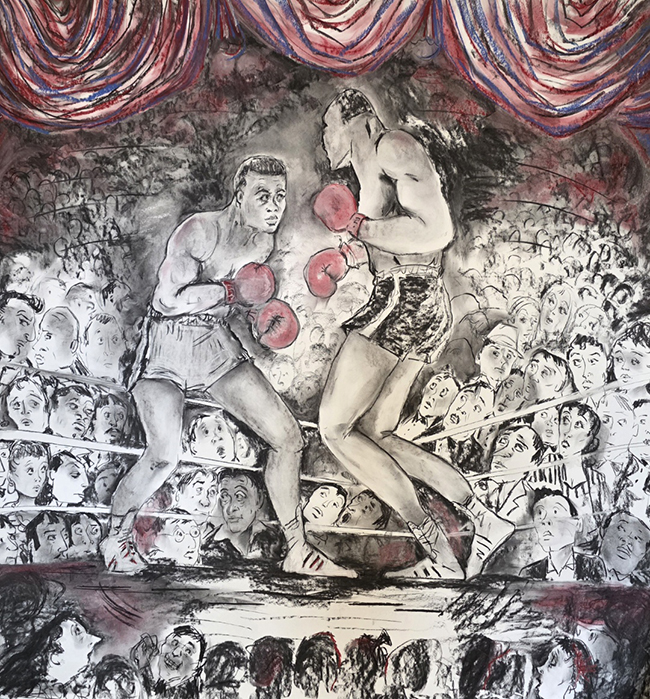
Charcoal and chalk on paper
Mazzotta’s portrait inspired by Rocky Marciano presents a different expression of the fighting spirit. The title, Why Waltz with a Guy for 10 Rounds If You Can Knock Him Out in One?, communicates Marciano’s direct and uncompromising attitude toward competition. Where Ali’s quotation is playful and theatrical, Marciano’s is practical, forceful, and focused on decisive action.
The reference to a waltz introduces an unexpected contrast. Dancing and boxing both depend on footwork, timing, distance, and an awareness of another body. Yet Marciano dismisses the idea of extending this dangerous dance. His statement reduces the contest to its essential objective: if victory can be achieved immediately, there is no reason to delay it.
Through charcoal and chalk, Mazzotta can communicate this sense of concentration and compressed energy. Dark marks carry the psychological weight of the fighter, while lighter areas suggest the flash of skin, the tension of muscle, or the illumination of a face under arena lights. The marks may feel controlled in one area and raw in another, reflecting the balance between discipline and instinct required in boxing.
Placed together, the two works explore contrasting forms of power. Ali dominates through language, charisma, strategy, and physical skill. Marciano represents efficiency, endurance, and relentless determination. Both men understood that boxing required far more than strength. It demanded mental discipline, self-belief, timing, and the ability to recognize weakness.
Mazzotta does not treat these fighters only as sporting legends. She presents them as cultural characters whose words reveal different philosophies of life. Their quotations transform the portraits into reflections on confidence and ambition. One fighter overwhelms his opponent through personality and prediction; the other focuses on the shortest route to victory.
In these drawings, boxing becomes a form of theatre. The ring operates like a stage, the fighter becomes a performer, and every gesture contributes to the unfolding drama. Mazzotta’s smoky, expressive visual world is particularly effective in capturing this atmosphere. Her charcoal shadows suggest both the glamour of spectacle and the danger concealed beneath it.
Ultimately, the works are not simply about winning or losing. They examine how individuals prepare themselves to confront fear, pressure, and uncertainty. Through expressive materials and carefully selected words, Mazzotta reveals the boxer as athlete, actor, strategist, and symbol of human resilience.
