
Jane Gottlieb has developed a distinctive visual language shaped by her enduring fascination with color, movement, and energy. Raised in Los Angeles and now based in Santa Barbara, Gottlieb first worked as a painter before embracing photography as another way to explore light, rhythm, and composition. More than three decades ago, she began hand-painting individual Cibachrome prints, a turning point that helped define her artistic practice. By altering the photographic surface, she transformed captured scenes into singular art objects that move freely between photography and painting. Her colors do more than decorate an existing image; they reshape its atmosphere and emotional character. Familiar buildings, urban settings, and cultural landmarks become intensified visions in which observation and imagination coexist. Gottlieb’s work retains the recognizable structure of the photographed world while revealing the expressive presence of the artist’s hand.
Architecture, Light, and an Amplified Reality
Across Gottlieb’s work, color functions as both a visual force and a means of interpretation. Her images begin with places and structures that viewers may recognize, yet they do not remain faithful records of physical reality. Instead, the artist heightens their colors, rearranges their emotional temperature, and invites us to experience them anew. The resulting compositions feel simultaneously familiar and imaginary. They occupy a territory in which photography provides the framework while painting releases the scene from ordinary expectations.
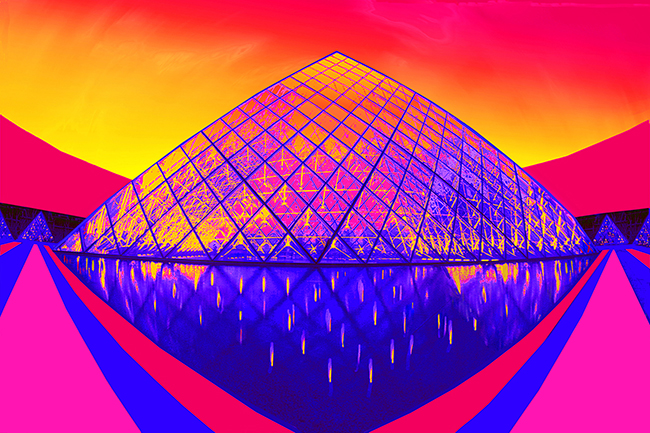
In Paris Pyramid at Dusk, the Louvre Pyramid rises from the center of the composition with striking monumentality. Its precise geometric structure gives the image a strong sense of order, but the intense palette transforms the well-known landmark into something almost futuristic. Electric violet lines define the glass framework, while pink, orange, and yellow flood the pyramid and surrounding sky. Deep blue water reflects fragments of light below, creating a visual counterpoint to the radiant atmosphere above.
The composition is carefully balanced around the pyramid’s central peak. Strong diagonal lines move inward from the edges, directing the viewer’s attention toward the structure. This symmetry lends the work a formal, architectural stability, yet the colors disrupt any sense of stillness. The sky appears to glow with the intensity of fire or neon, while the reflective pool becomes an expanse of saturated blue and purple. Gottlieb takes a familiar symbol of Paris and removes it from conventional time. It could be dusk, a dream, or a vision of the city in an imagined future.
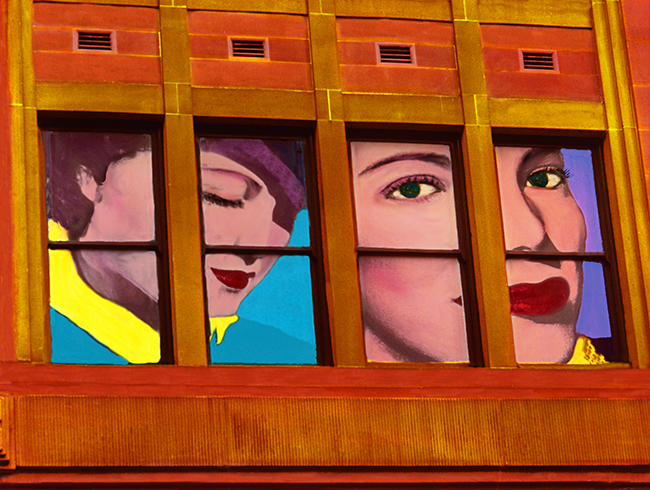
Window Ladies approaches architecture differently. Here, a row of windows divides several women’s faces into separate visual fragments. The building becomes a frame within the frame, organizing the composition into a sequence of cinematic glimpses. One figure appears in profile, another looks downward, while two enlarged faces turn their eyes outward. Their expressions and directions of gaze suggest separate private worlds, despite their physical closeness.
The image carries echoes of fashion illustration, advertising, film, and urban spectacle. Bright turquoise, yellow, red, pink, and violet give the women a glamorous, graphic presence. At the same time, the windowpanes interrupt their faces, emphasizing the tension between visibility and separation. The women are presented for observation, yet they remain inaccessible behind the glass. Viewers can see them but cannot enter their environment or fully understand the relationships among them. This ambiguity gives the work its narrative energy. It resembles a single scene extracted from a larger story whose beginning and conclusion remain unknown.
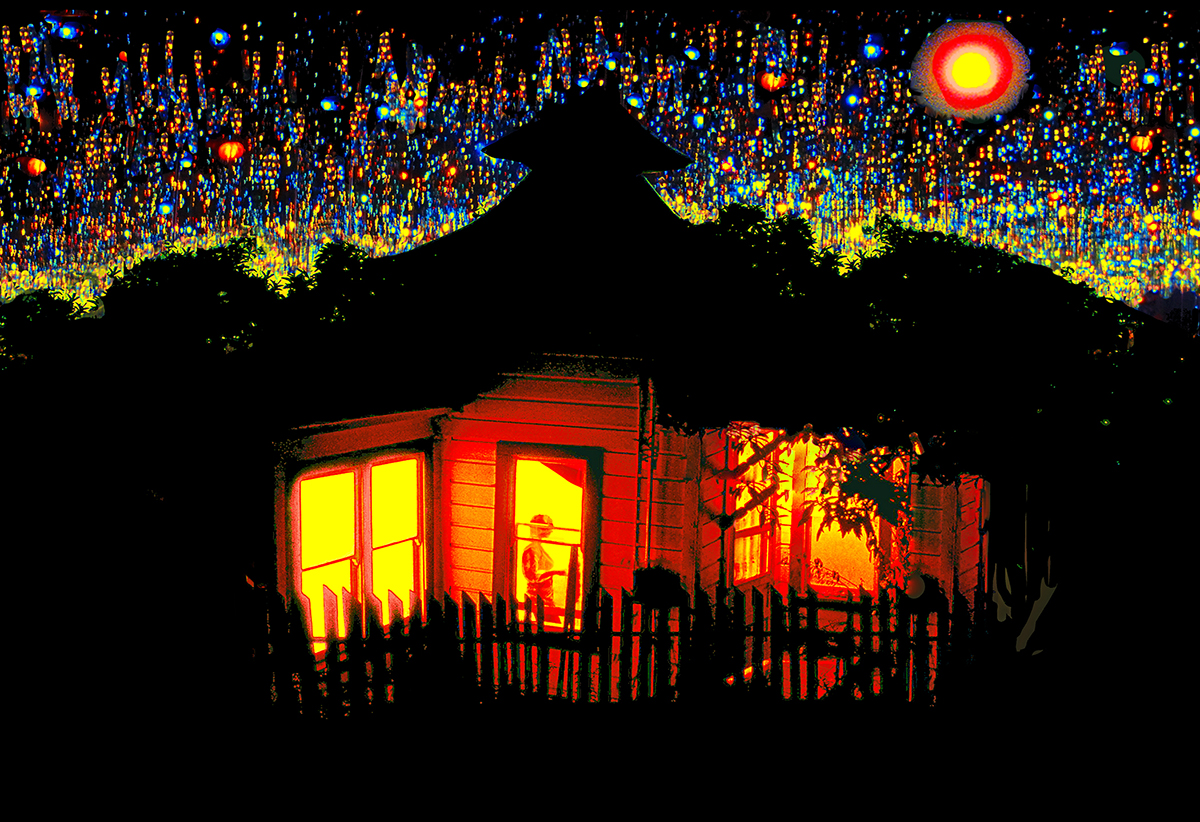
A more mysterious mood emerges in China Town Full Moon Lady. The composition is dominated by darkness, with a sharply silhouetted roofline separating the illuminated city from the glowing interior of a house. Above, the urban landscape flickers with hundreds of small points of blue, yellow, orange, and red. These lights form a dense, almost abstract field, making the distant city appear alive with restless activity.
At the lower center, a solitary figure stands behind a brightly lit window. The vivid yellow and red interior contrasts dramatically with the surrounding blackness. This person becomes the emotional focus of the image, appearing both protected by the house and isolated within it. The full moon above repeats the warm colors of the windows, establishing a quiet connection between the figure and the sky. Its concentric rings resemble an eye, a target, or a distant beacon watching over the nocturnal scene.
Together, these works demonstrate Gottlieb’s ability to move between monument, portrait, and urban narrative while maintaining a recognizable visual identity. Geometry provides structure, darkness creates suspense, and saturated color energizes every surface. Her architectural subjects are never merely backgrounds; windows, pyramids, rooftops, and reflections shape how each scene is understood.
Gottlieb’s art ultimately encourages viewers to reconsider the boundaries between documentation and invention. Her photographs preserve traces of real places, but her transformation of color allows those places to become emotional and imaginative environments. Rather than showing the world exactly as it appears, she presents what it might feel like when memory, fantasy, and perception converge. Her work combines photography, painting, and Photoshop.
