
Ruth Poniarski’s path to painting began with an education in architecture. After earning a Bachelor of Architecture from Pratt Institute in 1982, she spent approximately ten years working in construction. In 1988, she turned her attention to painting, discovering a form of expression that offered both imaginative freedom and a rewarding creative challenge. Her architectural background remains relevant to the way she organizes space, balances visual elements, and constructs intricate environments within her compositions. Working in a surrealist style, Poniarski draws inspiration from mythology, cultural traditions, philosophy, and literature. These influences come together in mysterious scenes that resist straightforward interpretation and invite viewers to form their own narratives. By bringing recognizable figures and objects into dreamlike settings, she creates a distinctive visual language in which memory, symbolism, and fantasy coexist. Her paintings do not simply illustrate stories; they transform familiar ideas into deeply personal worlds.
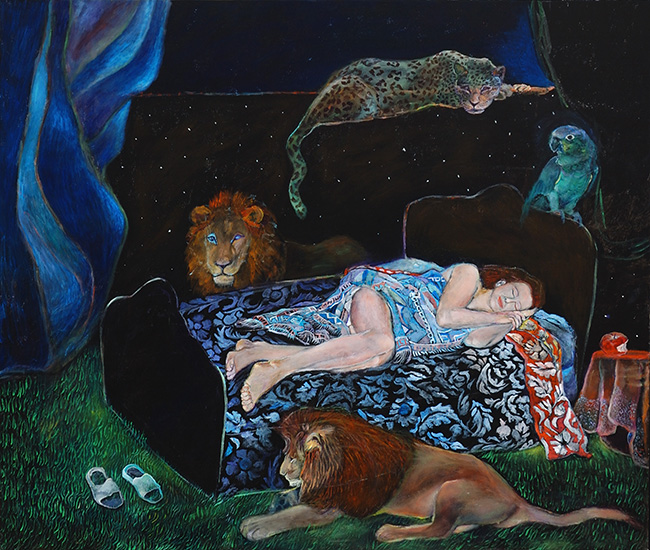
Rip Van Winkle’s Wife: A Kingdom Reclaimed by Nature
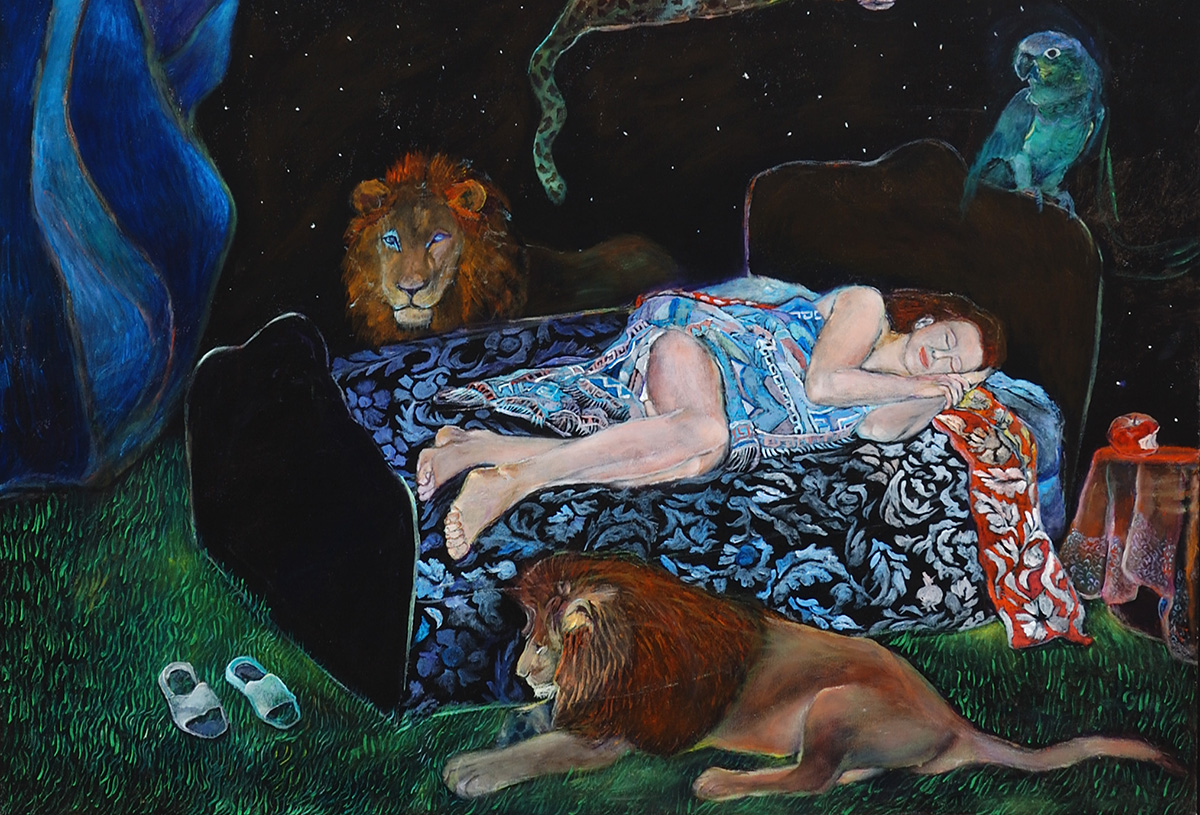
In Rip Van Winkle’s Wife, Ruth Poniarski presents a nocturnal world poised between domestic comfort and untamed wilderness. A sleeping woman occupies the center of the composition, resting peacefully on a richly patterned bed. Yet this is not an ordinary bedroom. The walls have seemingly disappeared, grass has replaced the floor, and wild animals have entered the private space. Lions, a leopard, and a parrot quietly surround the sleeping figure, turning her chamber into an unusual kingdom governed by instinct, dreams, and mystery.
The title evokes Washington Irving’s story of Rip Van Winkle, the man who falls asleep for many years and awakens to discover that the world has changed around him. Poniarski shifts attention toward the wife, encouraging viewers to consider the person traditionally left behind. Rather than presenting her merely as a secondary figure in someone else’s story, the painting gives her an imaginative territory of her own. In sleep, she becomes the central presence within an alternate narrative.
The artist’s accompanying poetic language describes a wilderness growing beyond its “tempered edge” and a “curious kingdom abandoned.” These phrases suggest that the boundaries between civilization and nature are gradually dissolving. The chamber, once protected and orderly, has become a frontier where creatures investigate the remains of human life. The wilderness does not destroy the room through violence. Instead, it gently absorbs it, allowing the domestic and natural worlds to occupy the same space.
The animals contribute to the painting’s symbolic uncertainty. A lion rests prominently in the foreground, while another peers from behind the bed. Above the sleeping woman, a leopard stretches across a branch or narrow ledge, appearing relaxed yet watchful. A parrot sits near the headboard like a colorful guardian. Their presence may suggest strength, protection, danger, or the untamed forces of the subconscious. Although these creatures could easily threaten the woman, they remain calm. She appears safe among them, as if she belongs within their realm.
This reversal transforms the wilderness from a place of fear into a shelter for the imagination. The woman’s peaceful posture contrasts with the extraordinary setting, making the scene feel less like an invasion and more like a dream she has created. Perhaps the animals represent desires and instincts that remain hidden during waking life. In the “silent hours,” they emerge and take physical form.
Poniarski’s use of deep blues and blacks intensifies the dreamlike atmosphere. The darkness is punctuated by vivid color: the lions’ warm brown fur, the leopard’s patterned body, the parrot’s blue-green feathers, and the elaborate fabrics covering the bed. Small white marks scattered across the background resemble distant stars, further confusing the distinction between an interior room and an open landscape. The chamber seems suspended in a limitless night.
Several familiar objects keep the scene connected to everyday life. A pair of slippers rests on the grass, waiting for the woman to awaken. Textiles hang beside the bed, while patterned blankets create a sense of warmth and history. These “relics” of the chamber become evidence of a former order, even as nature establishes a different one. The objects remind viewers that this strange environment may have developed slowly, perhaps over an impossibly long period of sleep.
The composition also reflects Poniarski’s architectural understanding. The bed functions as the visual foundation, anchoring a scene filled with animals, fabrics, trees, and darkness. Each figure occupies a carefully considered position, creating balance without diminishing the painting’s sense of mystery. The result feels constructed yet unpredictable, much like a dream whose images appear irrational but remain emotionally connected.
Ultimately, Rip Van Winkle’s Wife transforms a familiar literary reference into a meditation on time, identity, abandonment, and renewal. The woman does not simply sleep while the world moves forward without her. She inhabits a private universe in which forgotten spaces become fertile and wild creatures adapt to human dreams. Poniarski leaves the meaning deliberately open, allowing the painting to exist between story and symbol. It is a vision of fallen time offered to a “quixotic earth,” where reality gives way to imagination and the abandoned chamber becomes a living frontier.
