
Cynthia Karalla is an American artist working at the intersection of activism, material exploration, and a clear, direct visual language. Her background began in architecture, later moving into photography, and eventually expanding into a broader fine art practice that resists simple definition. Across these shifts, one consistent thread remains: a focus on examining systems—political, social, and visual—and translating them into something physical. Karalla treats materials almost like a photographic process, taking what feels dense or distant and bringing it into view with intention. Her work exists in a space of contrast, balancing order with disruption, and content with form. By reshaping complex, bureaucratic information into sculptural and photographic works, she changes how that information is encountered, asking viewers not just to observe, but to reassess what they think they already understand.
Her recent work draws from one of the most widely circulated political documents in contemporary American history: the Mueller Report. Instead of presenting it as something to be read line by line, Karalla breaks it apart and rebuilds it. Thousands of pages filled with legal language are cut, folded, layered, and transformed into sculptural compositions. What was once meant to inform becomes something to confront visually. The shift is intentional. A document that many people found overwhelming or inaccessible is reintroduced as an object that demands a different kind of attention.
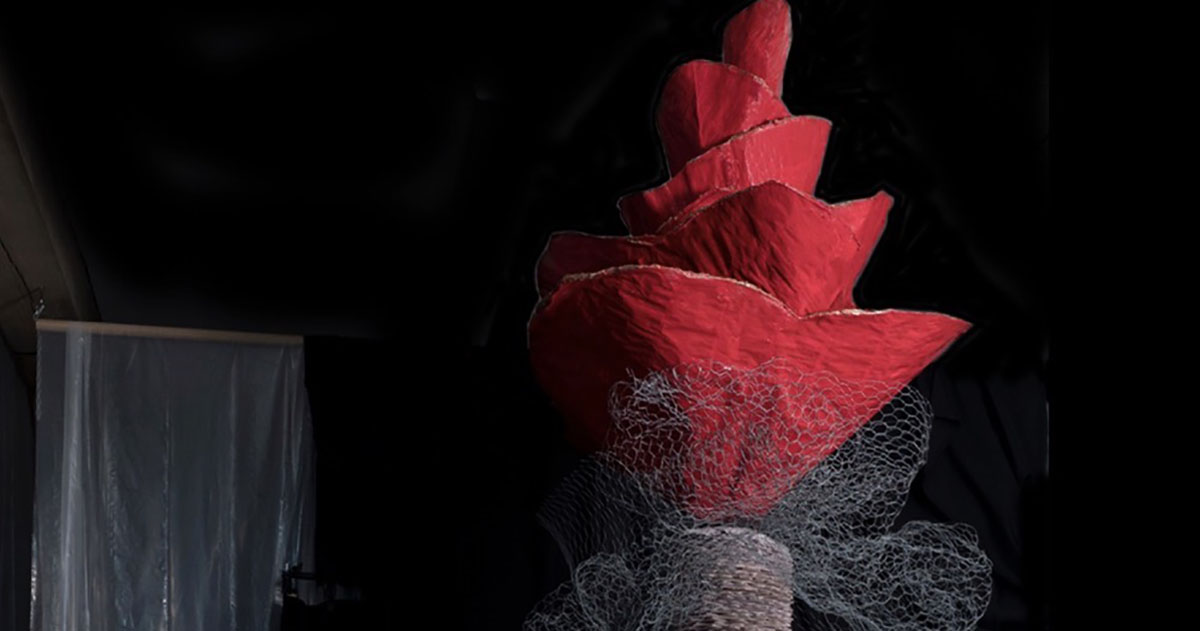
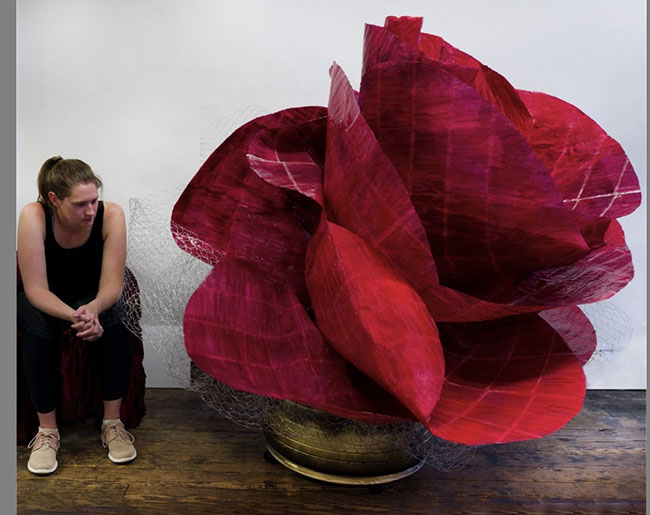
In The Gift, Karalla shapes these pages into a large red form that recalls the structure of a rose. The scale immediately changes the experience. It is not intimate or decorative—it occupies space in a way that feels unavoidable. The material itself, fragile as paper, gains strength through repetition and construction. The use of red adds weight to the piece, connecting the familiar symbol of the rose with the intensity of the subject matter embedded in the pages. The form suggests both an offering and something more complicated—something given, but not easily received or resolved.
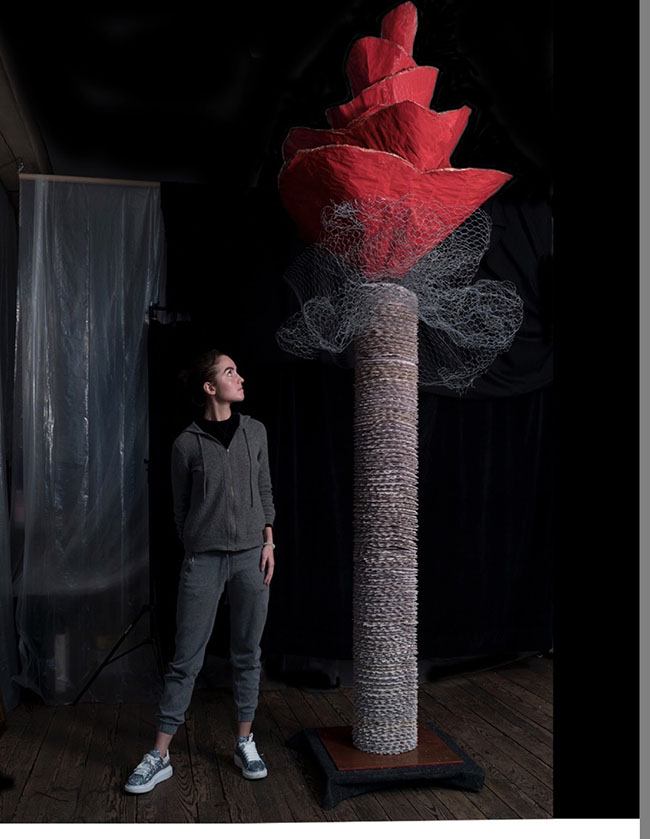
This line of thinking expands in The Pillar of Truth, where roughly 20,000 pages are assembled into a tall, column-like structure. Here, the emphasis shifts from a single form to the idea of accumulation. The work becomes about scale—of information, of narrative, of burden. The vertical structure echoes monuments or architectural forms, reinforcing the sense of weight and permanence. At its top, the rose reappears, acting as a focal point. The piece does not ask the viewer to read everything contained within it, but instead to consider what it means to be faced with something so extensive. It becomes less about detail and more about magnitude.
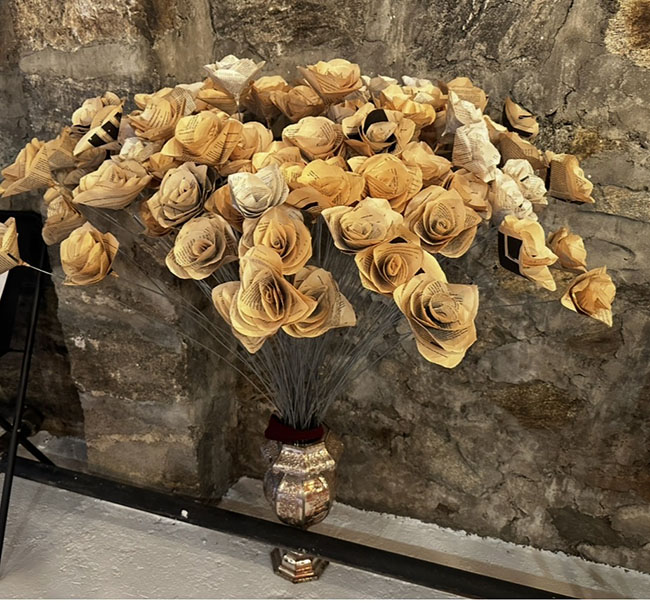
The rose continues as a recurring form throughout Karalla’s work. In White Roses, the approach becomes quieter. Without the intensity of red, the forms feel more subdued, but still carry complexity. Constructed entirely from printed pages, the roses retain visible fragments of text—words and lines that remain partially legible. These fragments never fully resolve into clear meaning. Instead, they sit in between readability and abstraction. The viewer is left with traces of language, enough to suggest content, but not enough to fully grasp it.
This tension—between what can be seen and what cannot be fully understood—is central to Karalla’s practice. By turning text into physical form, she interrupts its original purpose. The Mueller Report, designed as a source of information, becomes a material to think with rather than something to decode in full. The work does not require complete comprehension. Instead, it opens a space to consider how information is delivered, processed, and often overlooked.
Photography becomes an essential part of this process. Karalla documents her sculptures carefully, presenting them in controlled settings that resemble product imagery. This choice is deliberate. By framing the works in this way, she creates a distance that allows them to circulate beyond their physical presence. The photograph is not just documentation—it becomes an extension of the work itself. The refined presentation contrasts with the raw, fragmented nature of the source material, emphasizing the shift from document to object.
Additional materials, such as wire mesh, appear in some of the works, introducing a sense of tension. These elements seem to both support and confine the forms, suggesting structures that hold things in place while also limiting them. This reflects broader ideas within the work—systems that organize information while shaping how it is understood. The interaction between organic shapes like roses and more industrial materials highlights the relationship between human experience and institutional frameworks.
The Read Roses of the Mueller Report series extends beyond the objects themselves. It forms part of a larger effort to encourage engagement with political realities. The works act as entry points, drawing attention through their visual presence while directing thought back to their source. The intention is clear: to prompt inquiry, to encourage awareness, and to make visible what is often left unexamined.
Karalla’s work operates across multiple layers. It is grounded in material experimentation, shaped by conceptual thinking, and tied directly to its source. It does not rely solely on abstraction, nor does it present a fixed message. Instead, it creates space for interpretation while maintaining a strong connection to the document it originates from. These sculptures are not solutions or conclusions. They function as prompts—encouraging viewers to look again, to question, and to consider how meaning is constructed.
By transforming thousands of pages into physical forms, Karalla repositions the viewer. The work calls for engagement rather than passive observation. It suggests that understanding is not just about having access to information, but about choosing to engage with it.
