
L. Scooter Morris creates art that extends beyond the conventional limits of the painted surface. Describing herself as a sensory illusionist, she constructs works that engage vision, movement, and physical perception at the same time. Her signature Sculpted Paintings® combine acrylic paint with mixed-media elements to produce raised passages, irregular edges, layered seams, and shifting shadows. From one position, a work may appear atmospheric and expansive; from another, its material structure comes forward. Light continually changes the relationship between these elements, allowing the composition to evolve as the viewer moves around it. Morris is not primarily concerned with creating passive decoration. Instead, she seeks an immediate, bodily response. Her paintings invite viewers to approach, step back, and reconsider what they are seeing. Through this process, landscape, history, and material become part of an experience that feels active, tactile, and emotionally present.
Landscapes of Memory, History, and Change
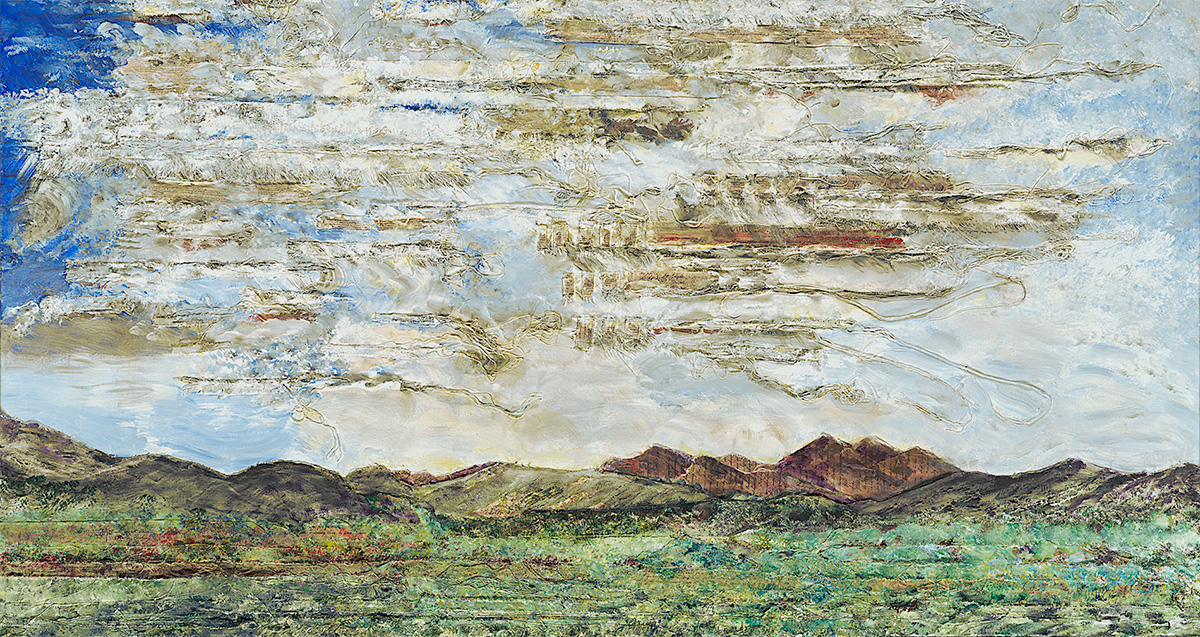
In America Forever (2026), Morris brings the immense scale of the American landscape into conversation with the written foundations of the nation. Measuring 48 by 72 inches, the work has a panoramic presence. Mountains stretch across the lower portion of the composition, while an expansive sky occupies most of the surface. Yet the sky is not presented as an open, untouched space. It is built from overlapping layers of pale blue, white, gray, gold, and earth tones, creating an environment that seems filled with weather, history, and accumulated time.
National historic documents are incorporated directly into the painting. They do not function as separate illustrations placed over the landscape; instead, they become part of its physical and conceptual structure. Lines of writing appear, disappear, and reemerge through layers of paint and material. At certain points, the text can be sensed more clearly than it can be read. This partial visibility is important. It suggests that the principles on which a country is founded may remain present even when they are obscured by conflict, distance, or changing interpretations.
Morris’s sculptural technique gives those documents a material presence. Their inclusion acknowledges that national identity is shaped not only by land and visual symbols but also by language, agreements, laws, and shared ideals. By embedding this written history within the painting, Morris presents the country as something constructed through both geography and thought.
The landscape below appears comparatively grounded, though it is far from still. Green fields are activated by flecks of color and dense variations in texture. Dark mountains rise against reddish peaks, creating a rhythm that anchors the turbulent sky. The contrast between land and atmosphere can be understood as a tension between permanence and uncertainty. Mountains imply endurance, while the layered sky feels restless and continuously changing.
The title, America Forever, carries both confidence and complexity. “Forever” may suggest continuity, but the work does not present America as fixed or complete. Instead, the nation appears as an evolving accumulation of landscape, memory, founding language, and lived experience. The painting asks viewers to consider what survives, what becomes concealed, and what must repeatedly be brought back into view.
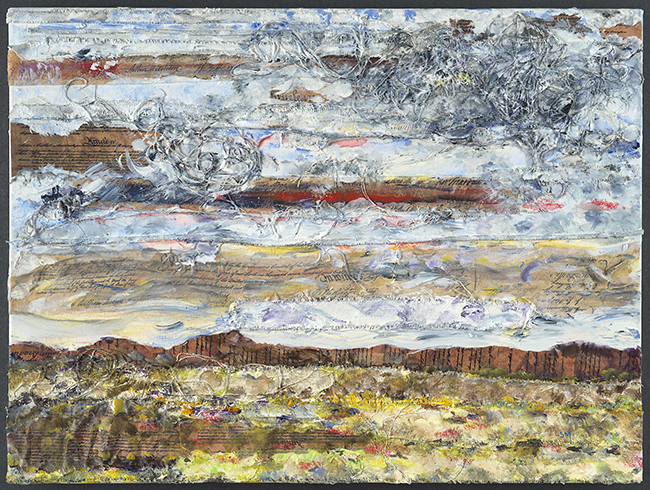
What A Day (2026), measuring 20 by 26 inches, compresses a similarly expansive visual language into a more intimate format. Here, the surface is visibly active. Tangled strands, raised formations, horizontal bands, handwritten passages, and flashes of red, yellow, blue, and metallic color move across the composition. These elements create the feeling of a day crowded with impressions, events, thoughts, and rapidly changing emotions.
Once again, Morris grounds the work through landscape. A long formation of reddish cliffs extends across the lower middle section, separating the animated sky from a richly textured foreground. This geological line provides stability, but the materials above it twist and gather like wind, clouds, smoke, or unsettled thought. Nothing remains entirely contained. Marks overlap, fragments interrupt one another, and the surface appears to be recording several moments simultaneously.
The historic writing woven into What A Day creates another connection between private experience and collective memory. Against the openness of the land, these words appear almost like voices carried through time. Their presence suggests that even an ordinary day unfolds within a much longer cultural and historical continuum.
The difference in scale between the two paintings changes their emotional effect. America Forever surrounds the viewer through breadth and distance, while What A Day draws attention toward concentrated details. Despite these differences, both works depend on movement and discovery. Their meanings cannot be absorbed in a single glance.
Through her Sculpted Paintings®, Morris turns the canvas into an active field where paint, documents, landscape, and light continually interact. The works do not merely depict history or nature. They give both a physical body, asking viewers to experience them as layered, unfinished, and alive.
